
肠道微生物群与慢性便秘:综述与更新
Gut Microbiota and Chronic Constipation: A Review and Update.
作者信息
Ohkusa Toshifumi, Koido Shigeo, Nishikawa Yuriko, Sato Nobuhiro
机构信息
Department of Microbiota Research, Juntendo University Graduate School of Medicine, Tokyo, Japan.
Department of Gastroenterology and Hepatology, The Jikei University Kashiwa Hospital, Kashiwa, Japan.
出版信息
Front Med (Lausanne). 2019 Feb 12;6:19. doi: 10.3389/fmed.2019.00019. eCollection 2019.
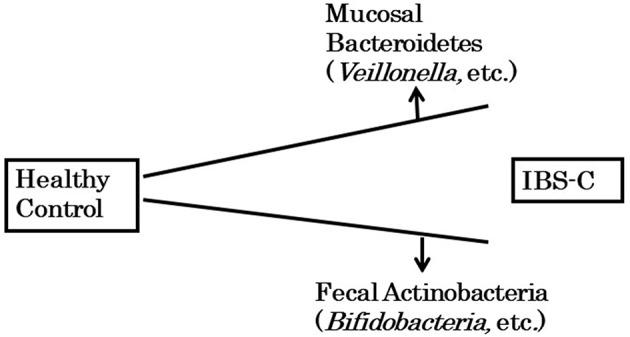
Chronic constipation, including functional constipation and constipation-type irritable bowel syndrome, is a prevalent, multifactorial gastrointestinal disorder, and its etiology and pathophysiology remain poorly understood. Recently studies using 16S rRNA-based microbiota profiling have demonstrated dysbiosis of gut microbiota in chronic constipation. To provide an overview of recent studies for microbiota in chronic constipation and treatments for chronic constipation using probiotics, prebiotics, synbiotics, antibiotics and fecal microbiota transplantation (FMT). PubMed searches were performed up to 1 August 2018 using keywords: "IBS," "IBS-C," "irritable bowel syndrome," "irritable bowel syndrome with constipation," "functional constipation," "chronic constipation" in combination with "gut microbiota," "dysbiosis," "gut microflora" for microbiota in chronic constipation, and in combination with "probiotics," "prebiotics," "synbiotics," "antibiotics," and "fecal microbiota transplantation." The findings of gut microbiota in functional constipation are inconsistent, and currently no consensus exists. Although no clear consensus exists, compared with healthy subjects, IBS-C patients have a lower level of Actinobacteria, including , in their fecal samples and a higher level of Bacteroidetes in their mucosa. In most randomized controlled and parallel-group trials, probiotics, prebiotics, synbiotics, antibiotics, and FMT therapy for chronic constipation were effective with few side effects. However, there are many studies in a small number and the types of probiotics are different, it is difficult to evaluate the effect. Evidence indicates that dysbiosis of gut microbiota may contribute to functional constipation and constipation-type irritable bowel syndrome. Targeting treatments for the dysbiosis of constipation by probiotics, prebiotics, synbiotics, antibiotics, and FMT may be a new option, especially for refractory constipation to conventional therapies.
慢性便秘,包括功能性便秘和便秘型肠易激综合征,是一种常见的、多因素的胃肠道疾病,其病因和病理生理学仍知之甚少。最近使用基于16S rRNA的微生物群分析的研究表明,慢性便秘患者肠道微生物群存在失调。为了概述慢性便秘中微生物群的最新研究以及使用益生菌、益生元、合生元、抗生素和粪便微生物群移植(FMT)治疗慢性便秘的情况。截至2018年8月1日,在PubMed上进行了搜索,使用的关键词有:“IBS”、“IBS-C”、“肠易激综合征”、“便秘型肠易激综合征”、“功能性便秘”、“慢性便秘”,并与“肠道微生物群”、“失调”、“肠道微生物区系”组合用于慢性便秘中微生物群的研究,还与“益生菌”、“益生元”、“合生元”、“抗生素”和“粪便微生物群移植”组合。功能性便秘中肠道微生物群的研究结果并不一致,目前尚无共识。虽然尚无明确共识,但与健康受试者相比,IBS-C患者粪便样本中放线菌的水平较低,包括 ,而其黏膜中拟杆菌的水平较高。在大多数随机对照和平行组试验中,益生菌、益生元、合生元、抗生素和FMT治疗慢性便秘有效,副作用较少。然而,研究数量较少且益生菌类型不同,难以评估效果。有证据表明,肠道微生物群失调可能导致功能性便秘和便秘型肠易激综合征。通过益生菌、益生元、合生元和抗生素以及FMT针对便秘失调进行靶向治疗可能是一种新的选择,特别是对于传统疗法难治的便秘。
 Zotero 插件