
ST258 碳青霉烯类耐药肺炎克雷伯菌肠定植因子的全基因组筛查
Genome-Wide Screening for Enteric Colonization Factors in Carbapenem-Resistant ST258 Klebsiella pneumoniae.
机构信息
Immunology Program, Sloan Kettering Institute, Memorial Sloan Kettering Cancer Center, New York, New York, USA
Center for Microbes, Inflammation, and Cancer, Molecular Microbiology Core Facility, Memorial Sloan Kettering Cancer Center, New York, New York, USA.
出版信息
mBio. 2019 Mar 12;10(2):e02663-18. doi: 10.1128/mBio.02663-18.
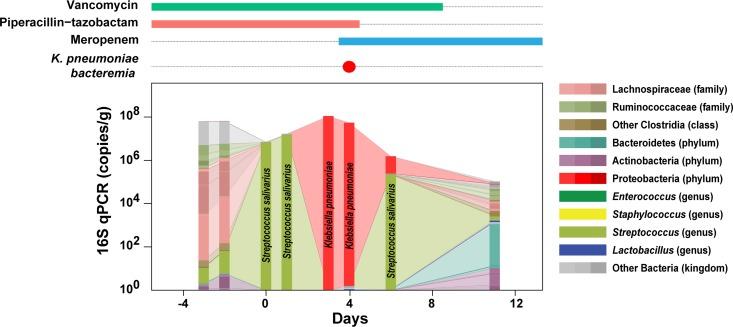
A diverse, antibiotic-naive microbiota prevents highly antibiotic-resistant microbes, including carbapenem-resistant (CR), from achieving dense colonization of the intestinal lumen. Antibiotic-mediated destruction of the microbiota leads to expansion of CR in the gut, markedly increasing the risk of bacteremia in vulnerable patients. While preventing dense colonization represents a rational approach to reduce intra- and interpatient dissemination of CR, little is known about pathogen-associated factors that enable dense growth and persistence in the intestinal lumen. To identify genetic factors essential for dense colonization of the gut by CR, we constructed a highly saturated transposon mutant library with >150,000 unique mutations in an ST258 strain of CR and screened for growth and intestinal colonization in antibiotic-treated mice. Stochastic and partially reversible fluctuations in the representation of different mutations during dense colonization revealed the dynamic nature of intestinal microbial populations. We identified genes that are crucial for early and late stages of dense gut colonization and confirmed their role by testing isogenic mutants in competition assays with wild-type CR- Screening of the transposon library also identified mutations that enhanced CR growth. These newly identified colonization factors may provide novel therapeutic opportunities to reduce intestinal colonization by CR- is a common cause of bloodstream infections in immunocompromised and hospitalized patients, and over the last 2 decades, some strains have acquired resistance to nearly all available antibiotics, including broad-spectrum carbapenems. The U.S. Centers for Disease Control and Prevention has listed carbapenem-resistant (CR) as an urgent public health threat. Dense colonization of the intestine by CR and other antibiotic-resistant bacteria is associated with an increased risk of bacteremia. Reducing the density of gut colonization by CR is likely to reduce their transmission from patient to patient in health care facilities as well as systemic infections. How CR expands and persists in the gut lumen, however, is poorly understood. Herein, we generated a highly saturated mutant library in a multidrug-resistant strain and identified genetic factors that are associated with dense gut colonization by This study sheds light on host colonization by and identifies potential colonization factors that contribute to high-density persistence of in the intestine.
一个多样化的、未使用过抗生素的微生物群可以防止高度耐药的微生物(包括耐碳青霉烯类的)在肠道腔中密集定植。抗生素介导的微生物群落破坏导致肠道中耐碳青霉烯类的扩张,显著增加了脆弱患者发生菌血症的风险。虽然防止密集定植是减少耐碳青霉烯类肠内和肠间传播的合理方法,但对于使耐碳青霉烯类在肠道中密集生长和持续存在的病原体相关因素知之甚少。为了确定耐碳青霉烯类在肠道中密集定植所必需的遗传因素,我们构建了一个高度饱和的转座子突变体文库,其中包含耐碳青霉烯类 ST258 菌株的 >150,000 个独特突变,并在抗生素处理的小鼠中筛选其生长和肠道定植情况。在密集定植过程中,不同突变体的代表性随机和部分可逆波动揭示了肠道微生物种群的动态性质。我们确定了对早期和晚期肠道密集定植至关重要的基因,并通过在与野生型耐碳青霉烯类的竞争测定中测试同源突变体来验证其作用-对转座子文库的筛选还确定了增强耐碳青霉烯类生长的突变。这些新发现的定植因子可能为减少耐碳青霉烯类的肠道定植提供新的治疗机会。耐碳青霉烯类是免疫功能低下和住院患者血流感染的常见原因,在过去的 20 年中,一些菌株已获得几乎所有可用抗生素(包括广谱碳青霉烯类)的耐药性。美国疾病控制与预防中心已将耐碳青霉烯类的列为紧急公共卫生威胁。耐碳青霉烯类和其他抗生素耐药菌在肠道中的密集定植与菌血症风险增加有关。减少耐碳青霉烯类在肠道中的定植密度可能会降低其在医疗机构中从患者传播到患者以及全身感染的风险。然而,耐碳青霉烯类在肠道腔中如何扩张和持续存在仍知之甚少。在此,我们在多药耐药菌株中生成了一个高度饱和的突变体文库,并确定了与耐碳青霉烯类在肠道中密集定植相关的遗传因素。这项研究揭示了耐碳青霉烯类对宿主的定植,并确定了有助于耐碳青霉烯类在肠道中高密度持续存在的潜在定植因子。



 Zotero 插件