
抗-αFR CAR 工程化 NK-92 细胞对 αFR 阳性卵巢癌显示出强大的细胞毒性。
Anti-αFR CAR-engineered NK-92 Cells Display Potent Cytotoxicity Against αFR-positive Ovarian Cancer.
机构信息
State Key Laboratory of Trauma, Burn and Combined Injury, Department of Stem Cell & Regenerative Medicine, Daping Hospital and Research Institute of Surgery.
State Key Laboratory of Trauma, Burn and Combined Injury, First Department, Daping Hospital and Research Institute of Surgery.
出版信息
J Immunother. 2019 Oct;42(8):284-296. doi: 10.1097/CJI.0000000000000286.
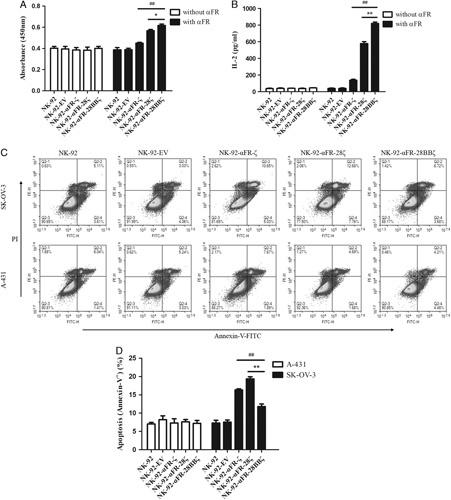
Folate receptor alpha (αFR) is overexpressed in 90% of ovarian cancers, one of the most lethal gynecologic cancers. Recent studies have suggested that natural killer (NK) cells may be better chimeric antigen receptor (CAR) drivers because of their favorable innate characteristics, such as directly recognizing and killing tumor cells. However, the therapeutic effects of CAR-engineered NK cells targeting αFR in ovarian cancer have not been reported. In this research, 3 generations of anti-αFR CAR were constructed, namely αFR-ζ (first generation), αFR-28ζ (second generation), and αFR-28BBζ (third generation), and were highly expressed on the surface of NK-92 cells by lentivirus gene transfection. Three anti-αFR CAR-engineered NK-92 cells can specifically kill αFR-positive tumor cells in vitro, especially ovarian cancer cells with high αFR expression. Compared with NK-92 cells expressing αFR-ζ or αFR-28ζ, NK-92 cells expressing αFR-28BBζ showed not only higher antigen-specific cytotoxicity and proliferation but also lower antigen-induced apoptosis. Moreover, stronger degranulation and cytokine secretion were detected in NK-92 cells expressing αFR-28BBζ cocultured with αFR-positive tumor cells. Real-time cell analysis and live cell imaging recorded the process of NK-92 cells expressing αFR-28BBζ killing ovarian cancer cells in vitro. Furthermore, NK-92 cells expressing αFR-28BBζ can effectively eliminate cancer cells in a mouse xenograft model of ovarian cancer and significantly prolong the survival of tumor-bearing mice. These results demonstrate that the anti-αFR CARs redirect NK-92 cells with specific antitumor activity, and the third-generation anti-αFR CAR-engineered NK-92 cells display more potent cytotoxicity against αFR-positive ovarian cancer, laying the foundation for future clinical research.
叶酸受体 α(αFR)在 90%的卵巢癌中过表达,是最致命的妇科癌症之一。最近的研究表明,自然杀伤(NK)细胞可能是更好的嵌合抗原受体(CAR)驱动细胞,因为它们具有有利的先天特征,例如直接识别和杀死肿瘤细胞。然而,针对卵巢癌中αFR 的 CAR 修饰 NK 细胞的治疗效果尚未报道。在这项研究中,构建了 3 代抗-αFR CAR,即 αFR-ζ(第一代)、αFR-28ζ(第二代)和 αFR-28BBζ(第三代),并通过慢病毒基因转染在 NK-92 细胞表面高度表达。三种抗-αFR CAR 修饰的 NK-92 细胞可以在体外特异性杀伤 αFR 阳性肿瘤细胞,特别是高表达 αFR 的卵巢癌细胞。与表达 αFR-ζ 或 αFR-28ζ 的 NK-92 细胞相比,表达 αFR-28BBζ 的 NK-92 细胞不仅表现出更高的抗原特异性细胞毒性和增殖能力,而且抗原诱导的凋亡率更低。此外,在与 αFR 阳性肿瘤细胞共培养时,表达 αFR-28BBζ 的 NK-92 细胞检测到更强的脱颗粒和细胞因子分泌。实时细胞分析和活细胞成像记录了表达 αFR-28BBζ 的 NK-92 细胞在体外杀伤卵巢癌细胞的过程。此外,表达 αFR-28BBζ 的 NK-92 细胞可有效消除卵巢癌小鼠异种移植模型中的癌细胞,并显著延长荷瘤小鼠的生存期。这些结果表明,抗-αFR CAR 可使 NK-92 细胞具有特异性抗肿瘤活性,第三代抗-αFR CAR 修饰的 NK-92 细胞对 αFR 阳性卵巢癌具有更强的细胞毒性,为未来的临床研究奠定了基础。




 Zotero 插件