
1992 年至 2018 年美国国立卫生研究院资助的包括亚裔美国人、夏威夷原住民和太平洋岛民参与者在内的临床研究趋势。
Trends in Clinical Research Including Asian American, Native Hawaiian, and Pacific Islander Participants Funded by the US National Institutes of Health, 1992 to 2018.
机构信息
College of Public Health and Human Sciences, School of Social and Behavioral Sciences, Oregon State University, Corvallis.
College of Public Health and Human Sciences, School of Biological and Population Health Sciences, Oregon State University, Corvallis.
出版信息
JAMA Netw Open. 2019 Jul 3;2(7):e197432. doi: 10.1001/jamanetworkopen.2019.7432.
IMPORTANCE
Advancing the health equity agenda for Asian American, Native Hawaiian, and Pacific Islander (AA/NHPI) individuals has become an intersecting priority for federal agencies. However, the impact of federal investments and legislation to ensure systematic processes and resources to eliminate health disparities in AA/NHPI populations is unclear.
OBJECTIVE
To perform a portfolio review of clinical research funded by the National Institutes of Health (NIH) for AA/NHPI populations and determine the level of NIH investment in serving these populations.
DESIGN, SETTING, AND PARTICIPANTS: Cross-sectional study in which the NIH Research Portfolio Online Reporting Tools Expenditures and Results system was queried for extramural AA/NHPI-focused clinical research projects conducted in the United States from January 1, 1992, to December 31, 2018. Clinical research funded under research project grants, centers, cooperative awards, research career awards, training grants, and fellowships was included, with an advanced text search for AA/NHPI countries and cultures of origin. Project titles and terms were screened for inclusion and project abstracts were reviewed to verify eligibility. Descriptive analyses were completed.
MAIN OUTCOMES AND MEASURES
Outcomes included NIH funding trends and characteristics of funded projects and organizations. The proportions of AA/NHPI-related funding trends were calculated using 2 denominators, total NIH expenditures and clinical research expenditures.
RESULTS
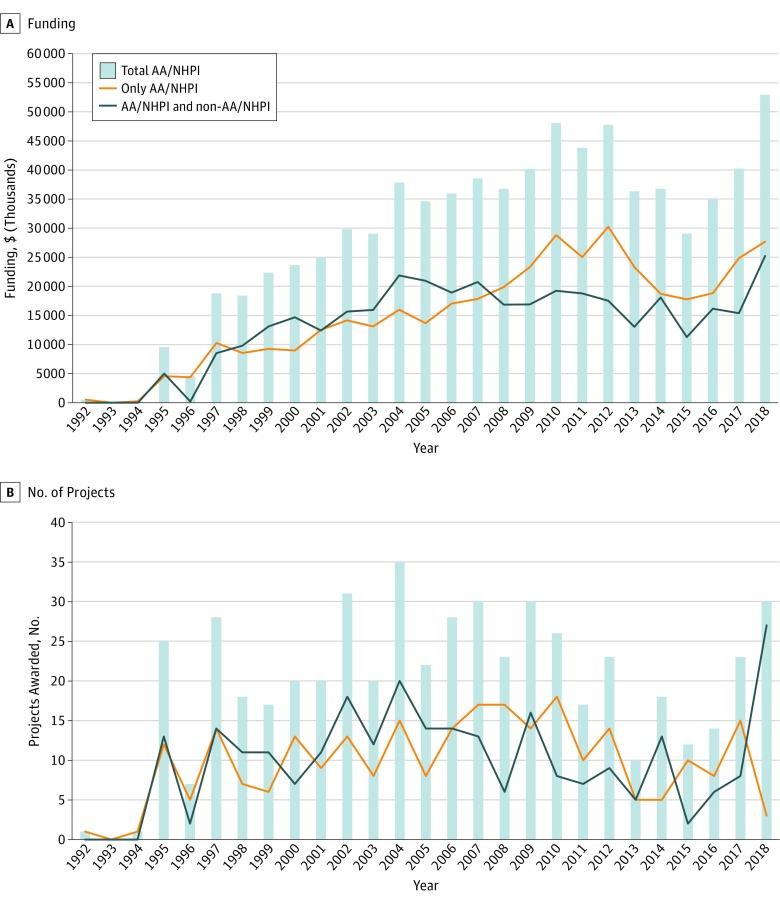
There were 5460 records identified, of which 891 studies were reviewed for eligibility. Of these, 529 clinical research studies focused on AA/NHPI participants composed 0.17% of the total NIH budget over 26 years. Projects studying AA/NHPI individuals in addition to other populations were funded across 17 NIH institutes and centers. The top 5 funders collectively contributed almost 60% of the total funding dollars for AA/NHPI projects and were the National Cancer Institute ($231 584 664), National Institute on Aging ($108 365 124), National Heart, Lung, and Blood Institute ($67 232 910), National Institute on Minority Health and Health Disparities ($62 982 901), and National Institute on Mental Health ($60 072 779). Funding of these projects ($775 536 121) made up 0.17% of the overall NIH expenditures ($451 284 075 000) between 1992 and 2018, and 0.18% ($677 479 468) of the NIH research budget after 2000. Funding for AA/NHPI projects significantly increased over time, but the proportion of the total NIH budget has only increased from 0.12% before 2000 to 0.18% after 2000. Of total funding, 60.8% was awarded to research project grants compared with only 5.1% allocated to research career awards, training grants, and fellowships.
CONCLUSIONS AND RELEVANCE
Increases in research dollars for AA/NHPI clinical research were not associated with increases in the overall NIH research budget, and underrepresentation of AA/NHPI subgroups still remains. Without overt direction from federal entities and dedicated funds for health disparities research, as well as parallel efforts to increase diversity in the biomedical workforce, investments may continue to languish for AA/NHPI populations.
重要性:推进亚裔美国人、夏威夷原住民和太平洋岛民(AA/NHPI)个体的健康公平议程已成为联邦机构的一个交叉优先事项。然而,确保消除 AA/NHPI 人群健康差距的系统流程和资源的联邦投资和立法的影响尚不清楚。
目的:对美国国立卫生研究院(NIH)资助的针对 AA/NHPI 人群的临床研究组合进行投资组合审查,并确定 NIH 为服务这些人群提供的投资水平。
设计、设置和参与者:这是一项在美国国立卫生研究院研究组合在线报告工具支出和结果系统中查询的横断面研究,该系统针对 1992 年 1 月 1 日至 2018 年 12 月 31 日期间在美国进行的以 AA/NHPI 为重点的临床研究项目进行了调查。包括在研究项目赠款、中心、合作奖励、研究职业奖励、培训赠款和奖学金下资助的临床研究,对 AA/NHPI 国家和原籍国进行了高级文本搜索。对项目标题和术语进行了筛选以纳入项目,并对项目摘要进行了审查以验证资格。完成了描述性分析。
主要结果和措施:结果包括 NIH 资助趋势和资助项目和组织的特征。使用 2 个分母计算 AA/NHPI 相关资助趋势的比例,即 NIH 总支出和临床研究支出。
结果:共确定了 5460 条记录,其中有 891 项研究符合入选条件。其中,529 项针对 AA/NHPI 参与者的临床研究构成了 26 年来 NIH 预算的 0.17%。研究除其他人群外还研究 AA/NHPI 个体的项目分布在 17 个 NIH 研究所和中心。前 5 名资助者共同贡献了 AA/NHPI 项目总资金的近 60%,其中包括美国国立癌症研究所($231584664)、美国国立老龄化研究所($108365124)、美国国立心脏、肺和血液研究所($67232910)、美国国立少数民族健康和健康差异研究所($62982901)和美国国立心理健康研究所($60072779)。这些项目的资助($775536121)占 NIH 1992 年至 2018 年期间总支出($451284075000)的 0.17%,占 2000 年后 NIH 研究预算的 0.18%($677479468)。AA/NHPI 项目的资助随着时间的推移而增加,但在 NIH 总预算中的比例仅从 2000 年前的 0.12%增加到 2000 年后的 0.18%。在总资金中,60.8%授予研究项目赠款,而只有 5.1%分配给研究职业奖、培训赠款和奖学金。
结论和相关性:针对 AA/NHPI 临床研究的研究资金增加与 NIH 研究预算的整体增加无关,AA/NHPI 亚组的代表性仍然不足。如果没有联邦实体的明确指导和专门用于健康差异研究的资金,以及增加生物医学劳动力多样性的平行努力,投资可能会继续为 AA/NHPI 人群提供资金。

 Zotero 插件