
外泌体 PD-L1 在肿瘤进展和免疫治疗中的作用。
The role of exosomal PD-L1 in tumor progression and immunotherapy.
机构信息
Department of Laboratory Medicine, The Affiliated People's Hospital, Jiangsu University, Zhenjiang, 212013, China.
Department of Immunology, Jiangsu Key Laboratory of Laboratory Medicine, School of Medicine, Jiangsu University, Zhenjiang, China.
出版信息
Mol Cancer. 2019 Oct 23;18(1):146. doi: 10.1186/s12943-019-1074-3.
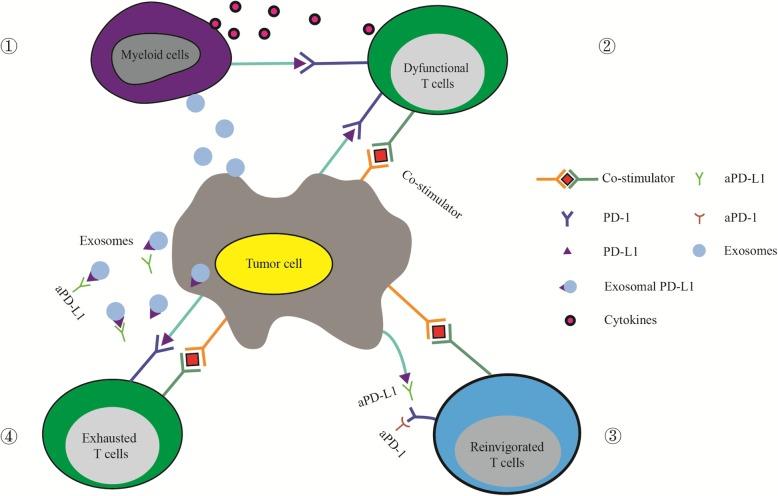
Programmed death ligand 1 (PD-L1), a type I transmembrane protein, binds to its receptor PD-1 to suppress the activation of T cells, thereby maintaining immunological homeostasis. In contrast, tumor cells highly express PD-L1, which binds to receptor PD-1 expressed on activated T cells, leading to immune escape. Anti-PD-1/PD-L1 immune checkpoint therapy blocks the binding of PD-1/PD-L1 to reinvigorate the exhausted T cells, thereby inhibiting tumor growth. Exosomes are biologically active lipid-bilayer nanovesicles secreted by various cell types that mediate intercellular signal communication. Numerous studies have shown that tumor cells are able to promote tumor epithelial-mesenchymal transition, angiogenesis, and immune escape by releasing exosomes. Recent studies imply that tumor-derived exosomes could carry PD-L1 in the same membrane topology as the cell surface, thereby resisting immune checkpoint therapy. In this review, we mainly discuss the role of exosomes in the regulation of tumor progression and the potential resistance mechanism to immunotherapy via exosomal PD-L1. In addition, we propose that exosomal PD-L1 may have the potential to be a target to overcome resistance to anti-PD-1/PD-L1 antibody therapy.
程序性死亡配体 1(PD-L1)是一种 I 型跨膜蛋白,与受体 PD-1 结合可抑制 T 细胞的激活,从而维持免疫稳态。相反,肿瘤细胞高度表达 PD-L1,它与激活的 T 细胞上表达的受体 PD-1 结合,导致免疫逃逸。抗 PD-1/PD-L1 免疫检查点治疗通过阻断 PD-1/PD-L1 的结合来重新激活耗竭的 T 细胞,从而抑制肿瘤生长。外泌体是各种细胞类型分泌的具有生物活性的双层脂纳米囊泡,介导细胞间信号通讯。大量研究表明,肿瘤细胞通过释放外泌体,促进肿瘤上皮间质转化、血管生成和免疫逃逸。最近的研究表明,肿瘤来源的外泌体可以在与细胞膜相同的膜拓扑结构中携带 PD-L1,从而抵抗免疫检查点治疗。在这篇综述中,我们主要讨论了外泌体在调节肿瘤进展中的作用,以及通过外泌体 PD-L1 产生的潜在免疫治疗耐药机制。此外,我们提出外泌体 PD-L1 可能有潜力成为克服抗 PD-1/PD-L1 抗体治疗耐药性的靶点。
 Zotero 插件