
血管生成拟态的分子机制与抗癌治疗策略
Molecular Mechanisms and Anticancer Therapeutic Strategies in Vasculogenic Mimicry.
作者信息
Zhang Xue, Zhang Jigang, Zhou Heming, Fan Guorong, Li Qin
机构信息
Department of Clinical Pharmacy, Shanghai General Hospital, Shanghai Jiao Tong University School of medicine, No.100 Haining Road, Shanghai, 200080, P.R. China.
出版信息
J Cancer. 2019 Oct 18;10(25):6327-6340. doi: 10.7150/jca.34171. eCollection 2019.
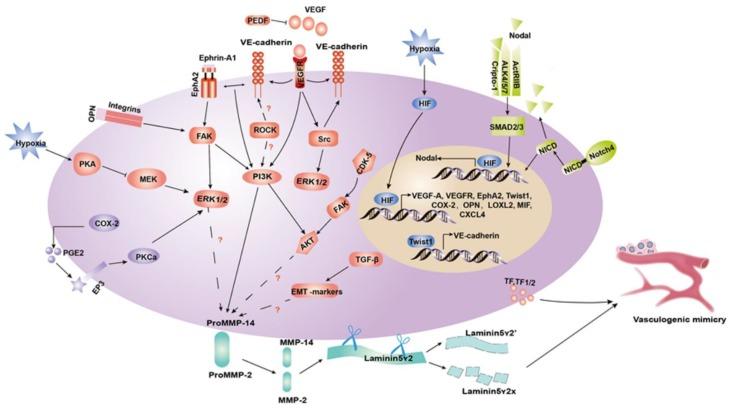
Vasculogenic mimicry (VM) is a vascular formation mechanism used by aggressive tumor cells. VM provides an alternative pathway for adequate blood perfusion and challenges the traditional angiogenesis mechanism that depends only on endothelial cells (ECs), as VM-forming tumor cells express a mixed endothelial/tumor phenotype. VM is closely correlated with tumor invasion, migration, and progression. Hence, anticancer therapeutic strategies targeting VM biogenesis are essential. It is widely acknowledged that the VM formation mechanism involves multiple pathways. The purpose of this review is to describe the potential molecular mechanisms related to different pathways and discuss the involvement of microRNAs (miRNAs), long non-coding RNAs (lncRNAs), and circular RNAs (circRNAs) in VM formation. Moreover, we discuss the significance of VM in clinical practice and present new anticancer therapeutic strategies that target VM.
血管生成拟态(VM)是侵袭性肿瘤细胞所采用的一种血管形成机制。VM为充足的血液灌注提供了一条替代途径,并对仅依赖内皮细胞(ECs)的传统血管生成机制提出了挑战,因为形成VM的肿瘤细胞表达一种内皮/肿瘤混合表型。VM与肿瘤侵袭、迁移和进展密切相关。因此,针对VM生物发生的抗癌治疗策略至关重要。人们普遍认为,VM形成机制涉及多种途径。本综述的目的是描述与不同途径相关的潜在分子机制,并讨论微小RNA(miRNA)、长链非编码RNA(lncRNA)和环状RNA(circRNA)在VM形成中的作用。此外,我们还讨论了VM在临床实践中的意义,并提出了针对VM的新抗癌治疗策略。


 Zotero 插件