
胎肝间充质干细胞通过靶向 MT1 恢复卵巢早衰小鼠的卵巢功能。
Fetal liver mesenchymal stem cells restore ovarian function in premature ovarian insufficiency by targeting MT1.
机构信息
Center of Reproduction and Genetics, Affiliated Suzhou Hospital of Nanjing Medical University, Suzhou Municipal Hospital, Suzhou, 215002, China.
State Key Laboratory of Reproductive Medicine, Nanjing Medical University, Nanjing, 210029, China.
出版信息
Stem Cell Res Ther. 2019 Nov 29;10(1):362. doi: 10.1186/s13287-019-1490-8.
BACKGROUND
With the development of regenerative medicine and tissue engineering technology, almost all stem cell therapy is efficacious for the treatment of premature ovarian failure (POF) or premature ovarian insufficiency (POI) animal models, whereas little stem cell therapy has been practiced in clinical settings. The underlying molecular mechanism and safety of stem cell treatment in POI are not fully understood. In this study, we explored whether fetal mesenchymal stem cells (fMSCs) from the liver restore ovarian function and whether melatonin membrane receptor 1 (MT1) acts as a regulator for treating POI disease.
METHODS
We designed an in vivo model (chemotherapy-induced ovary damage) and an in vitro model (human ovarian granulosa cells (hGCs)) to understand the efficacy and molecular cues of fMSC treatment of POI. Follicle development was observed by H&E staining. The concentration of sex hormones in serum (E2, AMH, and FSH) and the concentration of oxidative and antioxidative metabolites and the enzymes MDA, SOD, CAT, LDH, GR, and GPx were measured by ELISA. Flow cytometry (FACS) was employed to detect the percentages of ROS and proliferation rates. mRNA and protein expression of antiapoptotic genes (SURVIVIN and BCL2), apoptotic genes (CASPASE-3 and CASPASE-9), and MT1 and its downstream genes (JNK1, PCNA, AMPK) were tested by qPCR and western blotting. MT1 siRNA and related antagonists were used to assess the mechanism.
RESULTS
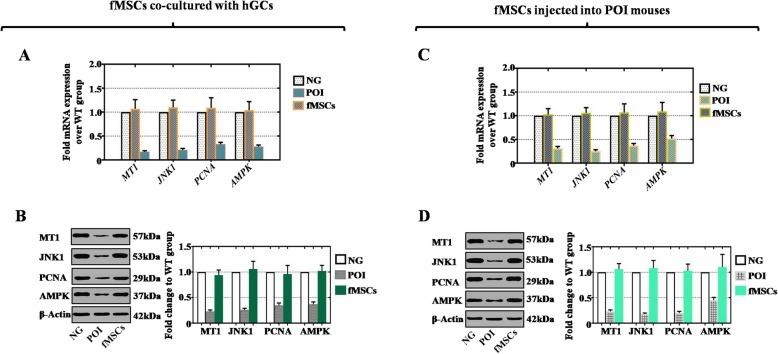
fMSC treatment prevented cyclophosphamide (CTX)-induced follicle loss and recovered sex hormone levels. Additionally, fMSCs significantly decreased oxidative damage, increased oxidative protection, improved antiapoptotic effects, and inhibited apoptotic genes in vivo and in vitro. Furthermore, fMSCs also upregulated MT1, JNK1, PCNA, and AMPK at the mRNA and protein levels. With MT1 knockdown or antagonist treatment in normal hGCs, the protein expression of JNK1, PCNA, and AMPK and the percentage of proliferation were impaired.
CONCLUSIONS
fMSCs might play a crucial role in mediating follicular development in the POI mouse model and stimulating the activity of POI hGCs by targeting MT1.
背景
随着再生医学和组织工程技术的发展,几乎所有的干细胞疗法对于治疗卵巢早衰(POF)或卵巢储备功能降低(POI)动物模型都有效,但在临床实践中很少应用干细胞疗法。干细胞治疗 POI 的潜在分子机制和安全性尚未完全阐明。在这项研究中,我们探讨了来自肝脏的胎儿间充质干细胞(fMSCs)是否能恢复卵巢功能,以及褪黑素膜受体 1(MT1)是否作为治疗 POI 疾病的调节剂。
方法
我们设计了体内模型(化疗诱导的卵巢损伤)和体外模型(人卵巢颗粒细胞(hGCs)),以了解 fMSC 治疗 POI 的疗效和分子线索。通过 H&E 染色观察卵泡发育情况。采用 ELISA 法检测血清中性激素(E2、AMH 和 FSH)浓度和氧化应激及抗氧化代谢产物浓度以及 MDA、SOD、CAT、LDH、GR 和 GPx 等酶的活性。采用流式细胞术(FACS)检测 ROS 百分比和增殖率。采用 qPCR 和 Western blot 检测抗凋亡基因(SURVIVIN 和 BCL2)、凋亡基因(CASPASE-3 和 CASPASE-9)以及 MT1 及其下游基因(JNK1、PCNA、AMPK)的 mRNA 和蛋白表达。采用 MT1 siRNA 和相关拮抗剂评估其作用机制。
结果
fMSC 治疗可预防环磷酰胺(CTX)诱导的卵泡丢失并恢复性激素水平。此外,fMSCs 可显著降低氧化应激损伤,增加氧化应激保护,改善体内和体外的抗凋亡作用,并抑制凋亡基因。此外,fMSCs 还可上调 MT1、JNK1、PCNA 和 AMPK 的 mRNA 和蛋白水平。在正常 hGCs 中敲低 MT1 或用拮抗剂处理后,JNK1、PCNA 和 AMPK 的蛋白表达及增殖率受到损害。
结论
fMSCs 可能通过靶向 MT1 在 POI 小鼠模型中发挥重要作用,介导卵泡发育,并刺激 POI hGCs 的活性。



 Zotero 插件