
1990 - 2017年全球、区域和国家子宫内膜癌负担:全球疾病负担研究2017年结果
Global, Regional, and National Burden of Endometrial Cancer, 1990-2017: Results From the Global Burden of Disease Study, 2017.
作者信息
Zhang Shuang, Gong Ting-Ting, Liu Fang-Hua, Jiang Yu-Ting, Sun Hui, Ma Xiao-Xin, Zhao Yu-Hong, Wu Qi-Jun
机构信息
Department of Clinical Epidemiology, Shengjing Hospital of China Medical University, Shenyang, China.
Clinical Research Center, Shengjing Hospital of China Medical University, Shenyang, China.
出版信息
Front Oncol. 2019 Dec 19;9:1440. doi: 10.3389/fonc.2019.01440. eCollection 2019.
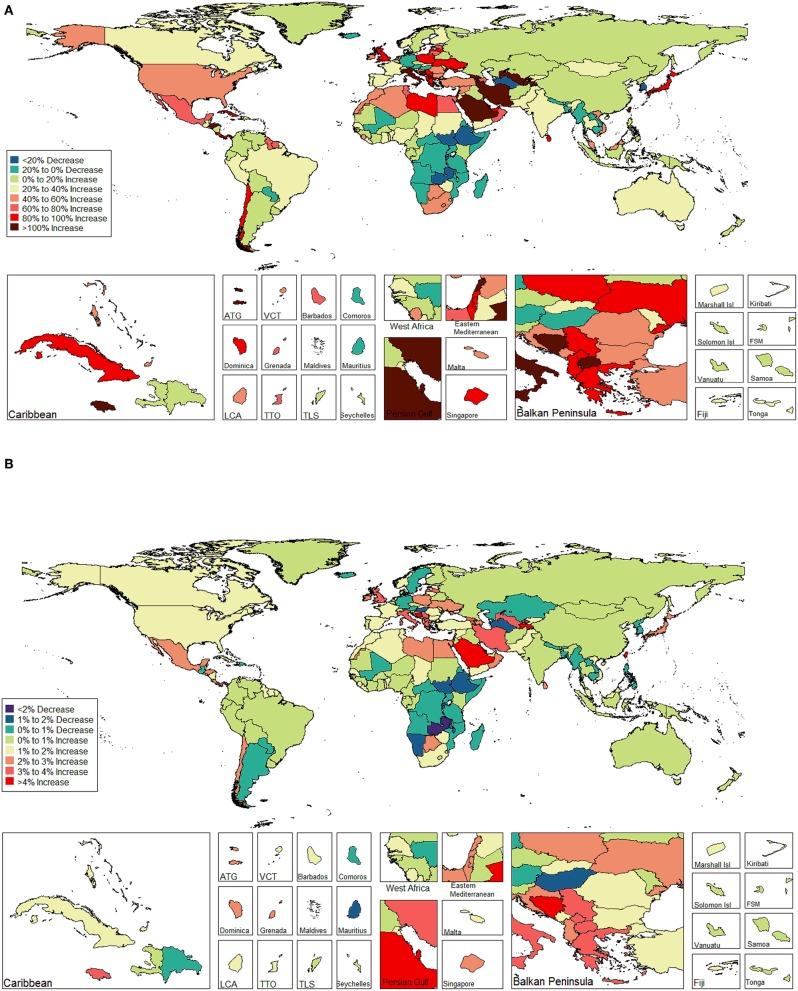
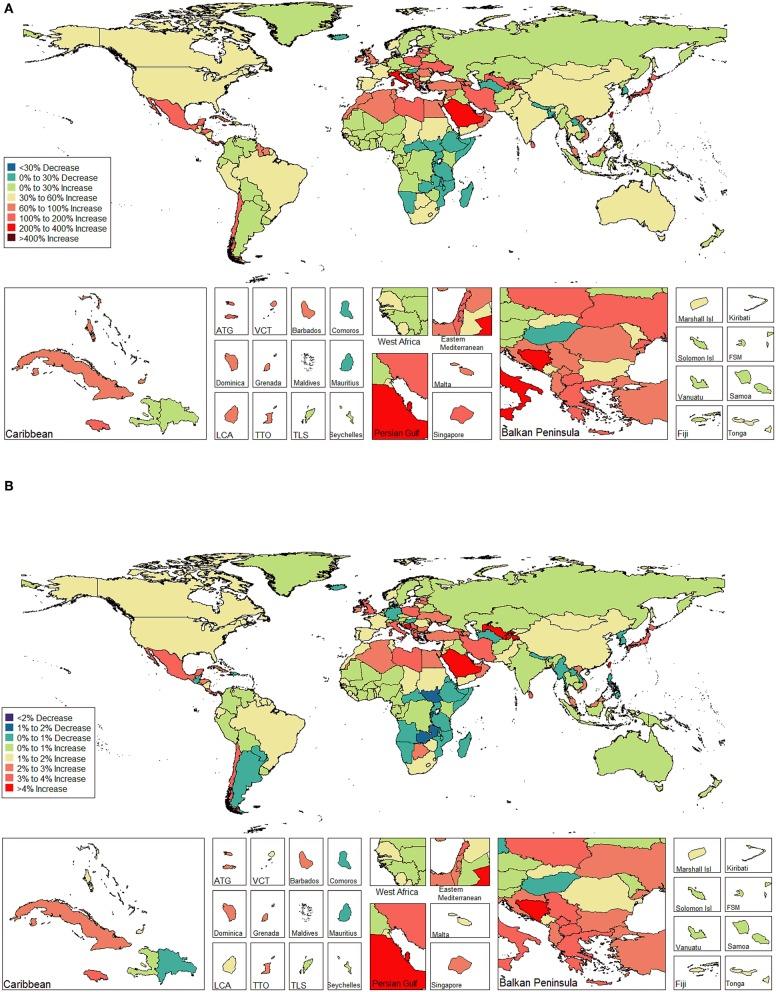
Endometrial cancer (EC) is the most common malignancy affecting women in developed countries. Recently, the EC disease burden has changed; therefore, the Global Burden of Disease (GBD) 2017 was used to comprehensively analyze the global, regional, and national burden of EC between 1990 and 2017. General GBD cancer estimation methods were used with the data input from vital registration systems and cancer registries. Annual percent changes were calculated to quantify the trends of EC burden estimates during the study period. Furthermore, the sociodemographic index (SDI) was used to assess the relationship between the EC burden estimates and development level. From 1990 to 2017, the age-standardized incidence and prevalence rate of EC increased globally by 0.58 and 0.89% per year, respectively. In contrast, the age-standardized death rate and disability-adjusted-life years (DALYs) decreased by 1.19 and 1.21% per year, respectively. Increasing trends in both the incidence and prevalence were observed in all SDI quintiles, except for the low SDI quintiles, whereas decreasing trends were observed in all SDI quintiles for mortality and DALYs. Additionally, a non-linear association existed for the level of mortality rate, DALYs, and SDI. Of note, there was a strong positive association between a high body mass index and DALYs across all SDI quintiles. In conclusion, EC incidence and prevalence rates are growing globally, whereas the death rate and DALYs decreased between 1990 and 2017. Greater efforts, particularly detailed prevention strategies for reducing obesity, should be performed to reverse this phenomenon.
子宫内膜癌(EC)是发达国家影响女性的最常见恶性肿瘤。最近,子宫内膜癌的疾病负担发生了变化;因此,利用《2017年全球疾病负担》(GBD 2017)全面分析了1990年至2017年间全球、区域和国家层面的子宫内膜癌负担。采用一般的全球疾病负担癌症估计方法,并输入生命登记系统和癌症登记处的数据。计算年度百分比变化以量化研究期间子宫内膜癌负担估计的趋势。此外,社会人口指数(SDI)用于评估子宫内膜癌负担估计与发展水平之间的关系。1990年至2017年,全球范围内,子宫内膜癌的年龄标准化发病率和患病率分别以每年0.58%和0.89%的速度上升。相比之下,年龄标准化死亡率和伤残调整生命年(DALY)分别以每年1.19%和1.21%的速度下降。除社会人口指数较低的五分位数外,在所有社会人口指数五分位数中均观察到发病率和患病率呈上升趋势,而在所有社会人口指数五分位数中死亡率和伤残调整生命年呈下降趋势。此外,死亡率、伤残调整生命年水平与社会人口指数之间存在非线性关联。值得注意的是,在所有社会人口指数五分位数中,高体重指数与伤残调整生命年之间存在很强的正相关。总之,1990年至2017年间,全球子宫内膜癌的发病率和患病率在上升,而死亡率和伤残调整生命年在下降。应做出更大努力,特别是制定详细的预防策略以减少肥胖,来扭转这一现象。


 Zotero 插件