
联合微环境正常化策略以提高癌症免疫治疗效果。
Combining microenvironment normalization strategies to improve cancer immunotherapy.
机构信息
Cancer Biophysics Laboratory, Department of Mechanical and Manufacturing Engineering, University of Cyprus, 1678 Nicosia, Cyprus.
Department of Biomedical Engineering, Bucknell University, Lewisburg, PA 17837.
出版信息
Proc Natl Acad Sci U S A. 2020 Feb 18;117(7):3728-3737. doi: 10.1073/pnas.1919764117. Epub 2020 Feb 3.
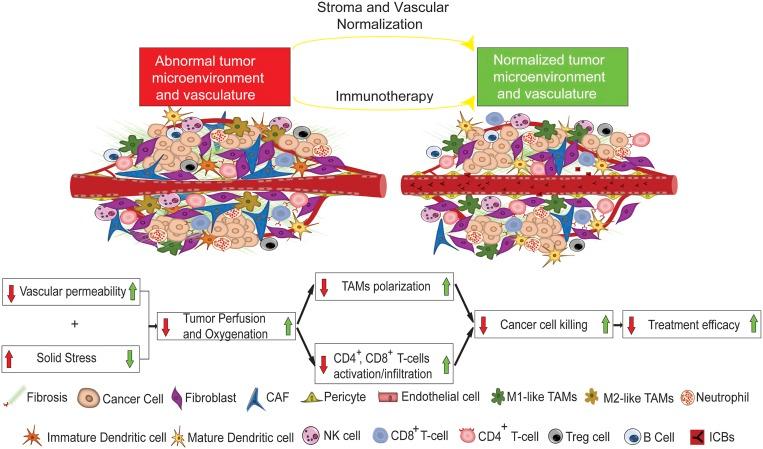
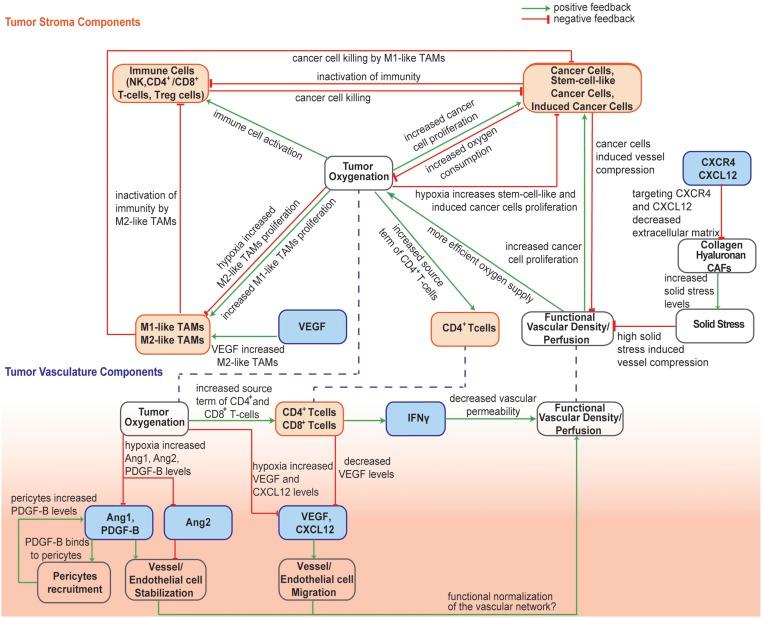
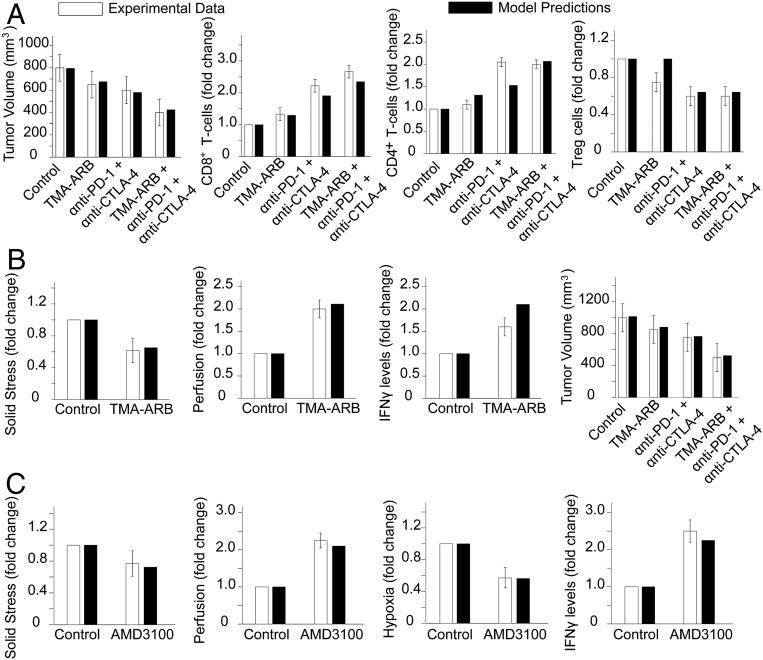
Advances in immunotherapy have revolutionized the treatment of multiple cancers. Unfortunately, tumors usually have impaired blood perfusion, which limits the delivery of therapeutics and cytotoxic immune cells to tumors and also results in hypoxia-a hallmark of the abnormal tumor microenvironment (TME)-that causes immunosuppression. We proposed that normalization of TME using antiangiogenic drugs and/or mechanotherapeutics can overcome these challenges. Recently, immunotherapy with checkpoint blockers was shown to effectively induce vascular normalization in some types of cancer. Although these therapeutic approaches have been used in combination in preclinical and clinical studies, their combined effects on TME are not fully understood. To identify strategies for improved immunotherapy, we have developed a mathematical framework that incorporates complex interactions among various types of cancer cells, immune cells, stroma, angiogenic molecules, and the vasculature. Model predictions were compared with the data from five previously reported experimental studies. We found that low doses of antiangiogenic treatment improve immunotherapy when the two treatments are administered sequentially, but that high doses are less efficacious because of excessive vessel pruning and hypoxia. Stroma normalization can further increase the efficacy of immunotherapy, and the benefit is additive when combined with vascular normalization. We conclude that vessel functionality dictates the efficacy of immunotherapy, and thus increased tumor perfusion should be investigated as a predictive biomarker of response to immunotherapy.
免疫疗法的进步彻底改变了多种癌症的治疗方式。不幸的是,肿瘤通常存在血液灌注受损的情况,这限制了治疗药物和细胞毒性免疫细胞向肿瘤的输送,也导致了缺氧——异常肿瘤微环境(TME)的标志——从而引起免疫抑制。我们提出,使用抗血管生成药物和/或机械治疗来使 TME 正常化,可以克服这些挑战。最近,检查点抑制剂的免疫疗法已被证明可有效诱导某些类型癌症的血管正常化。尽管这些治疗方法已在临床前和临床研究中联合使用,但它们对 TME 的联合作用尚未完全了解。为了找到改善免疫疗法的策略,我们开发了一个数学框架,其中纳入了各种类型的癌细胞、免疫细胞、基质、血管生成分子和血管之间的复杂相互作用。模型预测与之前报告的五项实验研究的数据进行了比较。我们发现,当两种治疗方法顺序进行时,低剂量的抗血管生成治疗可改善免疫疗法的效果,但高剂量的治疗效果较差,因为血管过度修剪和缺氧。基质正常化可以进一步提高免疫疗法的疗效,与血管正常化结合使用时,效果具有加性。我们得出结论,血管功能决定了免疫疗法的疗效,因此应该将增加肿瘤灌注作为对免疫疗法反应的预测性生物标志物进行研究。


 Zotero 插件