
在一家学术性三级儿科医院实施现场 FilmArray 脑膜炎/脑炎检测面板前后抗生素和阿昔洛韦使用情况的比较:一项回顾性观察研究。
Comparison of antibiotic and acyclovir usage before and after the implementation of an on-site FilmArray meningitis/encephalitis panel in an academic tertiary pediatric hospital: a retrospective observational study.
机构信息
Division of Pediatric Infectious Disease, Hauner Children's Hospital, University of Munich (LMU), Lindwurmstraße 4, 80337, Munich, Germany.
出版信息
BMC Pediatr. 2020 Feb 5;20(1):56. doi: 10.1186/s12887-020-1944-2.
BACKGROUND
Prompt initiation of empiric therapy is common practice in case of suspected meningitis or encephalitis. However, in children the most common pathogens are viruses that usually do not require and are not covered by the applied anti-infective treatment. Novel multiplex PCR (mPCR) panels provide rapid on-site diagnostic testing for a variety of pathogens. This study compared empiric antibiotic and acyclovir usage before and after the introduction of an on-site FilmArray Meningitis/Encephalitis Panel (FA ME Panel).
METHODS
We retrospectively compared data for empiric antibiotic and acyclovir usage between pediatric patients with suspected central nervous system (CNS) infection receiving mPCR testing and a matched historical control group. Patients were matched by age and suspected CNS infection. We included all patients for whom empiric antibiotics and/or acyclovir were prescribed.
RESULTS
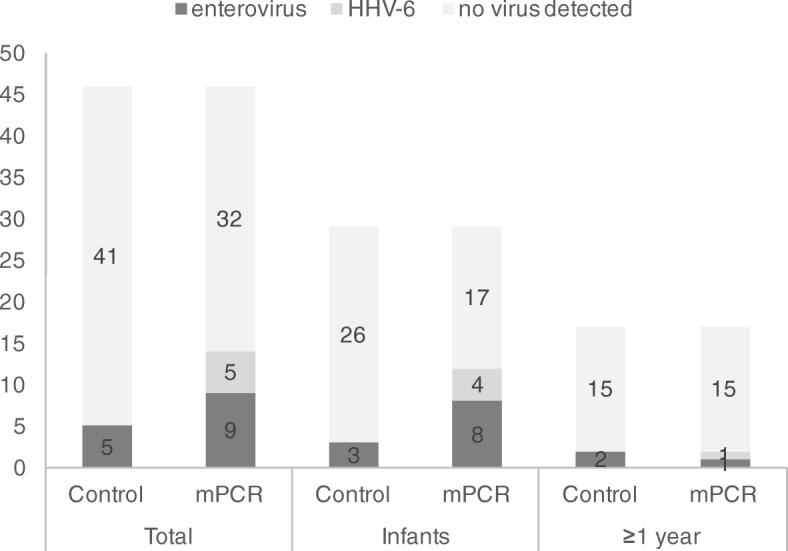
Each study group consisted of 46 patients with 29 (63.0%) infants and 17 (37.0%) older children. A viral pathogen was diagnosed in 5/46 (10.9%) patients in the control group (all enteroviruses) and in 14/46 (30.4%) patients in the mPCR group (enterovirus n = 9; human herpesvirus 6 (HHV-6) n = 5), (p = 0.038)). Length of Therapy (LoT) and Days of Therapy (DoT) for antibiotics were significantly lower for infants (4.0 vs. 3.0, p = 0.038 and 8.0 vs. 6.0, p = 0.015, respectively). Acyclovir therapy was significantly shorter for both, infants and older children (3.0 vs. 1.0 day, p < 0.001 for both age groups).
CONCLUSION
The findings of our study suggest that the introduction of a FA ME Panel into clinical routine procedures is associated with a significantly reduced LoT and DoT of empiric anti-infective treatment in children with suspected meningoencephalitis. The largest effect was observed in infants.
背景
在疑似脑膜炎或脑炎的情况下,及时启动经验性治疗是常见做法。然而,在儿童中,最常见的病原体是病毒,通常不需要且不受应用抗感染治疗的覆盖。新型多重 PCR(mPCR)试剂盒为各种病原体提供了快速现场诊断检测。本研究比较了现场 FilmArray 脑膜炎/脑炎试剂盒(FA ME 试剂盒)引入前后经验性抗生素和阿昔洛韦的使用情况。
方法
我们回顾性比较了接受 mPCR 检测的疑似中枢神经系统(CNS)感染的儿科患者与匹配的历史对照组之间经验性抗生素和阿昔洛韦使用的数据。患者按年龄和疑似 CNS 感染进行匹配。我们纳入了所有经验性使用抗生素和/或阿昔洛韦的患者。
结果
每组研究均包括 46 名患者,其中 29 名(63.0%)为婴儿,17 名(37.0%)为较大儿童。对照组中有 5/46(10.9%)名患者(均为肠道病毒)和 mPCR 组中有 14/46(30.4%)名患者(肠道病毒 9 例;人类疱疹病毒 6(HHV-6)5 例)诊断为病毒病原体(p=0.038)。抗生素的治疗疗程(LoT)和治疗天数(DoT)在婴儿中显著较低(4.0 与 3.0,p=0.038 和 8.0 与 6.0,p=0.015)。婴儿和较大儿童的阿昔洛韦治疗时间均显著缩短(3.0 与 1.0 天,p<0.001,两个年龄组均如此)。
结论
我们的研究结果表明,在临床常规操作中引入 FA ME 试剂盒与疑似脑膜炎或脑炎儿童经验性抗感染治疗的 LoT 和 DoT 显著减少相关。最大的影响发生在婴儿中。


 Zotero 插件