
鉴定和验证血管生成基因,构建用于诊断、预后和复发预测的肝细胞癌模型。
Identification and validation of the angiogenic genes for constructing diagnostic, prognostic, and recurrence models for hepatocellular carcinoma.
机构信息
Key Laboratory of Imaging Diagnosis and Minimally Invasive Intervention Research, Lishui Hospital, School of Medicine, Zhejiang University, Lishui 323000, China.
Department of Radiology, Second Affiliated Hospital, School of Medicine, Zhejiang University, Hangzhou 310058, China.
出版信息
Aging (Albany NY). 2020 May 6;12(9):7848-7873. doi: 10.18632/aging.103107.
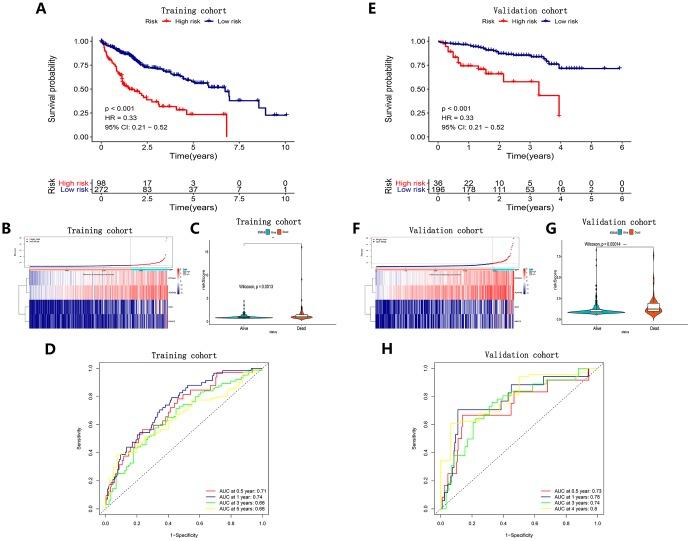
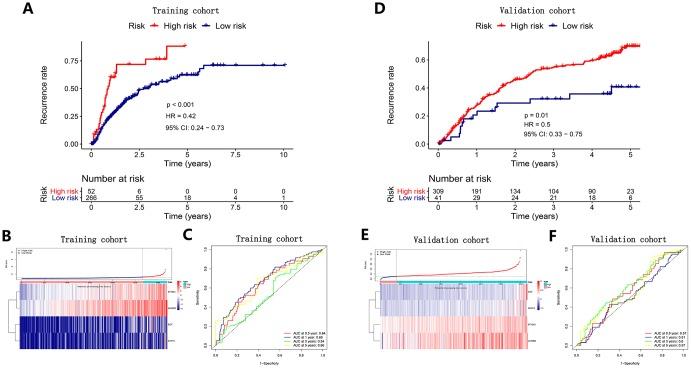
Since angiogenesis has an indispensable effect in the development and progression of tumors, in this study we aimed to identify angiogenic genes closely associated with prognosis of HCC to establish diagnostic, prognostic, and recurrence models. We analyzed 132 angiogenic genes and HCC-related RNA sequence data from the TCGA and ICGC databases by Cox and least absolute shrinkage and selection operator (LASSO) regression, and identified four angiogenic genes (ENFA3, EGF, MMP3 and AURKB) to establish prognosis, recurrence and diagnostic models and corresponding nomograms. The prognostic and recurrence models were determined to be independent predictors of prognosis and recurrence (P < 0.05). And compared with the low-risk group, patients in the high-risk group had worse overall survival (OS) rates in training cohort (P < 0.001) and validation cohort (P < 0.001), and higher recurrence rates in training cohort (P<0.001) and validation cohort (P=0.01). The diagnostic models have been validated to correctly distinguish HCC from normal samples and proliferative nodule samples. Through pharmacological analysis we identified piperlongumine as a drug for targeting angiogenesis, and it was validated to inhibit HCC cell proliferation and angiogenesis via the EGF/EGFR axis.
由于血管生成在肿瘤的发生和发展中具有不可或缺的作用,因此在这项研究中,我们旨在确定与 HCC 预后密切相关的血管生成基因,以建立诊断、预后和复发模型。我们通过 Cox 和最小绝对收缩和选择算子(LASSO)回归分析了来自 TCGA 和 ICGC 数据库的 132 个血管生成基因和 HCC 相关 RNA 序列数据,并确定了四个血管生成基因(ENFA3、EGF、MMP3 和 AURKB)来建立预后、复发和诊断模型及相应的列线图。预后和复发模型被确定为预后和复发的独立预测因子(P<0.05)。与低危组相比,高危组患者在训练队列(P<0.001)和验证队列(P<0.001)中的总生存率(OS)更差,且在训练队列(P<0.001)和验证队列(P=0.01)中的复发率更高。该诊断模型已被验证可正确区分 HCC 与正常样本和增生性结节样本。通过药理学分析,我们确定了胡椒碱作为一种针对血管生成的药物,并通过 EGF/EGFR 轴验证了其抑制 HCC 细胞增殖和血管生成的作用。





 Zotero 插件