
使用急性心理健康环境中的患者的电话测量值测试自杀风险预测算法:可行性研究。
Testing Suicide Risk Prediction Algorithms Using Phone Measurements With Patients in Acute Mental Health Settings: Feasibility Study.
机构信息
Faculty of Health, Psychology and Social Care, Manchester Metropolitan University, Manchester, United Kingdom.
CLARA Labs, CLARA Analytics, Santa Clara, CA, United States.
出版信息
JMIR Mhealth Uhealth. 2020 Jun 26;8(6):e15901. doi: 10.2196/15901.
BACKGROUND
Digital phenotyping and machine learning are currently being used to augment or even replace traditional analytic procedures in many domains, including health care. Given the heavy reliance on smartphones and mobile devices around the world, this readily available source of data is an important and highly underutilized source that has the potential to improve mental health risk prediction and prevention and advance mental health globally.
OBJECTIVE
This study aimed to apply machine learning in an acute mental health setting for suicide risk prediction. This study uses a nascent approach, adding to existing knowledge by using data collected through a smartphone in place of clinical data, which have typically been collected from health care records.
METHODS
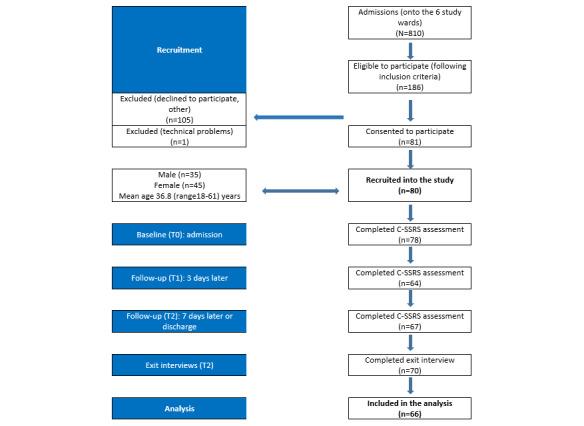
We created a smartphone app called Strength Within Me, which was linked to Fitbit, Apple Health kit, and Facebook, to collect salient clinical information such as sleep behavior and mood, step frequency and count, and engagement patterns with the phone from a cohort of inpatients with acute mental health (n=66). In addition, clinical research interviews were used to assess mood, sleep, and suicide risk. Multiple machine learning algorithms were tested to determine the best fit.
RESULTS
K-nearest neighbors (KNN; k=2) with uniform weighting and the Euclidean distance metric emerged as the most promising algorithm, with 68% mean accuracy (averaged over 10,000 simulations of splitting the training and testing data via 10-fold cross-validation) and an average area under the curve of 0.65. We applied a combined 5×2 F test to test the model performance of KNN against the baseline classifier that guesses training majority, random forest, support vector machine and logistic regression, and achieved F statistics of 10.7 (P=.009) and 17.6 (P=.003) for training majority and random forest, respectively, rejecting the null of performance being the same. Therefore, we have taken the first steps in prototyping a system that could continuously and accurately assess the risk of suicide via mobile devices.
CONCLUSIONS
Predicting for suicidality is an underaddressed area of research to which this paper makes a useful contribution. This is part of the first generation of studies to suggest that it is feasible to utilize smartphone-generated user input and passive sensor data to generate a risk algorithm among inpatients at suicide risk. The model reveals fair concordance between phone-derived and research-generated clinical data, and with iterative development, it has the potential for accurate discriminant risk prediction. However, although full automation and independence of clinical judgment or input would be a worthy development for those individuals who are less likely to access specialist mental health services, and for providing a timely response in a crisis situation, the ethical and legal implications of such advances in the field of psychiatry need to be acknowledged.
背景
数字表型和机器学习目前正被用于在许多领域(包括医疗保健领域)增强甚至取代传统的分析程序。鉴于全球对智能手机和移动设备的高度依赖,这种现成的数据来源是一个重要且尚未得到充分利用的来源,具有改善心理健康风险预测和预防以及促进全球心理健康的潜力。
目的
本研究旨在将机器学习应用于急性心理健康环境中的自杀风险预测。本研究采用了一种新兴方法,通过使用智能手机收集数据来代替临床数据,从而增加现有知识,而临床数据通常是从医疗记录中收集的。
方法
我们创建了一个名为“Strength Within Me”的智能手机应用程序,该应用程序与 Fitbit、Apple Health kit 和 Facebook 相关联,以从一组急性心理健康的住院患者中收集重要的临床信息,如睡眠行为和情绪、步数和计数以及与手机的互动模式(n=66)。此外,还使用临床研究访谈来评估情绪、睡眠和自杀风险。测试了多种机器学习算法以确定最佳拟合度。
结果
K-最近邻(KNN;k=2),具有均匀加权和欧几里得距离度量,是最有前途的算法,平均准确率为 68%(通过 10 折交叉验证在训练和测试数据之间进行 10000 次模拟平均),平均曲线下面积为 0.65。我们应用了一个组合的 5×2 F 检验来测试 KNN 模型对基准分类器的性能,该基准分类器猜测训练多数、随机森林、支持向量机和逻辑回归,分别获得了 10.7(P=.009)和 17.6(P=.003)的 F 统计量,拒绝了性能相同的零假设。因此,我们已经迈出了原型设计一个系统的第一步,该系统可以通过移动设备连续、准确地评估自杀风险。
结论
预测自杀倾向是一个研究不足的领域,本文对此做出了有益的贡献。这是第一代研究中的一部分,表明利用智能手机生成的用户输入和被动传感器数据在自杀风险的住院患者中生成风险算法是可行的。该模型揭示了手机衍生数据和研究生成的临床数据之间的公平一致性,并且随着迭代开发,它具有准确区分风险预测的潜力。然而,尽管对于那些不太可能获得专业心理健康服务的个人以及在危机情况下提供及时响应来说,临床判断或输入的完全自动化和独立性可能是一个值得发展的方向,但需要承认精神病学领域此类进展的伦理和法律影响。



 Zotero 插件