
生长/分化因子 15(GDF-15):从生物标志物到新型可靶向免疫检查点。
Growth/Differentiation Factor-15 (GDF-15): From Biomarker to Novel Targetable Immune Checkpoint.
机构信息
Experimental Tumor Immunology, Department of Obstetrics and Gynecology, University of Würzburg Medical School, Würzburg, Germany.
Program of Immunology and Immunotherapy, Center for Applied Medical Research (CIMA), Pamplona, Spain.
出版信息
Front Immunol. 2020 May 19;11:951. doi: 10.3389/fimmu.2020.00951. eCollection 2020.
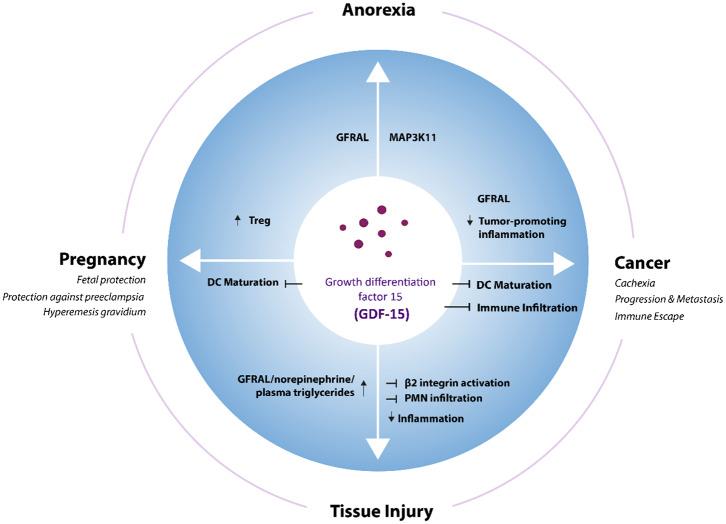
Growth/differentiation factor-15 (GDF-15), also named macrophage inhibitory cytokine-1, is a divergent member of the transforming growth factor β superfamily. While physiological expression is barely detectable in most somatic tissues in humans, GDF-15 is abundant in placenta. Elsewhere, GDF-15 is often induced under stress conditions, seemingly to maintain cell and tissue homeostasis; however, a moderate increase in GDF-15 blood levels is observed with age. Highly elevated GDF-15 levels are mostly linked to pathological conditions including inflammation, myocardial ischemia, and notably cancer. GDF-15 has thus been widely explored as a biomarker for disease prognosis. Mechanistically, induction of anorexia via the brainstem-restricted GDF-15 receptor GFRAL (glial cell-derived neurotrophic factor [GDNF] family receptor α-like) is well-documented. GDF-15 and GFRAL have thus become attractive targets for metabolic intervention. Still, several GDF-15 mediated effects (including its physiological role in pregnancy) are difficult to explain via the described pathway. Hence, there is a clear need to better understand non-metabolic effects of GDF-15. With particular emphasis on its immunomodulatory potential this review discusses the roles of GDF-15 in pregnancy and in pathological conditions including myocardial infarction, autoimmune disease, and specifically cancer. Importantly, the strong predictive value of GDF-15 as biomarker may plausibly be linked to its immune-regulatory function. The described associations and mechanistic data support the hypothesis that GDF-15 acts as immune checkpoint and is thus an emerging target for cancer immunotherapy.
生长/分化因子 15(GDF-15),也称为巨噬细胞抑制细胞因子-1,是转化生长因子β超家族的一个分支成员。虽然在人类的大多数体组织中几乎检测不到生理表达,但 GDF-15 在胎盘组织中丰富表达。在其他地方,GDF-15 通常在应激条件下诱导产生,似乎是为了维持细胞和组织的内稳态;然而,随着年龄的增长,GDF-15 的血液水平会适度升高。GDF-15 水平的高度升高主要与包括炎症、心肌缺血和尤其是癌症在内的病理状况有关。因此,GDF-15 被广泛探索作为疾病预后的生物标志物。从机制上讲,通过脑干受限的 GDF-15 受体 GFRAL(神经胶质细胞衍生神经营养因子[GDNF]家族受体α样)诱导厌食已得到充分证实。因此,GDF-15 和 GFRAL 已成为代谢干预的有吸引力的目标。尽管如此,几种 GDF-15 介导的作用(包括其在妊娠中的生理作用)很难通过描述的途径来解释。因此,需要更好地了解 GDF-15 的非代谢作用。本综述特别强调了其免疫调节潜力,讨论了 GDF-15 在妊娠和病理状况(包括心肌梗死、自身免疫性疾病和特别是癌症)中的作用。重要的是,GDF-15 作为生物标志物的强预测价值可能与其免疫调节功能有关。所述关联和机制数据支持 GDF-15 作为免疫检查点的假说,因此是癌症免疫治疗的一个新兴靶点。

 Zotero 插件