
中性粒细胞与淋巴细胞比值对非小细胞肺癌患者程序性死亡受体-1/程序性死亡配体1抑制剂治疗效果的预测潜力:一项荟萃分析。
The prediction potential of neutrophil-to-lymphocyte ratio for the therapeutic outcomes of programmed death receptor-1/programmed death ligand 1 inhibitors in non-small cell lung cancer patients: A meta-analysis.
作者信息
Huang Ying, Shen Aizong
机构信息
Department of Pharmacy, the First Affiliated Hospital of USTC, Anhui Provincial Hospital, Hefei, Anhui, China.
出版信息
Medicine (Baltimore). 2020 Aug 21;99(34):e21718. doi: 10.1097/MD.0000000000021718.
BACKGROUND
Programmed death receptor-1 (PD-1)/programmed death ligand 1 (PD-L1) inhibitors have been demonstrated to improve the prognosis of patients with advanced non-small cell lung cancer (NSCLC) compared with chemotherapy. However, there were still some non-responders. Thus, how to effectively screen the responder may be an important issue. Recent studies revealed the immune-related indicator, neutrophil-lymphocyte ratio (NLR), may predict the therapeutic effects of anti-PD1/PD-L1 antibodies; however, the results were controversial. This study was to re-evaluate the prognostic potential of NLR for NSCLC patients receiving PD1/PD-L1 inhibitors by performing a meta-analysis.
METHODS
Eligible studies were identified by searching online databases of PubMed, EMBASE and Cochrane Library. The predictive values of NLR for overall survival, (OS), progression free survival (PFS) and overall response rate (ORR) were estimated by hazard ratio (HR) with 95% confidence interval (CI).
RESULTS
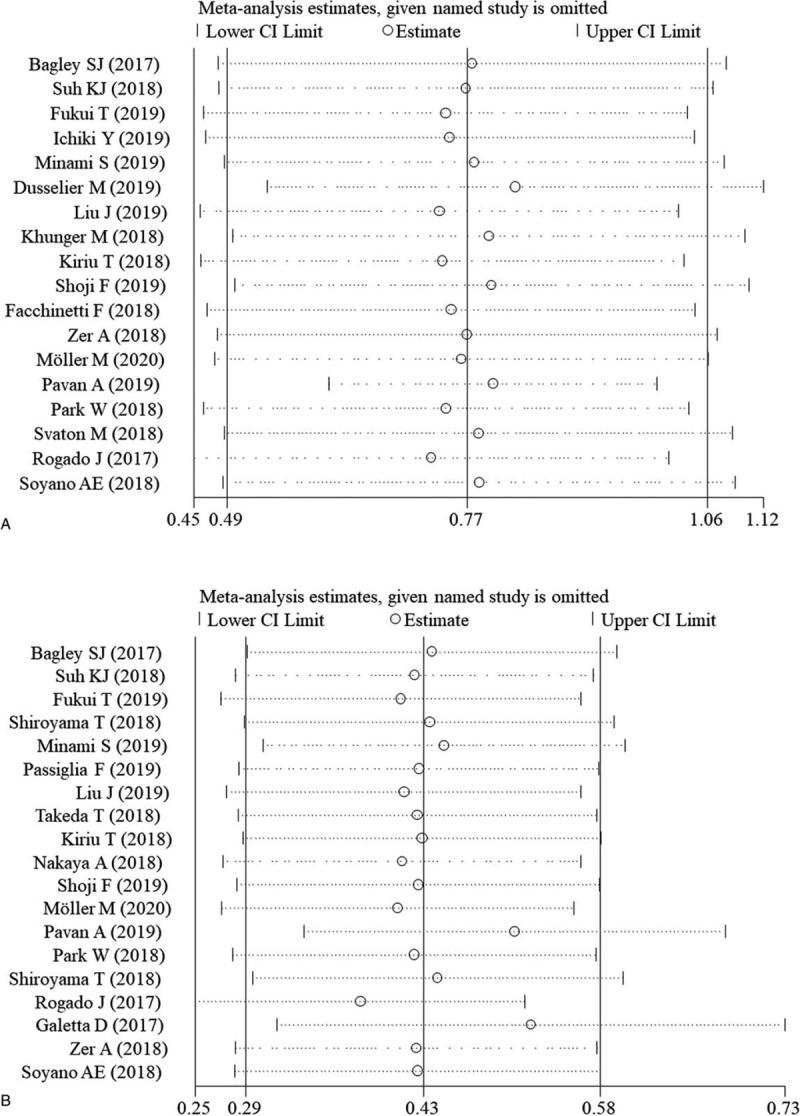
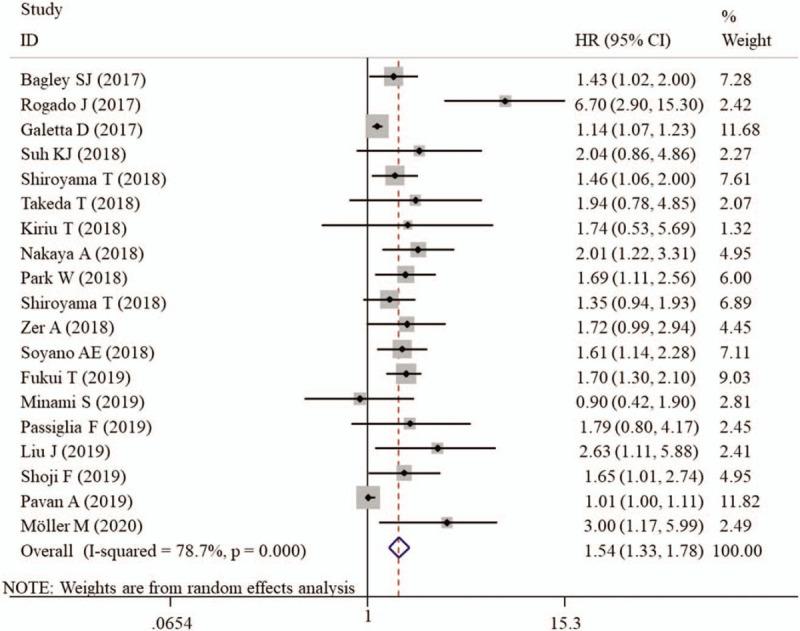
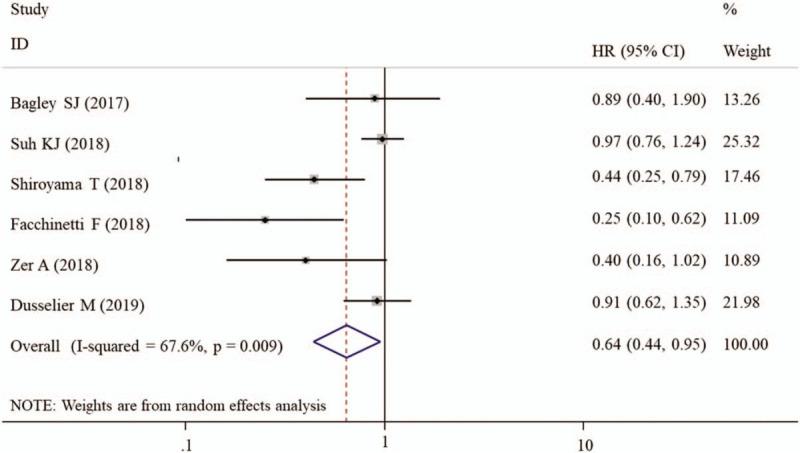
Twenty-four studies involving 2196 patients were included. The pooled analysis demonstrated that elevated NLR before PD-1/PD-L1 inhibitor treatment was a predictor of poor OS (HR = 2.17; 95% CI: 1.64 - 2.87, P < .001), PFS (HR = 1.54; 95% CI: 1.34 - 1.78, P < .001) and low ORR (HR = 0.64; 95% CI: 0.44 - 0.95, P = .027) in NSCLC patients. Subgroup analysis revealed the predictive ability of NLR for OS and PFS was not changed by ethnicity, sample size, cut-off, HR source, study design or inhibitor type (except the combined anti-PD-L1 group); while its association with ORR was only significant when the cut-off value was less than 5 and the studies were prospectively designed.
CONCLUSION
Our findings suggest patients with lower NLR may benefit from the use of PD-1/PD-L1 inhibitors to prolong their survival period.
背景
与化疗相比,程序性死亡受体1(PD-1)/程序性死亡配体1(PD-L1)抑制剂已被证明可改善晚期非小细胞肺癌(NSCLC)患者的预后。然而,仍有一些患者无反应。因此,如何有效筛选出有反应者可能是一个重要问题。最近的研究表明,免疫相关指标中性粒细胞与淋巴细胞比值(NLR)可能预测抗PD-1/PD-L1抗体的治疗效果;然而,结果存在争议。本研究旨在通过进行荟萃分析,重新评估NLR对接受PD-1/PD-L1抑制剂治疗的NSCLC患者的预后潜力。
方法
通过检索PubMed、EMBASE和Cochrane图书馆的在线数据库确定符合条件的研究。通过风险比(HR)及95%置信区间(CI)估计NLR对总生存期(OS)、无进展生存期(PFS)和总缓解率(ORR)的预测价值。
结果
纳入了涉及2196例患者的24项研究。汇总分析表明,在接受PD-1/PD-L1抑制剂治疗前NLR升高是NSCLC患者OS较差(HR = 2.17;95%CI:1.64 - 2.87,P <.001)、PFS较差(HR = 1.54;95%CI:1.34 - 1.78,P <.001)及ORR较低(HR = 0.64;95%CI:0.44 - 0.95,P =.027)的一个预测因素。亚组分析显示,NLR对OS和PFS的预测能力不受种族、样本量、临界值、HR来源、研究设计或抑制剂类型(联合抗PD-L1组除外)的影响;而仅当临界值小于5且研究为前瞻性设计时,其与ORR的关联才具有显著性。
结论
我们的研究结果表明,NLR较低的患者可能从使用PD-1/PD-L1抑制剂中获益,以延长生存期。


 Zotero 插件