
cGAS-STING 通路:自身 DNA 感知在炎症性肺病中的作用。
The cGAS-STING pathway: The role of self-DNA sensing in inflammatory lung disease.
机构信息
Division of Pulmonary and Critical Care Medicine, Department of Medicine, Northwestern University Feinberg School of Medicine, Chicago, IL, USA.
Division of Critical Care Medicine, Department of Pediatrics, Northwestern University Feinberg School of Medicine, Chicago, IL, USA.
出版信息
FASEB J. 2020 Oct;34(10):13156-13170. doi: 10.1096/fj.202001607R. Epub 2020 Aug 28.
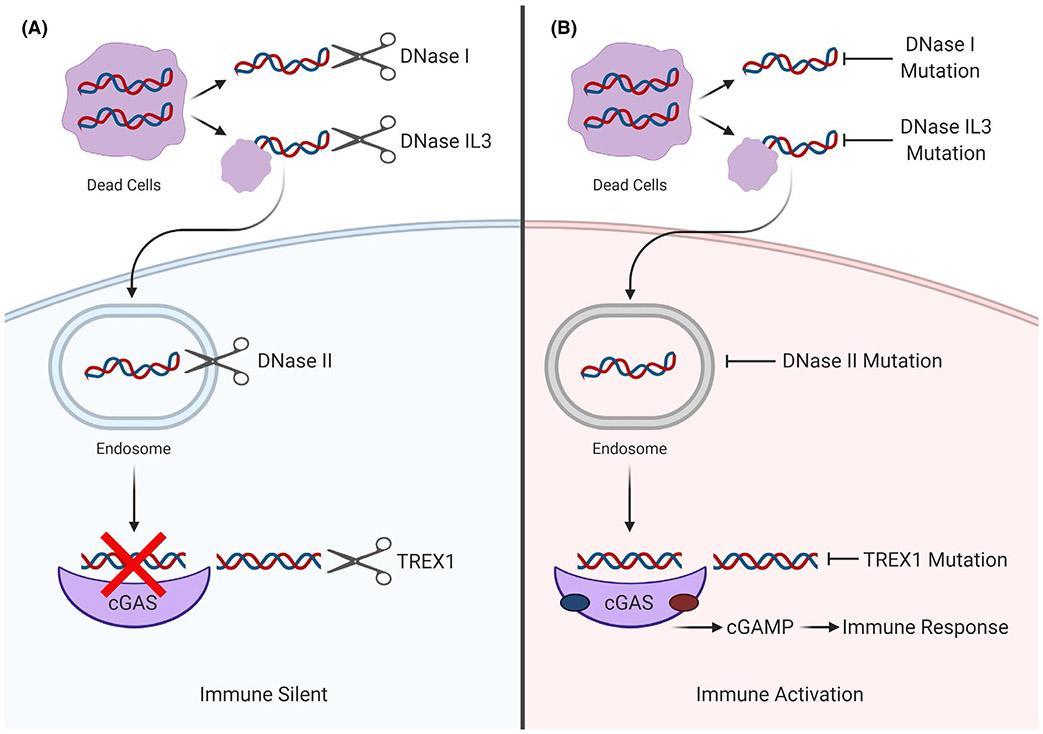
The presence of DNA in the cytosol is usually a sign of microbial infections, which alerts the host innate immune system to mount a defense response. Cyclic GMP-AMP synthase (cGAS) is a critical cytosolic DNA sensor that elicits robust innate immune responses through the production of the second messenger, cyclic GMP-AMP (cGAMP), which binds and activates stimulator of interferon genes (STING). However, cGAS binds to DNA irrespective of DNA sequence, therefore, self-DNA leaked from the nucleus or mitochondria can also serve as a cGAS ligand to activate this pathway and trigger extensive inflammatory responses. Dysregulation of the cGAS-STING pathway is responsible for a broad array of inflammatory and autoimmune diseases. Recently, evidence has shown that self-DNA release and cGAS-STING pathway over-activation can drive lung disease, making this pathway a promising therapeutic target for inflammatory lung disease. Here, we review recent advances on the cGAS-STING pathway governing self-DNA sensing, highlighting its role in pulmonary disease.
细胞质中 DNA 的存在通常是微生物感染的标志,这会促使宿主固有免疫系统启动防御反应。环鸟苷酸-腺苷酸合酶 (cGAS) 是一种关键的细胞质 DNA 传感器,通过产生第二信使环鸟苷酸-腺苷酸 (cGAMP) 引发强烈的固有免疫反应,cGAMP 结合并激活干扰素基因刺激物 (STING)。然而,cGAS 与 DNA 结合而不考虑 DNA 序列,因此,从核或线粒体泄漏的自身 DNA 也可以作为 cGAS 配体激活该途径并引发广泛的炎症反应。cGAS-STING 途径的失调与广泛的炎症和自身免疫性疾病有关。最近的证据表明,自身 DNA 的释放和 cGAS-STING 途径的过度激活可导致肺部疾病,这使得该途径成为治疗肺部炎症性疾病的一个有前途的靶点。在这里,我们综述了 cGAS-STING 途径对自身 DNA 感知的最新进展,强调了其在肺部疾病中的作用。


 Zotero 插件