
对吸烟人群使用的个人交互式一氧化碳呼吸传感器的评估:单臂队列研究。
Assessment of a Personal Interactive Carbon Monoxide Breath Sensor in People Who Smoke Cigarettes: Single-Arm Cohort Study.
作者信息
Marler Jennifer D, Fujii Craig A, Wong Kristine S, Galanko Joseph A, Balbierz Daniel J, Utley David S
机构信息
Carrot Inc., Redwood City, CA, United States.
Biostatistics Core for the Center for Gastrointestinal Biology and Disease and the biostatistician for the Clinical Nutrition Research Center, Department of Medicine, Division of Gastroenterology and Hepatology, University of North Carolina at Chapel Hill, Chapel Hill, NC, United States.
出版信息
J Med Internet Res. 2020 Oct 2;22(10):e22811. doi: 10.2196/22811.
BACKGROUND
Tobacco use is the leading cause of preventable morbidity and mortality. Existing evidence-based treatments are underutilized and have seen little recent innovation. The success of personal biofeedback interventions in other disease states portends a similar opportunity in smoking cessation. The Pivot Breath Sensor is a personal interactive FDA-cleared (over-the-counter) device that measures carbon monoxide (CO) in exhaled breath, enabling users to link their smoking behavior and CO values, and track their progress in reducing or quitting smoking.
OBJECTIVE
The objective of this study is to assess the Pivot Breath Sensor in people who smoke cigarettes, evaluating changes in attitudes toward quitting smoking, changes in smoking behavior, and use experience.
METHODS
US adults (18-80 years of age, ≥10 cigarettes per day [CPD]) were recruited online for this remote 12-week study. Participants completed a screening call, informed consent, and baseline questionnaire, and then were mailed their sensor. Participants were asked to submit 4 or more breath samples per day and complete questionnaires at 1-4, 8, and 12 weeks. Outcomes included attitudes toward quitting smoking (Stage of Change, success to quit, and perceived difficulty of quitting), smoking behavior (quit attempts, CPD reduction, and 7-, 30-day point prevalence abstinence [PPA]), and use experience (impact and learning).
RESULTS
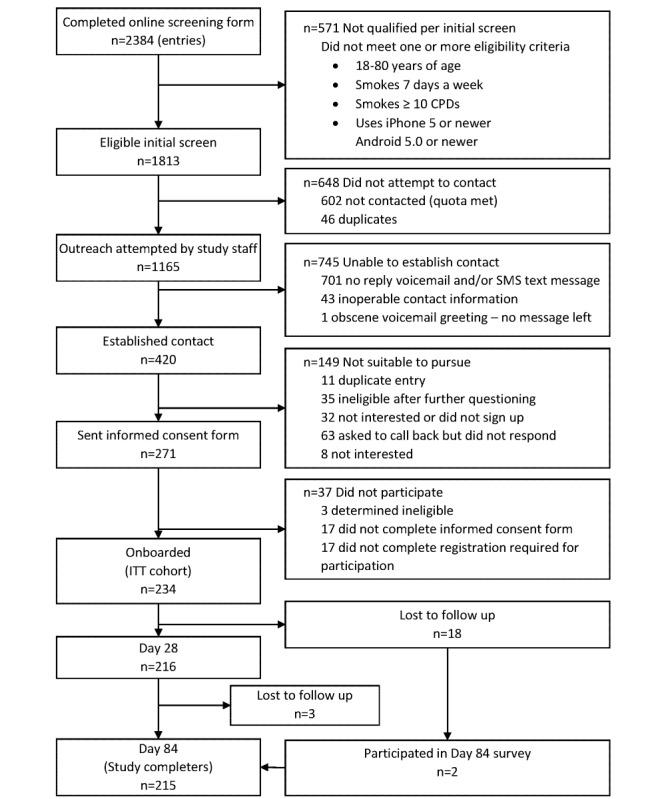
Participants comprised 234 smokers, mean age 39.9 (SD 11.3) years, 52.6% (123/234) female, mean CPD 20.3 (SD 8.0). The 4- and 12-week questionnaires were completed by 92.3% (216/234) and 91.9% (215/234) of participants, respectively. Concerning attitude outcomes, at baseline, 15.4% (36/234) were seriously thinking of quitting in the next 30 days, increasing to 38.9% (84/216) at 4 weeks and 47.9% (103/215) at 12 weeks (both P<.001). At 12 weeks, motivation to quit was increased in 39.1% (84/215), unchanged in 54.9% (118/215), and decreased in 6.0% (13/215; P<.001). Additional attitudes toward quitting improved from baseline to 12 weeks: success to quit 3.3 versus 5.0 (P<.001) and difficulty of quitting 2.8 versus 4.3 (P<.001). Regarding smoking behavior, at 4 weeks, 28.2% (66/234) had made 1 or more quit attempts (≥1 day of abstinence), increasing to 48.3% (113/234) at 12 weeks. At 4 weeks, 23.1% (54/234) had reduced CPD by 50% or more, increasing to 38.5% (90/234) at 12 weeks. At 12 weeks, CPD decreased by 41.1% from baseline (P<.001), and 7- and 30-day PPA were 12.0% (28/234) and 6.0% (14/234), respectively. Concerning use experience, 75.3% (171/227) reported the sensor increased their motivation to quit. More than 90% (>196/214) indicated the sensor taught them about their CO levels and smoking behavior, and 73.1% (166/227) reported that seeing their CO values made them want to quit smoking.
CONCLUSIONS
Use of the Pivot Breath Sensor resulted in a significant increase in motivation to quit, a reduction in CPD, and favorable quit attempt rates. These outcomes confer increased likelihood of quitting smoking. Accordingly, the results support a role for biofeedback via personal CO breath sampling in smoking cessation.
TRIAL REGISTRATION
ClinicalTrials.gov NCT04133064; https://clinicaltrials.gov/ct2/show/NCT04133064.
背景
烟草使用是可预防的发病和死亡的主要原因。现有的循证治疗方法未得到充分利用,且近期几乎没有创新。个人生物反馈干预在其他疾病状态下的成功预示着戒烟方面也有类似的机会。枢轴呼吸传感器是一种经美国食品药品监督管理局(FDA)批准(非处方)的个人交互式设备,可测量呼出气体中的一氧化碳(CO),使用户能够将吸烟行为与CO值联系起来,并跟踪他们在减少吸烟或戒烟方面的进展。
目的
本研究的目的是评估枢轴呼吸传感器在吸烟人群中的效果,评估其对戒烟态度的变化、吸烟行为的改变以及使用体验。
方法
通过网络招募美国成年人(18 - 80岁,每天吸烟≥10支)参与这项为期12周的远程研究。参与者完成筛选电话、知情同意和基线问卷,然后收到邮寄的传感器。要求参与者每天提交4个或更多的呼吸样本,并在第1、4、8和12周完成问卷。结果包括对戒烟的态度(改变阶段、戒烟成功和感知的戒烟难度)、吸烟行为(戒烟尝试、每日吸烟量减少以及7天和30天的点患病率戒烟率)和使用体验(影响和学习)。
结果
参与者包括234名吸烟者,平均年龄39.9(标准差11.3)岁,52.6%(123/234)为女性,平均每日吸烟量20.3(标准差8.0)支。分别有92.3%(216/234)和91.9%(215/234)的参与者完成了第4周和第12周的问卷。关于态度结果,在基线时,15.4%(36/234)的人在接下来30天内认真考虑戒烟,在第4周时增至38.9%(84/216),在第12周时增至47.9%(103/215)(两者P<0.001)。在第12周时,39.1%(84/215)的人戒烟动机增强,54.9%(118/215)的人不变,6.0%(13/215)的人减弱(P<0.001)。从基线到第12周,其他关于戒烟的态度有所改善:戒烟成功率从3.3提高到5.0(P<0.001),戒烟难度从2.8降至4.3(P<0.001)。关于吸烟行为,在第4周时,28.2%(66/234)的人进行了1次或更多次戒烟尝试(≥1天戒烟),在第12周时增至48.3%(113/234)。在第4周时,23.1%(54/234)的人每日吸烟量减少了50%或更多,在第12周时增至38.5%(90/234)。在第12周时,每日吸烟量较基线下降了41.1%(P<0.001),7天和30天的点患病率戒烟率分别为12.0%(28/234)和6.0%(14/234)。关于使用体验,75.3%(171/227)的人报告该传感器增强了他们的戒烟动机。超过90%(>196/214)的人表示该传感器让他们了解了自己的CO水平和吸烟行为,73.1%(166/227)的人报告看到自己的CO值后更想戒烟。
结论
使用枢轴呼吸传感器导致戒烟动机显著增加、每日吸烟量减少以及戒烟尝试率良好。这些结果增加了戒烟的可能性。因此,结果支持通过个人CO呼吸采样进行生物反馈在戒烟中的作用。
试验注册
ClinicalTrials.gov NCT04133064;https://clinicaltrials.gov/ct2/show/NCT04133064









 Zotero 插件