
2016 年美国可能发生的沙门氏菌、产志贺毒素大肠杆菌和单核细胞增生李斯特菌感染的多州疫情调查。
Investigations of Possible Multistate Outbreaks of Salmonella, Shiga Toxin-Producing Escherichia coli, and Listeria monocytogenes Infections - United States, 2016.
出版信息
MMWR Surveill Summ. 2020 Nov 13;69(6):1-14. doi: 10.15585/mmwr.ss6906a1.
PROBLEM/CONDITION: Salmonella, Shiga toxin-producing Escherichia coli (STEC), and Listeria monocytogenes are the leading causes of multistate foodborne disease outbreaks in the United States. Responding to multistate outbreaks quickly and effectively and applying lessons learned about outbreak sources, modes of transmission, and risk factors for infection can prevent additional outbreak-associated illnesses and save lives. This report summarizes the investigations of multistate outbreaks and possible outbreaks of Salmonella, STEC, and L. monocytogenes infections coordinated by CDC during the 2016 reporting period.
PERIOD COVERED
- An investigation was considered to have occurred in 2016 if it began during 2016 and ended on or before March 31, 2017, or if it began before January 1, 2016, and ended during March 31, 2016-March 31, 2017.
DESCRIPTION OF SYSTEM
CDC maintains a database of investigations of possible multistate foodborne and animal-contact outbreaks caused by Salmonella, STEC, and L. monocytogenes. Data were collected by local, state, and federal investigators during the detection, investigation and response, and control phases of the outbreak investigations. Additional data sources used for this report included PulseNet, the national molecular subtyping network based on isolates uploaded by local, state, and federal laboratories, and the Foodborne Disease Outbreak Surveillance System (FDOSS), which collects information from state, local, and territorial health departments and federal agencies about single-state and multistate foodborne disease outbreaks in the United States. Multistate outbreaks reported to FDOSS were linked using a unique outbreak identifier to obtain food category information when a confirmed or suspected food source was identified. Food categories were determined and assigned in FDOSS according to a classification scheme developed by CDC, the Food and Drug Administration (FDA), and the U.S. Department of Agriculture Food Safety and Inspection Service (FSIS) in the Interagency Food Safety Analytics Collaboration. A possible multistate outbreak was determined by expert judgment to be an outbreak if supporting data (e.g., temporal, geographic, demographic, dietary, travel, or food history) suggested a common source. A solved outbreak was an outbreak for which a specific kind of food or animal was implicated (i.e., confirmed or suspected) as the source. Outbreak-level variables included number of illnesses, hospitalizations, cases of hemolytic uremic syndrome (HUS), and deaths; the number of states with illnesses; date of isolation for the earliest and last cases; demographic data describing patients associated with a possible outbreak (e.g., age, sex, and state of residence); the types of data collected (i.e., epidemiologic, traceback, or laboratory); the outbreak source, mode of transmission, and exposure location; the name or brand of the source; whether the source was suspected or confirmed; whether a food was imported into the United States; the types of regulatory agencies involved; whether regulatory action was taken (and what type of action); whether an outbreak was publicly announced by CDC via website posting; beginning and end date of the investigation; and general comments about the investigation. The number of illnesses, hospitalizations, cases of HUS, and deaths were characterized by transmission mode, pathogen, outcome (i.e., unsolved, solved with suspected source, or solved with confirmed source), source, and food or animal category.
RESULTS
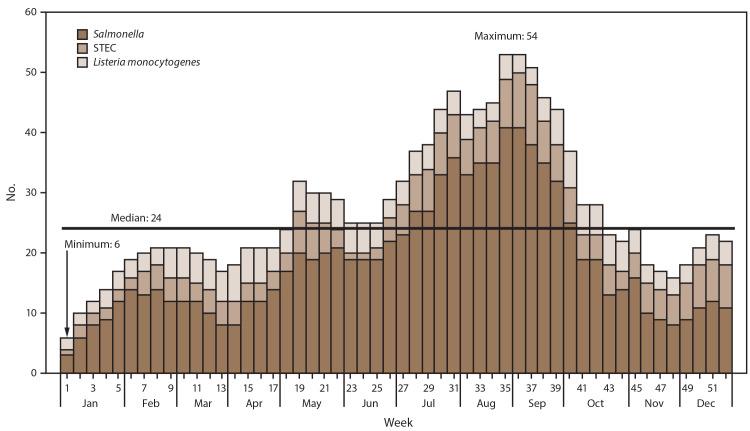
During the 2016 reporting period, 230 possible multistate outbreaks were detected and 174 were investigated. A median of 24 possible outbreaks was under investigation per week, and investigations were open for a median of 37 days. Of these 174 possible outbreaks investigated, 56 were excluded from this analysis because they occurred in a single state, were linked to international travel, or were pseudo-outbreaks (e.g., a group of similar isolates resulting from laboratory media contamination rather than infection in patients). Of the remaining 118 possible multistate outbreaks, 50 were determined to be outbreaks and 39 were solved (18 with a confirmed food source, 10 with a suspected food source, 10 with a confirmed animal source, and one with a suspected animal source). Sprouts were the most commonly implicated food category in solved multistate foodborne outbreaks (five). Chicken was the source of the most foodborne outbreak-related illnesses (134). Three outbreaks involved novel food-pathogen pairs: flour and STEC, frozen vegetables and L. monocytogenes, and bagged salad and L. monocytogenes. Eleven outbreaks were attributed to contact with animals (10 attributed to contact with backyard poultry and one to small turtles). Thirteen of 18 multistate foodborne disease outbreaks with confirmed sources resulted in product action, including 10 outbreaks with recalls, two with market withdrawals, and one with an FSIS public health alert. Twenty outbreaks, including 11 foodborne and nine animal-contact outbreaks, were announced to the public by CDC via its website, Facebook, and Twitter. These announcements resulted in approximately 910,000 webpage views, 55,000 likes, 66,000 shares, and 5,800 retweets.
INTERPRETATION
During the 2016 reporting period, investigations of possible multistate outbreaks occurred frequently, were resource intensive, and required a median of 37 days of investigation. Fewer than half (42%) of the 118 possible outbreaks investigated were determined to have sufficient data to meet the definition of a multistate outbreak. Moreover, of the 50 outbreaks with sufficient data, approximately three fourths were solved.
PUBLIC HEALTH ACTION
Close collaboration among CDC, FDA, FSIS and state and local health and agriculture partners is central to successful outbreak investigations. Identification of novel outbreak sources and trends in sources provides insights into gaps in food safety and safe handling of animals, which helps focus prevention strategies. Summarizing investigations of possible multistate outbreaks can provide insights into the investigative process, improve future investigations, and help prevent illnesses. Although identifying and investigating possible multistate outbreaks require substantial resources and investment in public health infrastructure, they are important in determining outbreak sources and implementing prevention and control measures.
问题/状况:沙门氏菌、产志贺毒素大肠杆菌(STEC)和单核细胞增生李斯特菌是美国导致食源性疾病暴发的主要原因。快速有效地应对多州暴发,并吸取暴发来源、传播方式和感染风险因素方面的经验教训,可以预防更多与暴发相关的疾病,挽救生命。本报告总结了 2016 年期间疾病预防控制中心协调调查的沙门氏菌、STEC 和单核细胞增生李斯特菌感染的多州暴发和可能暴发。
期间
2016 年。如果调查始于 2016 年且于 2017 年 3 月 31 日或之前结束,或者如果调查始于 2016 年 1 月 1 日之前且于 2016 年 3 月 31 日至 2017 年 3 月 31 日期间结束,则将其视为 2016 年发生的调查。
描述系统
疾病预防控制中心维护一个数据库,用于调查可能由沙门氏菌、STEC 和单核细胞增生李斯特菌引起的食源性和动物接触性多州暴发。当地、州和联邦调查人员在暴发调查的检测、调查和应对以及控制阶段收集数据。本报告还使用了其他数据来源,包括脉冲网,这是一个基于地方、州和联邦实验室上传的分离株的国家分子亚型网络,以及食源性疾病暴发监测系统(FDOSS),该系统从州、地方和地区卫生部门以及美国联邦机构收集有关美国单州和多州食源性疾病暴发的信息。当确定确认或疑似食物来源时,通过唯一暴发标识符将 FDOSS 报告的多州暴发联系起来以获取食物类别信息。在 FDOSS 中根据疾病预防控制中心、食品和药物管理局(FDA)和美国农业部食品安全和检验局(FSIS)制定的分类方案确定和分配食物类别。通过专家判断确定可能的多州暴发,如果支持数据(例如,时间、地理、人口统计学、饮食、旅行或食物史)表明存在共同来源,则认为是暴发。已解决的暴发是指一种暴发,其中特定的一种食物或动物被牵连(即确认或疑似)为来源。暴发级别的变量包括发病数、住院人数、溶血性尿毒综合征(HUS)病例数和死亡人数;发病的州数;最早和最后病例的分离日期;与可能暴发相关的患者的人口统计学数据(例如,年龄、性别和居住地);收集的各类数据(即流行病学、溯源或实验室);暴发来源、传播方式和暴露地点;来源名称或品牌;来源是否被怀疑或确认;食物是否进口到美国;涉及的监管机构类型;是否采取监管行动(以及何种类型的行动);疾病预防控制中心是否通过网站发布公告宣布暴发;调查的开始和结束日期;以及一般调查意见。根据传播方式、病原体、结果(即未解决、已解决但疑似来源或已解决但确认来源)、来源和食物或动物类别对发病数、住院人数、HUS 病例数和死亡人数进行分类。
结果
在 2016 年报告期内,检测到 230 起可能的多州暴发,其中 174 起进行了调查。每周平均有 24 起可能的暴发正在调查中,调查平均持续 37 天。在这 174 起调查的可能暴发中,56 起被排除在本分析之外,因为它们发生在一个州、与国际旅行有关或与实验室媒体污染导致的类似分离株有关,而不是与患者感染有关。在其余 118 起可能的多州暴发中,有 50 起被确定为暴发,39 起得到解决(18 起有确认的食物来源,10 起有疑似食物来源,10 起有确认的动物来源,一起有疑似动物来源)。在解决的多州食源性暴发中,芽苗菜是最常涉及的食物类别(5 起)。鸡是食源性暴发相关疾病发病最多的食物(134 例)。三个暴发涉及新的食物-病原体对:面粉和 STEC、冷冻蔬菜和单核细胞增生李斯特菌、以及袋装沙拉和单核细胞增生李斯特菌。11 个暴发与接触动物有关(10 个与后院家禽接触有关,1 个与小海龟有关)。18 个有确认来源的多州食源性疾病暴发中有 13 个导致产品采取行动,包括 10 个召回、2 个市场撤回和 1 个 FSIS 公共卫生警报。20 个暴发,包括 11 个食源性和 9 个动物接触暴发,通过疾病预防控制中心的网站、Facebook 和 Twitter 向公众宣布。这些公告导致大约 91 万网页浏览量、5.5 万“点赞”、6.6 万“分享”和 5800 次“转发”。
解释
在 2016 年报告期内,可能的多州暴发调查频繁进行,资源密集,需要平均 37 天的调查。在调查的 118 个可能暴发中,只有不到一半(42%)有足够的数据满足多州暴发的定义。此外,在有足够数据的 50 个暴发中,约有四分之三得到解决。
公共卫生行动
疾病预防控制中心、食品和药物管理局、FSIS 以及州和地方卫生和农业伙伴之间的密切合作是成功暴发调查的核心。新暴发来源和来源趋势的识别为食品安全和动物安全处理方面的差距提供了见解,有助于将预防策略重点放在这些差距上。总结可能的多州暴发情况可以提供调查过程的见解,改进未来的调查,并有助于预防疾病。尽管确定和调查可能的多州暴发需要大量资源和对公共卫生基础设施的投资,但它们对于确定暴发来源和实施预防和控制措施非常重要。

 Zotero 插件