
阿帕替尼联合同步放化疗治疗不可手术切除的局部晚期食管鳞状细胞癌患者的安全性和有效性
The Safety and Efficacy of Apatinib Treatment in Addition to Concurrent Chemoradiotherapy in Patients with Nonoperative Locally Advanced Esophageal Squamous Cell Carcinoma.
作者信息
Hu Lijun, Kong Ze, Meng Qinghong, Wang Jianlin, Zhou Mengyun, Yu Jingping, Jiang Xiaodong
机构信息
Department of Radiation Oncology, The Affiliated Changzhou No. 2 People's Hospital of Nanjing Medical University, Changzhou, Jiangsu, China (mainland).
Department of Radiation Oncology, The Affiliated Lianyungang Clinical Medical College of Nanjing Medical University, Lianyungang, Jiangsu, China (mainland).
出版信息
Med Sci Monit. 2020 Nov 27;26:e927221. doi: 10.12659/MSM.927221.
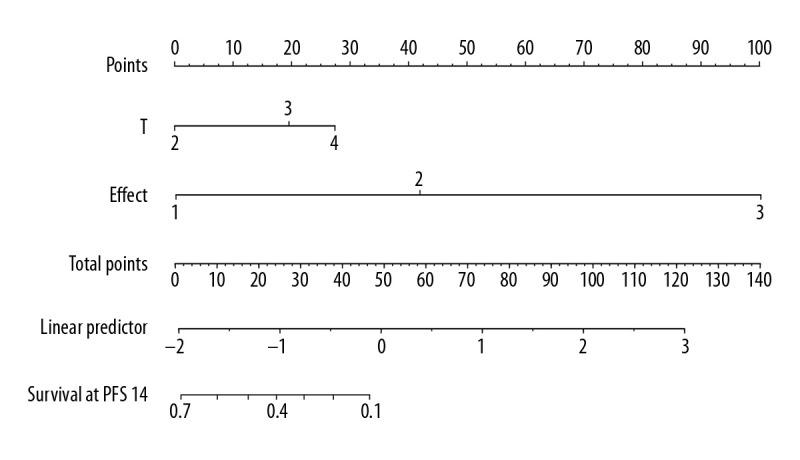
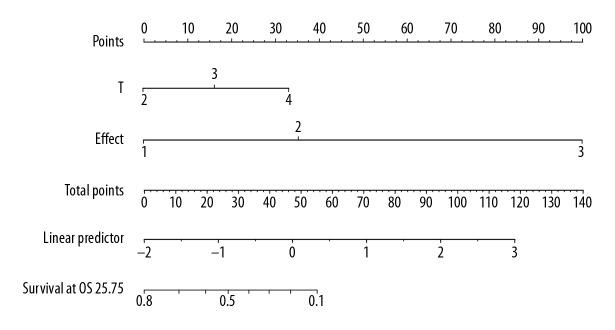
BACKGROUND Esophageal cancer is a common gastrointestinal malignancy in China. We evaluated the efficacy and safety of adding Apatinib to concurrent chemoradiotherapy in patients with locally advanced esophageal squamous cell carcinoma. MATERIAL AND METHODS In this single-center retrospective study, we compared short-term efficacy, long-term efficacy, and adverse events between patients who received Apatinib and concurrent chemoradiotherapy (Apatinib group), and those who received only concurrent chemoradiotherapy (CCRT group). RESULTS Sixty-five patients with stage II and III esophageal squamous cell carcinoma were enrolled (31 in the Apatinib group, 34 in the CCRT group). After treatment, the therapy response rate (the sum of the complete and partial remission rates) was significantly higher in the Apatinib group than in the CCRT group (P=0.045); the complete remission rate was particularly higher in the Apatinib group. Median progression-free survival in the Apatinib group (12 months) was higher than that of the CCRT group (7 months), and the 1- and 2-year progression-free survival rates were significantly higher in the Apatinib group than in the CCRT group (47.0% vs. 30.3% and 20.2% vs. 12.1%, respectively; P=0.040). The main adverse effects of Apatinib treatment were elevated blood pressure, proteinuria, hand-foot syndrome, fatigue, and oral mucositis, all of which were level 1-2. Cox multivariate regression analysis indicated T stage and short-term efficacy were independent prognostic factors for overall and progression-free survival. CONCLUSIONS For patients with locally advanced esophageal squamous cell carcinoma, combining Apatinib with concurrent chemoradiotherapy can improve patient survival and significantly prolong progression-free survival, with tolerable adverse reactions.
背景 食管癌是中国常见的胃肠道恶性肿瘤。我们评估了在局部晚期食管鳞状细胞癌患者中,将阿帕替尼添加到同步放化疗中的疗效和安全性。
材料与方法 在这项单中心回顾性研究中,我们比较了接受阿帕替尼与同步放化疗的患者(阿帕替尼组)和仅接受同步放化疗的患者(CCRT组)之间的短期疗效、长期疗效和不良事件。
结果 纳入了65例II期和III期食管鳞状细胞癌患者(阿帕替尼组31例,CCRT组34例)。治疗后,阿帕替尼组的治疗反应率(完全缓解率和部分缓解率之和)显著高于CCRT组(P=0.045);阿帕替尼组的完全缓解率尤其更高。阿帕替尼组的中位无进展生存期(12个月)高于CCRT组(7个月),且阿帕替尼组的1年和2年无进展生存率显著高于CCRT组(分别为47.0%对30.3%和20.2%对12.1%;P=0.040)。阿帕替尼治疗的主要不良反应为血压升高、蛋白尿、手足综合征、疲劳和口腔黏膜炎,均为1-2级。Cox多因素回归分析表明,T分期和短期疗效是总生存期和无进展生存期的独立预后因素。
结论 对于局部晚期食管鳞状细胞癌患者,将阿帕替尼与同步放化疗联合应用可提高患者生存率并显著延长无进展生存期,且不良反应可耐受。


 Zotero 插件