
TLR4 信号选择性地直接促进小鼠迷走传入纤维中 CGRP 的释放。
TLR4 Signaling Selectively and Directly Promotes CGRP Release from Vagal Afferents in the Mouse.
机构信息
Center for Hypothalamic Research and Department of Internal Medicine, The University of Texas Southwestern Medical Center, Dallas, TX 75390.
Neuroimmunology and Behavior Laboratory, Department of Neuroscience, School of Behavioral and Brain Sciences, and Center for Advanced Pain Studies, University of Texas at Dallas, Richardson, TX 75081.
出版信息
eNeuro. 2021 Jan 21;8(1). doi: 10.1523/ENEURO.0254-20.2020. Print 2021 Jan-Feb.
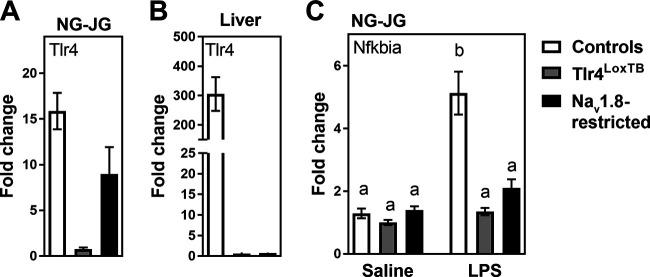
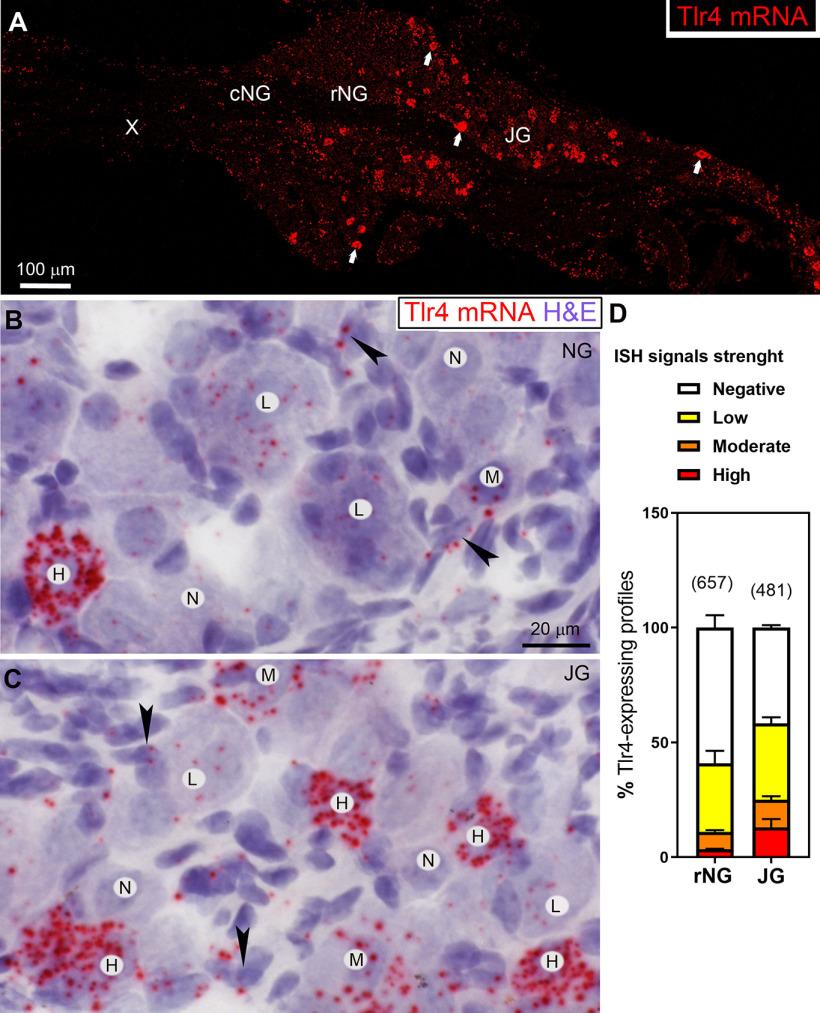
There has been a long-standing debate regarding the role of peripheral afferents in mediating rapid-onset anorexia among other responses elicited by peripheral inflammatory insults. Thus, the current study assessed the sufficiency of peripheral afferents expressing toll-like receptor 4 (TLR4) to the initiation of the anorexia caused by peripheral bacterial lipopolysaccharide (LPS). We generated a Tlr4 null (Tlr4) mouse in which Tlr4 expression is globally disrupted by a loxP-flanked transcription blocking (TB) cassette. This novel mouse model allowed us to restore the endogenous TLR4 expression in specific cell types. Using Zp3-Cre and Na1.8-Cre mice, we produced mice that express TLR4 in all cells (Tlr4 X Zp3-Cre) and in peripheral afferents (Tlr4 X Na1.8-Cre), respectively. We validated the Tlr4 mice, which were phenotypically identical to previously reported global TLR4 knock-out mice. Contrary to our expectations, the administration of LPS did not cause rapid-onset anorexia in mice with Na1.8-restricted TLR4. The later result prompted us to identify Tlr4-expressing vagal afferents using hybridization (ISH). , we found that Tlr4 mRNA was primarily enriched in vagal Na1.8 afferents located in the jugular ganglion that co-expressed calcitonin gene-related peptide (CGRP). , the application of LPS to cultured Na1.8-restricted TLR4 afferents was sufficient to stimulate the release of CGRP. In summary, we demonstrated using a new mouse model that vagally-expressed TLR4 is selectively involved in stimulating the release of CGRP but not in causing anorexia.
外周传入在介导外周炎症损伤引起的快速发作性厌食等反应方面的作用一直存在争议。因此,本研究评估了表达 Toll 样受体 4(TLR4)的外周传入在引发外周细菌脂多糖(LPS)引起的厌食中的充分性。我们生成了一种 Tlr4 缺失(Tlr4)小鼠,其中 Tlr4 表达通过loxP 侧翼转录阻断(TB)盒全局破坏。这种新型小鼠模型使我们能够在特定细胞类型中恢复内源性 TLR4 表达。使用 Zp3-Cre 和 Na1.8-Cre 小鼠,我们分别产生了在所有细胞(Tlr4 X Zp3-Cre)和外周传入(Tlr4 X Na1.8-Cre)中表达 TLR4 的小鼠。我们验证了 Tlr4 小鼠,其表型与先前报道的全局 TLR4 敲除小鼠相同。出乎意料的是,LPS 的给药并没有引起 Na1.8 限制的 TLR4 小鼠快速发作性厌食。这一结果促使我们使用杂交(ISH)来鉴定表达 TLR4 的迷走传入。结果表明,Tlr4 mRNA 主要富集在位于颈静脉神经节的迷走 Na1.8 传入中,这些传入共同表达降钙素基因相关肽(CGRP)。此外,将 LPS 应用于培养的 Na1.8 限制的 TLR4 传入足以刺激 CGRP 的释放。总之,我们使用新的小鼠模型证明,迷走神经表达的 TLR4 选择性参与刺激 CGRP 的释放,但不引起厌食。





 Zotero 插件