
JmjC-KDMs KDM3A 和 KDM6B 在低氧条件下调节食管鳞癌细胞的放射抵抗性。
JmjC-KDMs KDM3A and KDM6B modulate radioresistance under hypoxic conditions in esophageal squamous cell carcinoma.
机构信息
Cancer Biology & Epigenetics Group - Research Center, Portuguese Oncology Institute of Porto (CI-IPOP), Porto, Portugal.
Medical Physics, Radiobiology and Radiation Protection Group - Research Center, Portuguese Oncology Institute of Porto (CI-IPOP), Porto, Portugal.
出版信息
Cell Death Dis. 2020 Dec 14;11(12):1068. doi: 10.1038/s41419-020-03279-y.
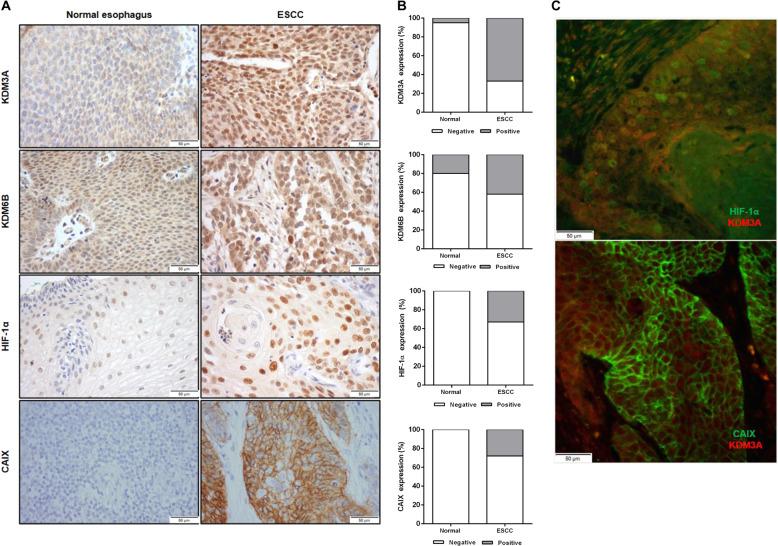
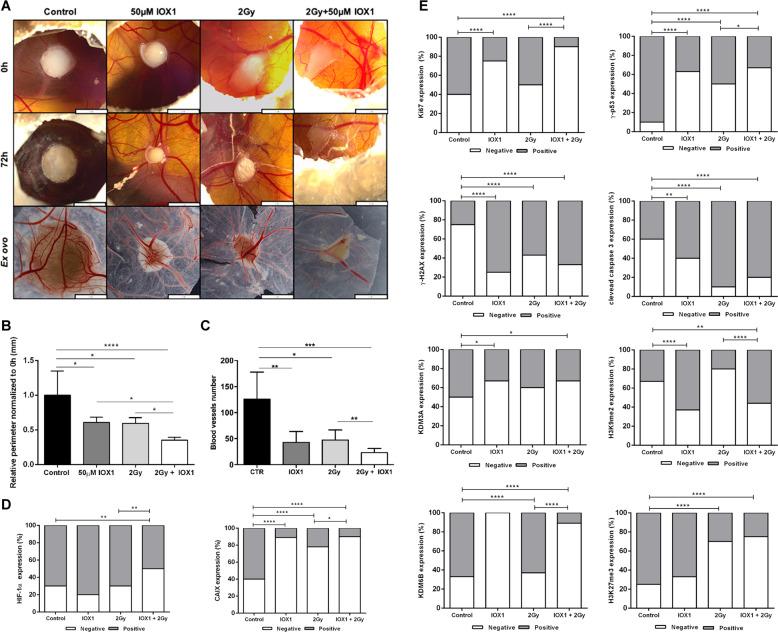
Esophageal squamous cell carcinoma (ESCC), the most frequent esophageal cancer (EC) subtype, entails dismal prognosis. Hypoxia, a common feature of advanced ESCC, is involved in resistance to radiotherapy (RT). RT response in hypoxia might be modulated through epigenetic mechanisms, constituting novel targets to improve patient outcome. Post-translational methylation in histone can be partially modulated by histone lysine demethylases (KDMs), which specifically removes methyl groups in certain lysine residues. KDMs deregulation was associated with tumor aggressiveness and therapy failure. Thus, we sought to unveil the role of Jumonji C domain histone lysine demethylases (JmjC-KDMs) in ESCC radioresistance acquisition. The effectiveness of RT upon ESCC cells under hypoxic conditions was assessed by colony formation assay. KDM3A/KDM6B expression, and respective H3K9me2 and H3K27me3 target marks, were evaluated by RT-qPCR, Western blot, and immunofluorescence. Effect of JmjC-KDM inhibitor IOX1, as well as KDM3A knockdown, in in vitro functional cell behavior and RT response was assessed in ESCC under hypoxic conditions. In vivo effect of combined IOX1 and ionizing radiation treatment was evaluated in ESCC cells using CAM assay. KDM3A, KDM6B, HIF-1α, and CAIX immunoexpression was assessed in primary ESCC and normal esophagus. Herein, we found that hypoxia promoted ESCC radioresistance through increased KDM3A/KDM6B expression, enhancing cell survival and migration and decreasing DNA damage and apoptosis, in vitro. Exposure to IOX1 reverted these features, increasing ESCC radiosensitivity and decreasing ESCC microtumors size, in vivo. KDM3A was upregulated in ESCC tissues compared to the normal esophagus, associating and colocalizing with hypoxic markers (HIF-1α and CAIX). Therefore, KDM3A upregulation in ESCC cell lines and primary tumors associated with hypoxia, playing a critical role in EC aggressiveness and radioresistance. KDM3A targeting, concomitant with conventional RT, constitutes a promising strategy to improve ESCC patients' survival.
食管鳞状细胞癌(ESCC)是最常见的食管癌(EC)亚型,预后不良。缺氧是晚期 ESCC 的常见特征,与放疗(RT)抵抗有关。通过表观遗传机制可以调节 RT 反应中的缺氧,为改善患者预后提供新的靶点。组蛋白翻译后甲基化可以部分通过组蛋白赖氨酸去甲基酶(KDM)来调节,KDM 专门去除某些赖氨酸残基上的甲基基团。KDM 失调与肿瘤侵袭性和治疗失败有关。因此,我们试图揭示 Jumonji C 结构域组蛋白赖氨酸去甲基酶(JmjC-KDMs)在 ESCC 获得放射抗性中的作用。通过集落形成实验评估缺氧条件下 ESCC 细胞接受 RT 的效果。通过 RT-qPCR、Western blot 和免疫荧光评估 KDM3A/KDM6B 表达及其相应的 H3K9me2 和 H3K27me3 靶标标记。在 ESCC 中,在缺氧条件下评估 JmjC-KDM 抑制剂 IOX1 以及 KDM3A 敲低对体外细胞功能和 RT 反应的影响。通过 CAM 实验评估 IOX1 和电离辐射联合治疗在 ESCC 细胞中的体内效果。在原发性 ESCC 和正常食管中评估 KDM3A、KDM6B、HIF-1α 和 CAIX 的免疫表达。在此,我们发现缺氧通过增加 KDM3A/KDM6B 表达促进 ESCC 放射抵抗,从而增强细胞存活和迁移,降低 DNA 损伤和细胞凋亡,在体外。暴露于 IOX1 可逆转这些特征,增加 ESCC 的放射敏感性并减少体内 ESCC 微肿瘤的大小。与正常食管相比,KDM3A 在 ESCC 组织中上调,与缺氧标志物(HIF-1α 和 CAIX)相关和共定位。因此,KDM3A 在 ESCC 细胞系和原发性肿瘤中的上调与缺氧相关,在 EC 的侵袭性和放射抵抗中起关键作用。KDM3A 的靶向治疗与常规 RT 联合使用可能是改善 ESCC 患者生存的一种有前途的策略。


 Zotero 插件