
宏基因组下一代测序对呼吸机相关性肺炎患者支气管肺泡灌洗液体内病原体检测的诊断价值
Diagnostic Value of Metagenomic Next-Generation Sequencing for the Detection of Pathogens in Bronchoalveolar Lavage Fluid in Ventilator-Associated Pneumonia Patients.
作者信息
Fang Xiaowei, Mei Qing, Fan Xiaoqin, Zhu Chunyan, Yang Tianjun, Zhang Lei, Geng Shike, Pan Aijun
机构信息
Department of Intensive Care Unit, The First Affiliated Hospital of USTC, Division of Life Science and Medicine, University of Science and Technology of China, Hefei, China.
Department of Intensive Care Unit, The Affiliated Provincial Hospital of Anhui Medical University, Hefei, China.
出版信息
Front Microbiol. 2020 Dec 1;11:599756. doi: 10.3389/fmicb.2020.599756. eCollection 2020.
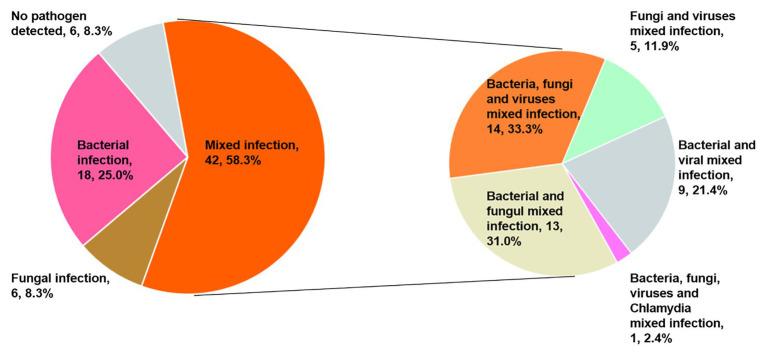
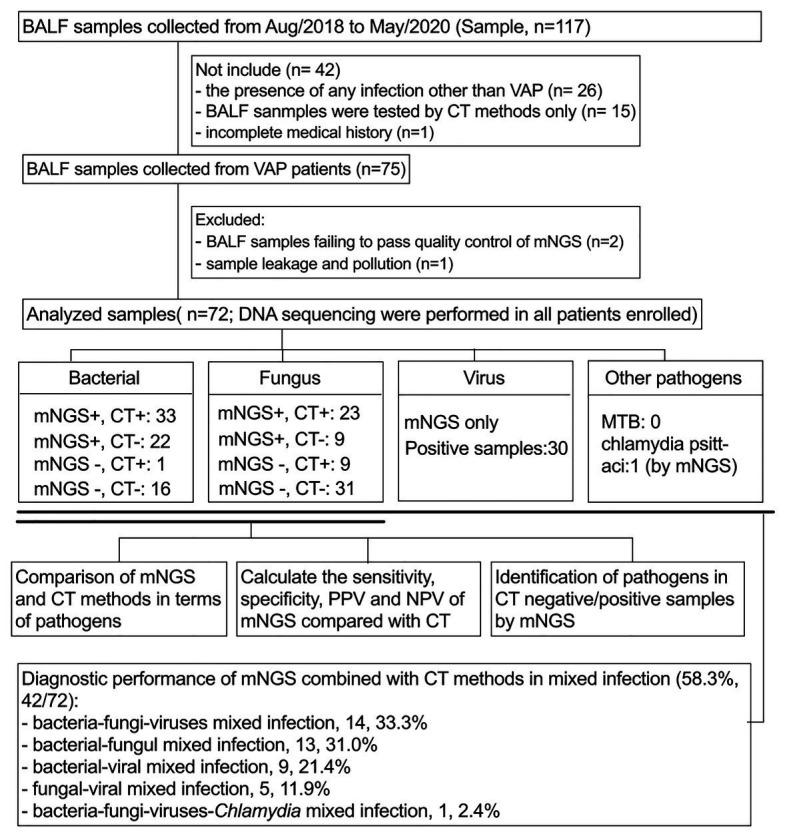
: To evaluate the diagnostic performance of metagenomic next-generation sequencing (mNGS) using bronchoalveolar lavage fluid (BALF) in patients with ventilator-associated pneumonia (VAP). : BALF samples of 72 patients with VAP were collected from August 2018 to May 2020. The diagnostic performance of conventional testing (CT) and mNGS methods were compared based on bacterial and fungal examinations. The diagnostic value of mNGS for viral and mixed infections was also analyzed. : The percentage of mNGS positive samples was significantly higher than that estimated by the CT method [odds ratio (OR), 4.33; 95% confidence interval (CI), 1.78-10.53; < 0.001]. The sensitivity and specificity of mNGS for bacterial detection were 97.1% (95% CI, 93.2-101.0%) and 42.1% (95 CI, 30.7-53.5%), respectively, whereas the positive predictive value (PPV) and the negative predictive value (NPV) were 60.0% (95% CI, 48.7-71.3%) and 94.1% (95% CI, 88.7-99.6%), respectively. A total of 38 samples were negative for bacterial detection as determined by the CT method, while 22 samples were positive as shown by the mNGS method. Conflicting results were obtained for three samples between the two methods of bacterial detection. However, no significant differences were noted between the mNGS and CT methods (OR, 1.42; 95% CI, 0.68-2.97; = 0.46) with regard to fungal infections. The sensitivity and specificity of mNGS were 71.9% (95% CI, 61.5-82.3%) and 77.5% (95% CI, 67.9-87.1%), respectively. mNGS exhibited a PPV of 71.9% (95% CI, 61.5-82.3%) and an NPV of 77.5% (95% CI, 67.9-87.1%). A total of 9 out of 40 samples were found positive for fungi according to mNGS, whereas the CT method failed to present positive results in these samples. The mNGS and CT methods produced conflicting results with regard to fungal detection of the two samples. A total of 30 patients were virus-positive using mNGS. Furthermore, 42 patients (58.3%) were identified as pulmonary mixed infection cases. : mNGS detection using BALF improved the sensitivity and specificity of bacterial identification in patients who developed VAP. In addition, mNGS exhibited apparent advantages in detecting viruses and identifying mixed infections.
评估宏基因组下一代测序(mNGS)技术利用支气管肺泡灌洗术(BALF)对呼吸机相关性肺炎(VAP)患者的诊断效能。收集2018年8月至2020年5月期间72例VAP患者的BALF样本。基于细菌和真菌检测,比较传统检测(CT)和mNGS方法的诊断效能。同时分析mNGS对病毒和混合感染的诊断价值。mNGS检测呈阳性的样本比例显著高于CT方法估计的比例[优势比(OR)为4.33;95%置信区间(CI)为1.78 - 10.53;P < 0.001]。mNGS检测细菌的敏感性和特异性分别为97.1%(95%CI为93.2 - 101.0%)和42.1%(95%CI为30.7 - 53.5%),而阳性预测值(PPV)和阴性预测值(NPV)分别为60.0%(95%CI为48.7 - 71.3%)和94.1%(95%CI为88.7 - 99.6%)。CT方法检测细菌呈阴性的38个样本中,mNGS方法检测出22个样本呈阳性。两种细菌检测方法对3个样本得出了相互矛盾的结果。然而,在真菌感染方面,mNGS和CT方法之间未观察到显著差异(OR为1.42;95%CI为0.68 - 2.97;P = 0.46)。mNGS检测真菌的敏感性和特异性分别为71.9%(95%CI为61.5 - 82.3%)和77.5%(95%CI为67.9 - 87.1%)。mNGS的PPV为71.9%(95%CI为61.5 - 82.3%),NPV为77.5%(95%CI为67.9 - 87.1%)。mNGS检测发现40个样本中有9个真菌呈阳性,而CT方法在这些样本中未呈现阳性结果。两种方法对2个样本的真菌检测结果相互矛盾。mNGS检测出30例患者病毒呈阳性。此外,42例患者(58.3%)被鉴定为肺部混合感染病例。利用BALF进行mNGS检测提高了VAP患者细菌鉴定的敏感性和特异性。此外,mNGS在检测病毒和鉴定混合感染方面具有明显优势。


 Zotero 插件