
宏基因组下一代测序在支气管肺泡灌洗液感染性病原体诊断中的应用。
Application of Metagenomic Next-Generation Sequencing in the Diagnosis of Pulmonary Infectious Pathogens From Bronchoalveolar Lavage Samples.
机构信息
Department of Respiratory and Critical Care Medicine, The First Affiliated Hospital of Xi'an Jiaotong University, Xi'an, China.
Ministry of Education Key Lab for Intelligent, Networks and Networks Security, School of Electronics and Information Engineering, Xi'an Jiaotong University, Xi'an, China.
出版信息
Front Cell Infect Microbiol. 2021 Mar 11;11:541092. doi: 10.3389/fcimb.2021.541092. eCollection 2021.
BACKGROUND
Metagenomic next-generation sequencing (mNGS) is a powerful method for pathogen detection. In this study, we assessed the value of mNGS for bronchoalveolar lavage (BAL) samples in the diagnosis of pulmonary infections.
METHODS
From February 2018 to April 2019, BAL samples were collected from 235 patients with suspected pulmonary infections. mNGS and microbial culture were performed to evaluate the effectiveness of mNGS in pulmonary infection diagnosis.
RESULTS
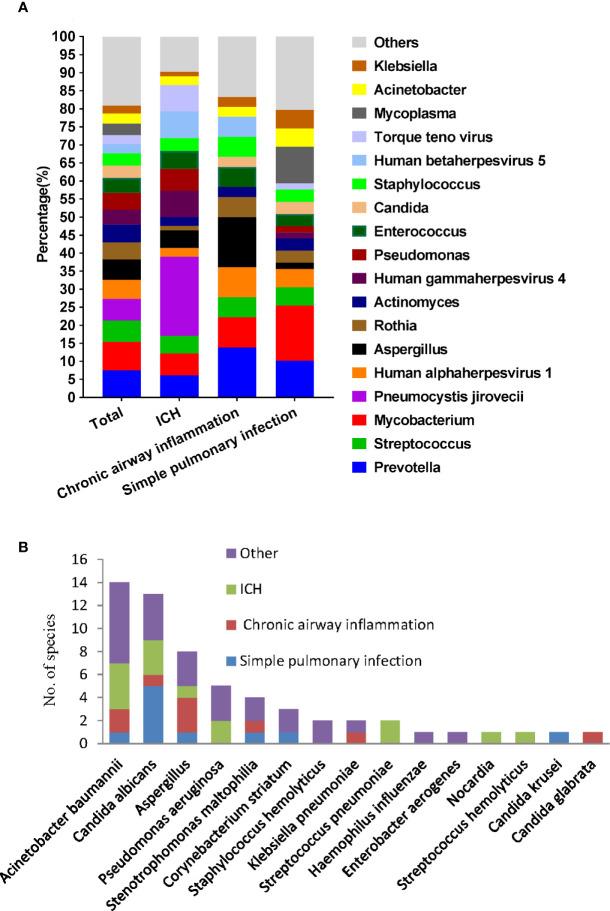
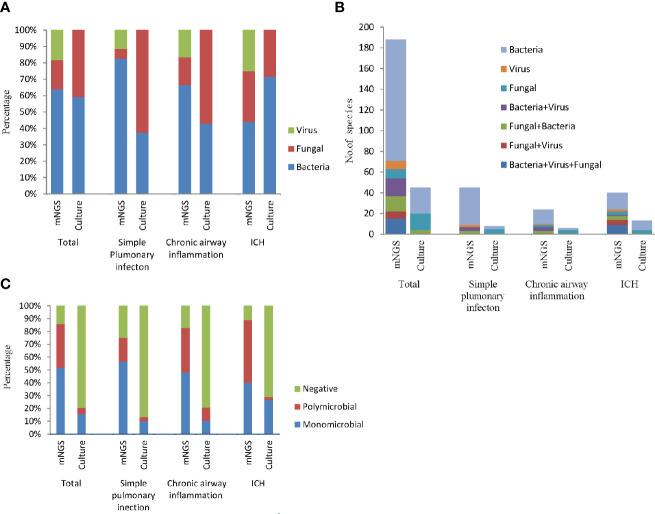
We employed mNGS to evaluate the alpha diversity, results suggesting that patients with confirmed pathogens had a lower microbial diversity index compared to that of patients with uncertain pathogens. For the patients admitted to the respiratory intensive care unit (RICU) or on a ventilator, they experienced a lower diversity index than that of the patients in the general ward or not on a ventilator. In addition, mNGS of BAL had a diagnostic sensitivity of 88.89% and a specificity of 14.86% in pulmonary infection, with 21.16% positive predictive value (PPV) and 83.87% negative predictive value (NPV). When rare pathogens were excluded, the sensitivity of mNGS decreased to 73.33%, and the specificity increased to 41.71%. For patients in the simple pulmonary infection group and the immunocompromised group, the main infection types were bacterial infection (58.33%) and mixed-infection (43.18%). Furthermore, mNGS had an advantage over culture in describing polymicrobial ecosystem, demonstrating the microbial distribution and the dominant strains of the respiratory tract in patients with different underlying diseases.
CONCLUSIONS
The study indicated that mNGS of BAL samples could provide more accurate diagnostic information in pulmonary infections and demonstrate the changes of respiratory microbiome in different underlying diseases. This method might play an important role in the clinical use of antimicrobial agents in the future.
背景
宏基因组下一代测序(mNGS)是一种强大的病原体检测方法。本研究评估了 mNGS 对肺泡灌洗液(BAL)样本在肺部感染诊断中的价值。
方法
从 2018 年 2 月至 2019 年 4 月,共采集 235 例疑似肺部感染患者的 BAL 样本。进行 mNGS 和微生物培养,以评估 mNGS 在肺部感染诊断中的有效性。
结果
我们采用 mNGS 评估了 alpha 多样性,结果表明,有明确病原体的患者的微生物多样性指数低于有不确定病原体的患者。对于入住呼吸重症监护病房(RICU)或使用呼吸机的患者,其多样性指数低于普通病房或未使用呼吸机的患者。此外,BAL 的 mNGS 在肺部感染中的诊断敏感性为 88.89%,特异性为 14.86%,阳性预测值(PPV)为 21.16%,阴性预测值(NPV)为 83.87%。当排除稀有病原体时,mNGS 的敏感性降低至 73.33%,特异性增加至 41.71%。在单纯肺部感染组和免疫抑制组患者中,主要感染类型为细菌感染(58.33%)和混合感染(43.18%)。此外,mNGS 比培养在描述多微生物生态系统方面具有优势,显示了不同基础疾病患者呼吸道的微生物分布和优势菌株。
结论
研究表明,BAL 样本的 mNGS 可为肺部感染提供更准确的诊断信息,并展示不同基础疾病患者呼吸微生物组的变化。该方法可能在未来对抗菌药物的临床应用中发挥重要作用。


 Zotero 插件