
目标靶向下一代测序与宏基因组下一代测序在先天性心脏病术后肺炎病原体鉴定中的比较:一项比较诊断准确性研究。
Comparison of targeted next-generation sequencing and metagenomic next-generation sequencing in the identification of pathogens in pneumonia after congenital heart surgery: a comparative diagnostic accuracy study.
机构信息
Department of Cardiac Surgery, College of Clinical Medicine for Obstetrics & Gynecology and Pediatrics, Fujian Medical University, Fujian Children's Hospital (Fujian Branch of Shanghai Children's Medical Center), Fuzhou, China.
College of Clinical Medicine for Obstetrics & Gynecology and Pediatrics, Fujian Medical University, Fujian Children's Hospital (Fujian Branch of Shanghai Children's Medical Center), Fuzhou, China.
出版信息
Ital J Pediatr. 2024 Sep 12;50(1):174. doi: 10.1186/s13052-024-01749-z.
BACKGROUND
This study aimed to compare targeted next-generation sequencing (tNGS) with metagenomic next-generation sequencing (mNGS) for pathogen detection in infants with severe postoperative pneumonia after congenital heart surgery.
METHODS
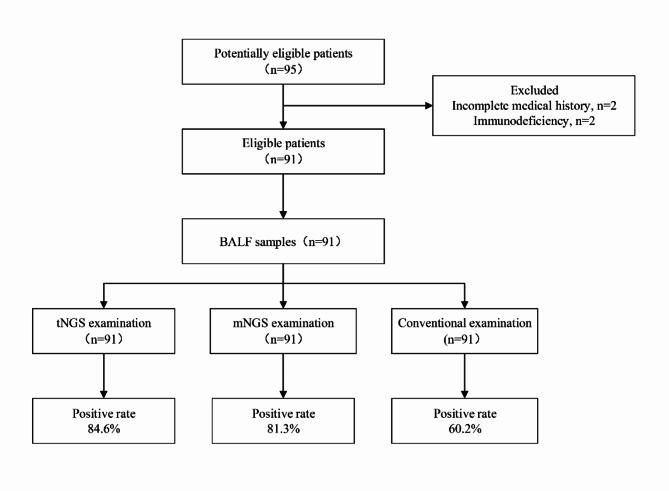
We conducted a retrospective observational study using data from the electronic medical record system of infants who developed severe pneumonia after surgery for congenital heart disease from August 2021 to August 2022. Infants were divided into tNGS and mNGS groups based on the pathogen detection methods. The primary outcome was the efficiency of pathogen detection, and the secondary outcomes were the timeliness and cost of each method.
RESULTS
In the study, 91 infants were included, with tNGS detecting pathogens in 84.6% (77/91) and mNGS in 81.3% (74/91) of cases (P = 0.55). No significant differences were found in sensitivity, specificity, PPA, and NPA between the two methods (P > 0.05). tNGS identified five strains with resistance genes, while mNGS detected one strain. Furthermore, tNGS had a faster detection time (12 vs. 24 h) and lower cost ($150 vs. $500) compared to mNGS.
CONCLUSION
tNGS offers similar sensitivity to mNGS but with greater efficiency and cost-effectiveness, making it a promising approach for respiratory pathogen detection.
背景
本研究旨在比较靶向下一代测序(tNGS)与宏基因组下一代测序(mNGS)在先天性心脏病手术后严重术后肺炎婴儿病原体检测中的应用。
方法
我们使用 2021 年 8 月至 2022 年 8 月先天性心脏病手术后发生严重肺炎的婴儿电子病历系统中的数据进行了回顾性观察性研究。根据病原体检测方法将婴儿分为 tNGS 和 mNGS 组。主要结局为病原体检测效率,次要结局为两种方法的及时性和成本。
结果
本研究共纳入 91 例婴儿,tNGS 检测出病原体的比例为 84.6%(77/91),mNGS 为 81.3%(74/91)(P=0.55)。两种方法的敏感性、特异性、PPA 和 NPA 无显著差异(P>0.05)。tNGS 鉴定出 5 株具有耐药基因的菌株,而 mNGS 检测出 1 株。此外,tNGS 的检测时间(12 小时 vs. 24 小时)更快,成本更低(150 美元 vs. 500 美元)。
结论
tNGS 与 mNGS 具有相似的敏感性,但具有更高的效率和成本效益,是一种有前途的呼吸道病原体检测方法。

 Zotero 插件