
膜附近的Anoplin、W-MreB和(KFF)K肽的构象变化。
Conformational Changes of Anoplin, W-MreB, and (KFF)K Peptides near the Membranes.
作者信息
Wojciechowska Monika, Miszkiewicz Joanna, Trylska Joanna
机构信息
Centre of New Technologies, University of Warsaw, Banacha 2c, 02-097 Warsaw, Poland.
College of Inter-Faculty Individual Studies in Mathematics and Natural Sciences, University of Warsaw, Banacha 2c, 02-097 Warsaw, Poland.
出版信息
Int J Mol Sci. 2020 Dec 18;21(24):9672. doi: 10.3390/ijms21249672.
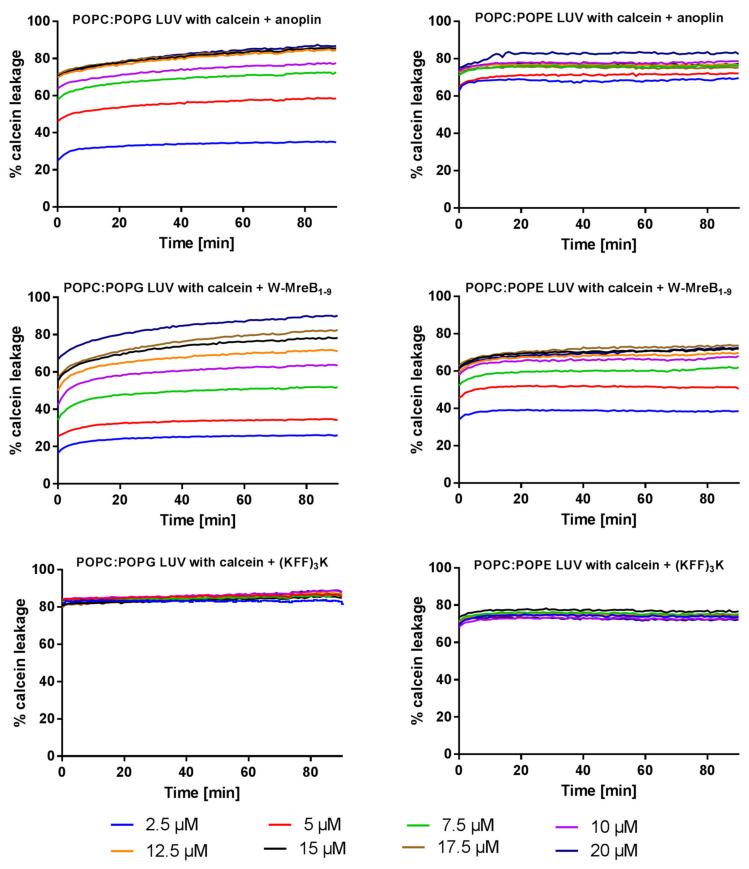
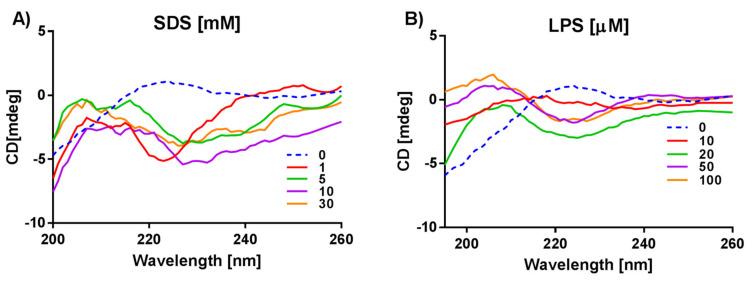
Many peptides interact with biological membranes, but elucidating these interactions is challenging because cellular membranes are complex and peptides are structurally flexible. To contribute to understanding how the membrane-active peptides behave near the membranes, we investigated peptide structural changes in different lipid surroundings. We focused on two antimicrobial peptides, anoplin and W-MreB, and one cell-penetrating peptide, (KFF)K. Firstly, by using circular dichroism spectroscopy, we determined the secondary structures of these peptides when interacting with micelles, liposomes, lipopolysaccharides, and live bacteria. The peptides were disordered in the buffer, but anoplin and W-MreB displayed lipid-induced helicity. Yet, structural changes of the peptide depended on the composition and concentration of the membranes. Secondly, we quantified the destructive activity of peptides against liposomes by monitoring the release of a fluorescent dye (calcein) from the liposomes treated with peptides. We observed that only for anoplin and W-MreB calcein leakage from liposomes depended on the peptide concentration. Thirdly, bacterial growth inhibition assays showed that peptide conformational changes, evoked by the lipid environments, do not directly correlate with the antimicrobial activity of the peptides. However, understanding the relation between peptide structural properties, mechanisms of membrane disruption, and their biological activities can guide the design of membrane-active peptides.
许多肽与生物膜相互作用,但阐明这些相互作用具有挑战性,因为细胞膜复杂且肽在结构上具有灵活性。为了有助于理解膜活性肽在膜附近的行为,我们研究了不同脂质环境中肽的结构变化。我们重点研究了两种抗菌肽,即无翅蛋白和W-MreB,以及一种细胞穿透肽(KFF)K。首先,通过使用圆二色光谱法,我们确定了这些肽在与胶束、脂质体、脂多糖和活细菌相互作用时的二级结构。这些肽在缓冲液中呈无序状态,但无翅蛋白和W-MreB表现出脂质诱导的螺旋结构。然而,肽的结构变化取决于膜的组成和浓度。其次,我们通过监测用肽处理的脂质体中荧光染料(钙黄绿素)的释放来量化肽对脂质体的破坏活性。我们观察到,只有无翅蛋白和W-MreB能使脂质体中的钙黄绿素泄漏量取决于肽的浓度。第三,细菌生长抑制试验表明,由脂质环境引起的肽构象变化与肽的抗菌活性没有直接关联。然而,了解肽的结构特性、膜破坏机制及其生物活性之间的关系可以指导膜活性肽的设计。


 Zotero 插件