
全面分析 NAC 转录因子家族揭示了珍珠粟(Pennisetum glaucum)对干旱和盐胁迫的响应。
Comprehensive analysis of NAC transcription factor family uncovers drought and salinity stress response in pearl millet (Pennisetum glaucum).
机构信息
Asian Natural Environmental Science Center (ANESC), The University of Tokyo, Nishitokyo-shi, Tokyo, 188-0002, Japan.
Department of Pharmaceutical Sciences, Center for Pharmaceutical Research and Innovation, College of Pharmacy, University of Kentucky, Lexington, KY, USA.
出版信息
BMC Genomics. 2021 Jan 21;22(1):70. doi: 10.1186/s12864-021-07382-y.
BACKGROUND
Pearl millet (Pennisetum glaucum) is a cereal crop that possesses the ability to withstand drought, salinity and high temperature stresses. The NAC [NAM (No Apical Meristem), ATAF1 (Arabidopsis thaliana Activation Factor 1), and CUC2 (Cup-shaped Cotyledon)] transcription factor family is one of the largest transcription factor families in plants. NAC family members are known to regulate plant growth and abiotic stress response. Currently, no reports are available on the functions of the NAC family in pearl millet.
RESULTS
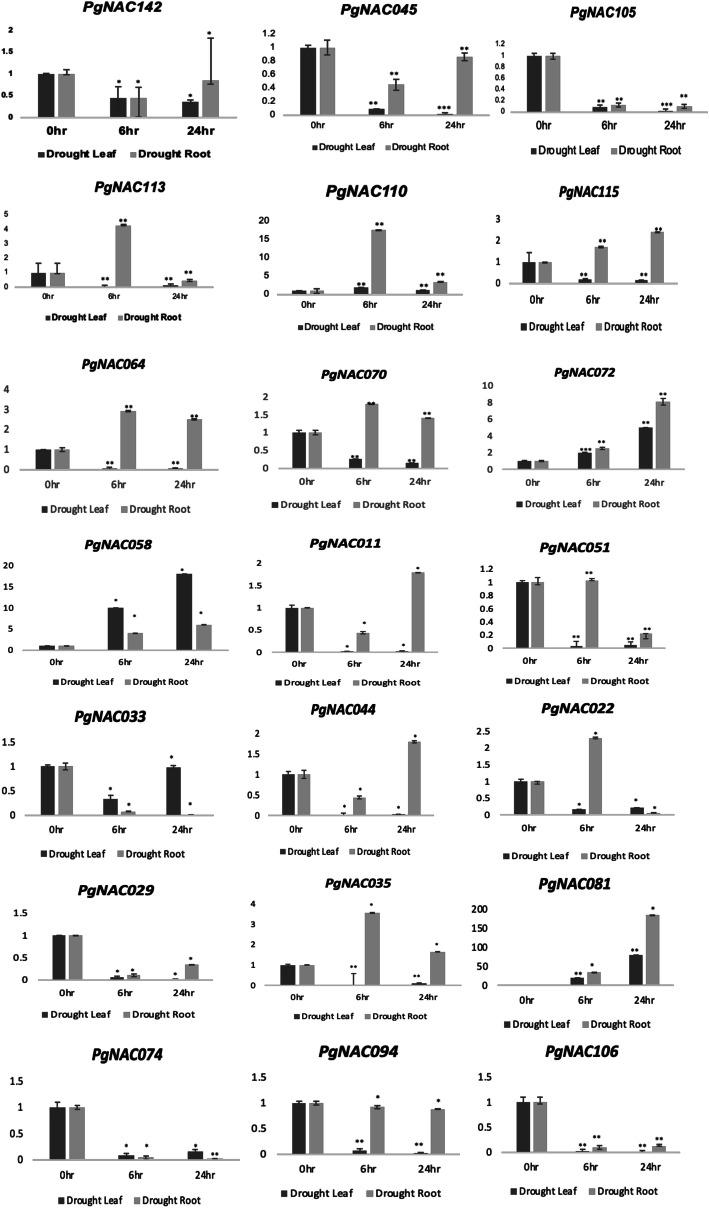
Our genome-wide analysis found 151 NAC transcription factor genes (PgNACs) in the pearl millet genome. Thirty-eight and 76 PgNACs were found to be segmental and dispersed duplicated respectively. Phylogenetic analysis divided these NAC transcription factors into 11 groups (A-K). Three PgNACs (- 073, - 29, and - 151) were found to be membrane-associated transcription factors. Seventeen other conserved motifs were found in PgNACs. Based on the similarity of PgNACs to NAC proteins in other species, the functions of PgNACs were predicted. In total, 88 microRNA target sites were predicted in 59 PgNACs. A previously performed transcriptome analysis suggests that the expression of 30 and 42 PgNACs are affected by salinity stress and drought stress, respectively. The expression of 36 randomly selected PgNACs were examined by quantitative reverse transcription-PCR. Many of these genes showed diverse salt- and drought-responsive expression patterns in roots and leaves. These results confirm that PgNACs are potentially involved in regulating abiotic stress tolerance in pearl millet.
CONCLUSION
The pearl millet genome contains 151 NAC transcription factor genes that can be classified into 11 groups. Many of these genes are either upregulated or downregulated by either salinity or drought stress and may therefore contribute to establishing stress tolerance in pearl millet.
背景
珍珠粟(Pennisetum glaucum)是一种谷物作物,具有耐旱、耐盐和耐高温的能力。NAC[NAM(无顶分生组织)、ATAF1(拟南芥激活因子 1)和 CUC2(杯状子叶)]转录因子家族是植物中最大的转录因子家族之一。已知 NAC 家族成员调节植物生长和非生物胁迫反应。目前,尚无关于 NAC 家族在珍珠粟中的功能的报道。
结果
我们的全基因组分析在珍珠粟基因组中发现了 151 个 NAC 转录因子基因(PgNACs)。发现 38 个和 76 个 PgNAC 分别为片段和分散重复。系统发育分析将这些 NAC 转录因子分为 11 组(A-K)。发现三个 PgNAC(-073、-29 和-151)为膜相关转录因子。在 PgNAC 中发现了另外 17 个保守基序。根据 PgNAC 与其他物种 NAC 蛋白的相似性,预测了 PgNAC 的功能。总共预测了 59 个 PgNAC 中的 88 个 microRNA 靶位点。先前进行的转录组分析表明,30 个和 42 个 PgNAC 的表达分别受到盐胁迫和干旱胁迫的影响。通过定量逆转录-PCR 检查了 36 个随机选择的 PgNAC 的表达。许多这些基因在根和叶中表现出不同的盐和干旱响应表达模式。这些结果证实 PgNAC 可能参与调节珍珠粟的非生物胁迫耐受性。
结论
珍珠粟基因组包含 151 个 NAC 转录因子基因,可分为 11 组。许多这些基因要么受到盐胁迫要么受到干旱胁迫的上调或下调,因此可能有助于建立珍珠粟的胁迫耐受性。


 Zotero 插件