
长链非编码 RNA MEG3 通过调控 miR-21-5p/PTEN 轴抑制非小细胞肺癌细胞的迁移和侵袭。
Long non‑coding RNA MEG3 inhibits cell migration and invasion of non‑small cell lung cancer cells by regulating the miR‑21‑5p/PTEN axis.
机构信息
Department of Medical Oncology, The Third Affiliated Hospital of Kunming Medical University (Tumor Hospital of Yunnan Province), Kunming, Yunnan 650118, P.R. China.
Department of Pharmacy, The Third Affiliated Hospital of Kunming Medical University (Tumor Hospital of Yunnan Province), Kunming, Yunnan 650118, P.R. China.
出版信息
Mol Med Rep. 2021 Mar;23(3). doi: 10.3892/mmr.2021.11830. Epub 2021 Jan 26.
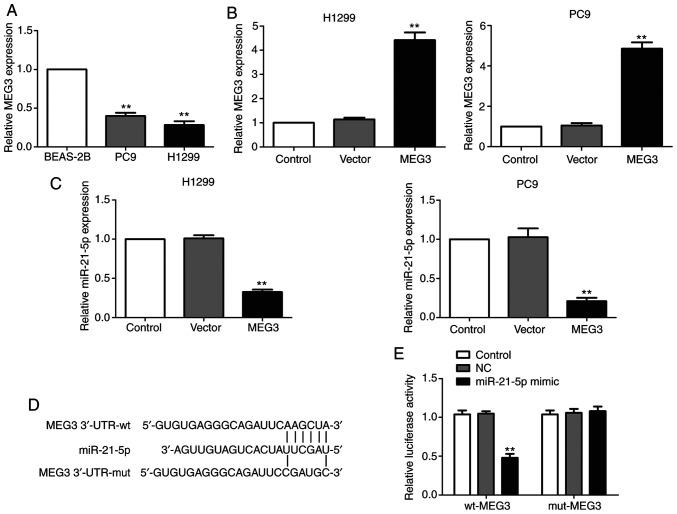
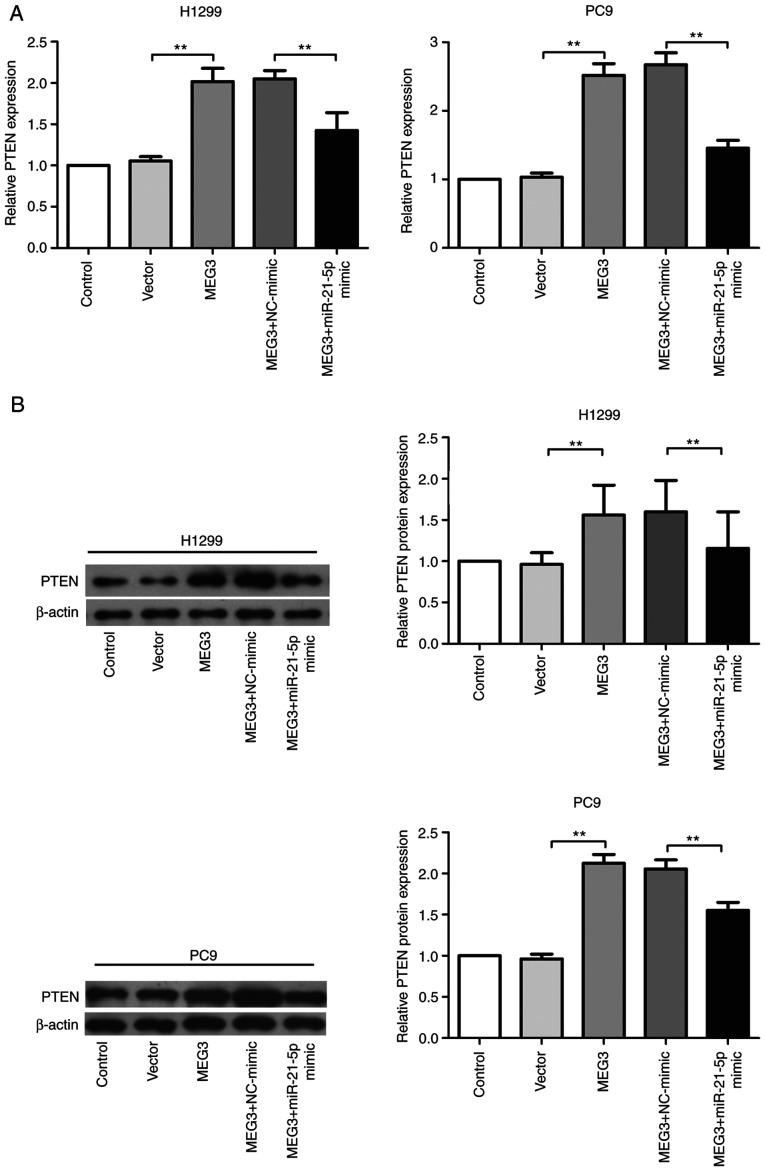
Long non‑coding RNAs (lncRNAs) are involved in the occurrence and progression of numerous types of cancer. The aim of the present study was to evaluate the effect of the lncRNA maternally expressed gene 3 (MEG3) on the migration and invasion of non‑small cell lung cancer (NSCLC) H1299 and PC9 cells. Reverse transcription‑quantitative (RT‑q)PCR analysis showed that MEG3 was downregulated in NSCLC PC9 and H1299 cells. Additionally, bioinformatics analysis indicated that MEG3 sponges microRNA (miR)‑21‑5p; miR‑21‑5p was predicted to target the phosphatase and tensin homolog (PTEN) 3'‑untranslated region sequence. MEG3 overexpression led to miR‑21‑5p suppression and PTEN upregulation in PC9 and H1299 cells, as detected by RT‑qPCR. Subsequently, western blot analysis confirmed that MEG3 overexpression enhanced PTEN expression levels and inhibited the PI3K/AKT signaling pathway in NSCLC cells. These effects were attenuated by miR‑21‑5p. Dual luciferase assay supported the sponging effect of MEG3 on miR‑21‑5p and validated the direct interaction between miR‑21‑5p and PTEN. Furthermore, Transwell assay demonstrated that MEG3 overexpression had an inhibitory effect on cell migration and invasion. MEG3 overexpression also mediated epithelial‑to‑mesenchymal transition by significantly enhancing E‑cadherin and decreasing N‑cadherin, Vimentin and matrix metalloprotein 9 expression levels in NSCLC cells, as indicated by western blot analysis. These changes were partially reversed by an miR‑21‑5p mimic. These results indicated that MEG3 acted as a tumor suppressor that inhibited NSCLC cell migration and invasion via sponging miR‑21‑5p, which, in turn, enhanced the expression levels of PTEN, in part via the PI3K/AKT signaling pathway. The results of the present study have suggested the potential of MEG3 as a novel therapeutic target for NSCLC treatment.
长链非编码 RNA(lncRNA)参与多种类型癌症的发生和发展。本研究旨在评估 lncRNA 母系表达基因 3(MEG3)对非小细胞肺癌(NSCLC)H1299 和 PC9 细胞迁移和侵袭的影响。逆转录-定量(RT-q)PCR 分析显示,MEG3 在 NSCLC PC9 和 H1299 细胞中下调。此外,生物信息学分析表明,MEG3 可作为 microRNA(miR)-21-5p 的海绵;miR-21-5p 被预测靶向磷酸酶和张力蛋白同源物(PTEN)3'非翻译区序列。MEG3 的过表达导致 miR-21-5p 在 PC9 和 H1299 细胞中的抑制和 PTEN 的上调,这可通过 RT-qPCR 检测到。随后,Western blot 分析证实,MEG3 的过表达增强了 NSCLC 细胞中 PTEN 的表达水平,并抑制了 PI3K/AKT 信号通路。这些作用被 miR-21-5p 减弱。双荧光素酶测定支持 MEG3 对 miR-21-5p 的海绵作用,并验证了 miR-21-5p 与 PTEN 之间的直接相互作用。此外,Transwell 测定表明,MEG3 的过表达对细胞迁移和侵袭具有抑制作用。MEG3 的过表达还通过显著增强 E-钙粘蛋白并降低 N-钙粘蛋白、波形蛋白和基质金属蛋白酶 9 的表达水平,介导上皮-间充质转化,这可通过 Western blot 分析证实,在 NSCLC 细胞中。这些变化被 miR-21-5p 模拟物部分逆转。这些结果表明,MEG3 作为一种肿瘤抑制因子,通过海绵 miR-21-5p 抑制 NSCLC 细胞的迁移和侵袭,从而增强 PTEN 的表达水平,部分通过 PI3K/AKT 信号通路。本研究的结果表明,MEG3 作为一种新型治疗靶点,可能为 NSCLC 的治疗提供新的思路。



 Zotero 插件