
口腔微生物群与胰腺癌
Oral microbiome and pancreatic cancer.
作者信息
Wei Ai-Lin, Li Mao, Li Guo-Qing, Wang Xuan, Hu Wei-Ming, Li Zhen-Lu, Yuan Jue, Liu Hong-Ying, Zhou Li-Li, Li Ka, Li Ang, Fu Mei Rosemary
机构信息
Department of Pancreatic Surgery, West China Hospital, Sichuan University, Chengdu 610000, Sichuan Province, China.
West China School of Public Health/West China fourth Hospital, Sichuan University, Chengdu 610000, Sichuan Province, China.
出版信息
World J Gastroenterol. 2020 Dec 28;26(48):7679-7692. doi: 10.3748/wjg.v26.i48.7679.
BACKGROUND
Microbiota profiles differ between patients with pancreatic cancer and healthy people, and understanding these differences may help in early detection of pancreatic cancer. Saliva sampling is an easy and cost-effective way to determine microbiota profiles compared to fecal and tissue sample collection.
AIM
To investigate the saliva microbiome distribution in patients with pancreatic adenocarcinoma (PDAC) and the role of oral microbiota profiles in detection and risk prediction of pancreatic cancer.
METHODS
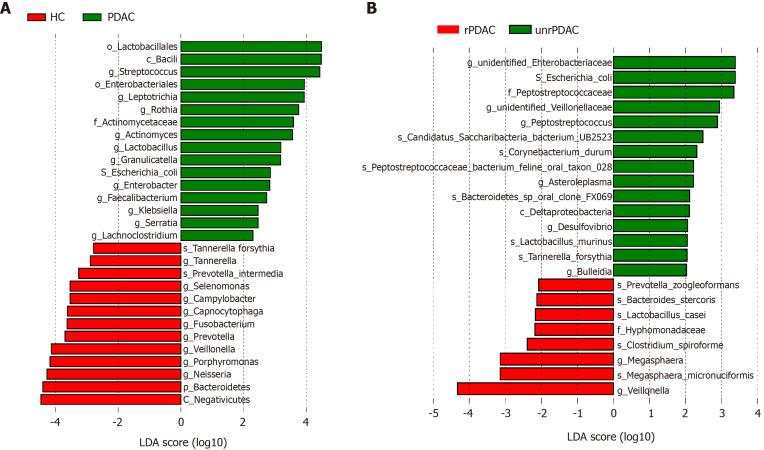
We conducted a prospective study of patients with pancreatic cancer ( = 41) and healthy individuals ( = 69). Bacterial taxa were identified by 16S ribosomal ribonucleic acid gene sequencing, and a linear discriminant analysis effect size algorithm was used to identify differences in taxa. Operational taxonomic unit values of all selected taxa were converted into a normalized Z-score, and logistic regressions were used to calculate risk prediction of pancreatic cancer.
RESULTS
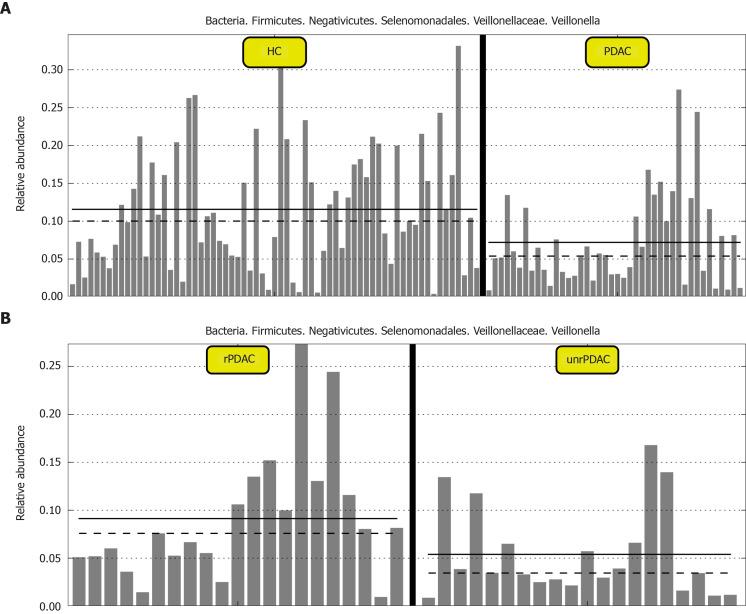
Compared with the healthy control group, carriage of and (z-score) was associated with a higher risk of PDAC [odds ratio (OR) = 5.344, 95% confidence interval (CI): 1.282-22.282, = 0.021 and OR = 6.886, 95%CI: 1.423-33.337, = 0.016, respectively]. and (z-score) were considered a protective microbe that decreased the risk of PDAC (OR = 0.187, 95%CI: 0.055-0.631, = 0.007 and OR = 0.309, 95%CI: 0.100-0.952, = 0.041, respectively). Among the patients with PDAC, patients reporting bloating have a higher abundance of ( = 0.039), ( = 0.024), and ( = 0.041); while patients reporting jaundice had a higher amount of ( = 0.008); patients reporting dark brown urine had a higher amount of ( = 0.035). Patients reporting diarrhea had a lower amount of and ( = 0.024 and = 0.034), and patients reporting vomiting had decreased ( = 0.036).
CONCLUSION
Saliva microbiome was able to distinguish patients with pancreatic cancer and healthy individuals. may be specific for patients living in Sichuan Province, southwest China. Symptomatic patients had different bacteria profiles than asymptomatic patients. Combined symptom and microbiome evaluation may help in the early detection of pancreatic cancer.
背景
胰腺癌患者与健康人的微生物群特征存在差异,了解这些差异可能有助于胰腺癌的早期检测。与粪便和组织样本采集相比,唾液采样是一种简单且经济高效的确定微生物群特征的方法。
目的
研究胰腺导管腺癌(PDAC)患者的唾液微生物组分布以及口腔微生物群特征在胰腺癌检测和风险预测中的作用。
方法
我们对胰腺癌患者(n = 41)和健康个体(n = 69)进行了一项前瞻性研究。通过16S核糖体核糖核酸基因测序鉴定细菌分类群,并使用线性判别分析效应大小算法来识别分类群的差异。将所有选定分类群的操作分类单元值转换为标准化Z分数,并使用逻辑回归计算胰腺癌的风险预测。
结果
与健康对照组相比,[具体细菌名称1]和[具体细菌名称2](Z分数)的携带与PDAC风险较高相关[比值比(OR)= 5.344,95%置信区间(CI):1.282 - 22.282,P = 0.021;OR = 6.886,95%CI:;1.423 - 33.337,P = 0.016]。[具体细菌名称3]和[具体细菌名称4](Z分数)被认为是降低PDAC风险的保护性微生物(OR = 0.187,95%CI:0.055 - 0.631,P = 0.007;OR =;0.309,95%CI:0.100 - 0.952,P = 0.041)。在PDAC患者中,报告腹胀的患者[具体细菌名称5](P = 0.039)、[具体细菌名称6](P = 0.024)和[具体细菌名称7](P = 0.041)丰度较高;报告黄疸的患者[具体细菌名称8]含量较高(P = 0.008);报告深棕色尿液的患者[具体细菌名称9]含量较高(P = 0.035)。报告腹泻的患者[具体细菌名称10]和[具体细菌名称11]含量较低(P = 0.024和P = 0.034),报告呕吐的患者[具体细菌名称12]减少(P = 0.036)。
结论
唾液微生物组能够区分胰腺癌患者和健康个体。[具体细菌名称13]可能对中国西南部四川省的患者具有特异性。有症状的患者与无症状的患者具有不同的细菌谱。症状与微生物组联合评估可能有助于胰腺癌的早期检测。
 Zotero 插件