
单分子显微镜揭示了活细胞中修复焦点的关键物理特征。
Single molecule microscopy reveals key physical features of repair foci in living cells.
机构信息
Institut Curie, PSL University, Sorbonne Université, CNRS, Nuclear Dynamics, Paris, France.
Laboratoire de Physique de l'Ecole Normale Supérieure, PSL University, CNRS, Sorbonne Université , Université de Paris, Paris, France.
出版信息
Elife. 2021 Feb 5;10:e60577. doi: 10.7554/eLife.60577.
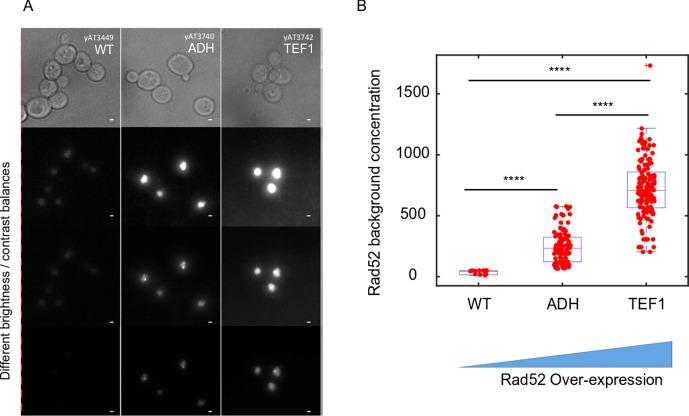
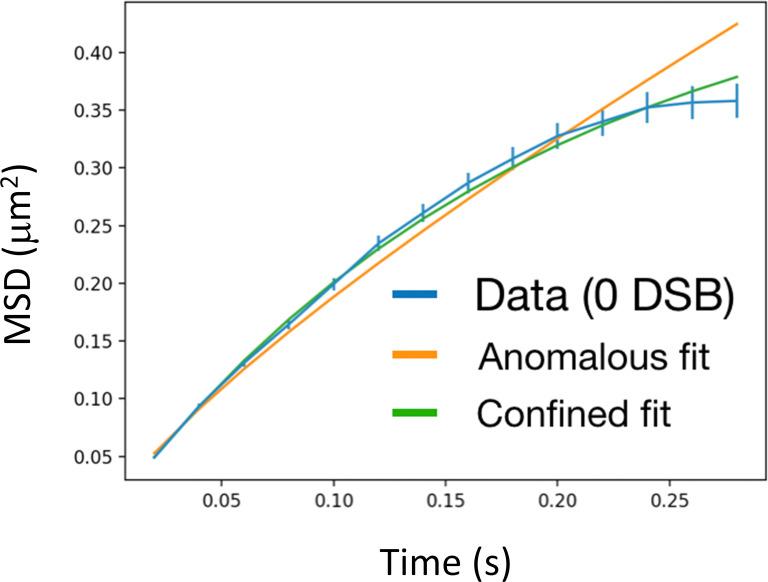
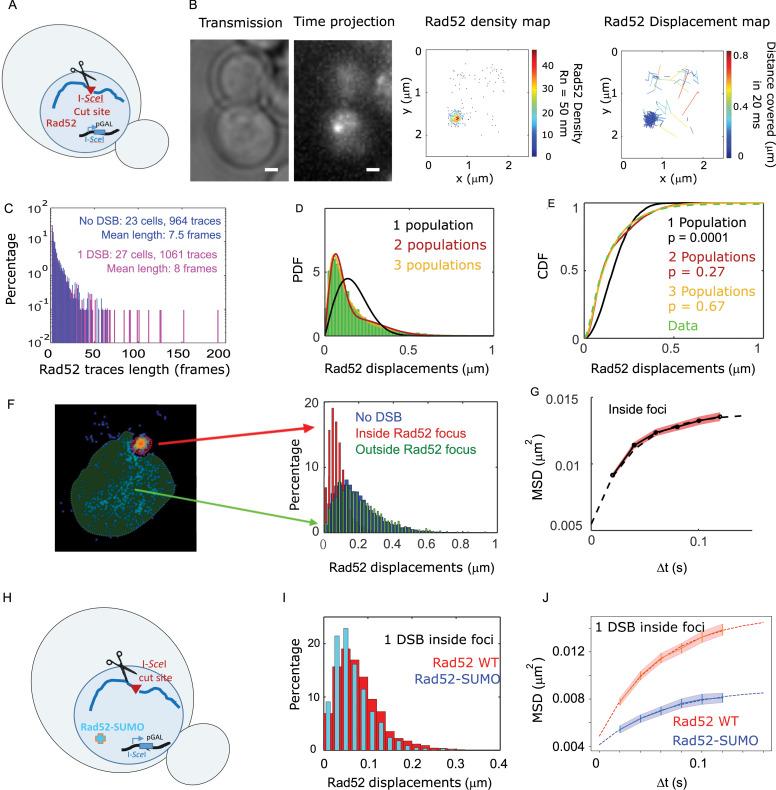
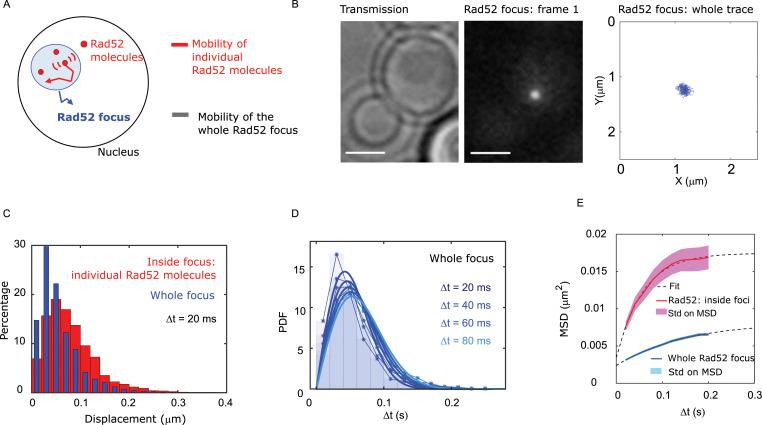
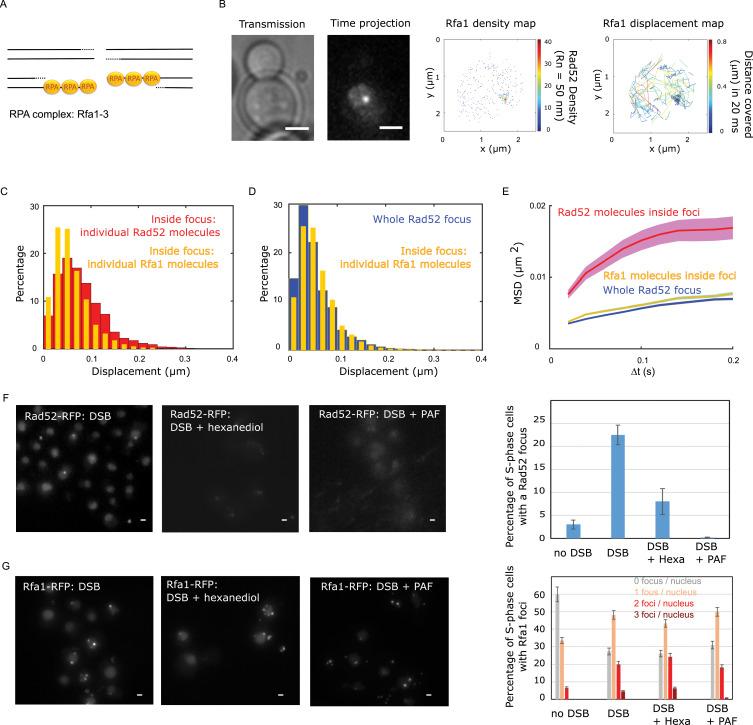
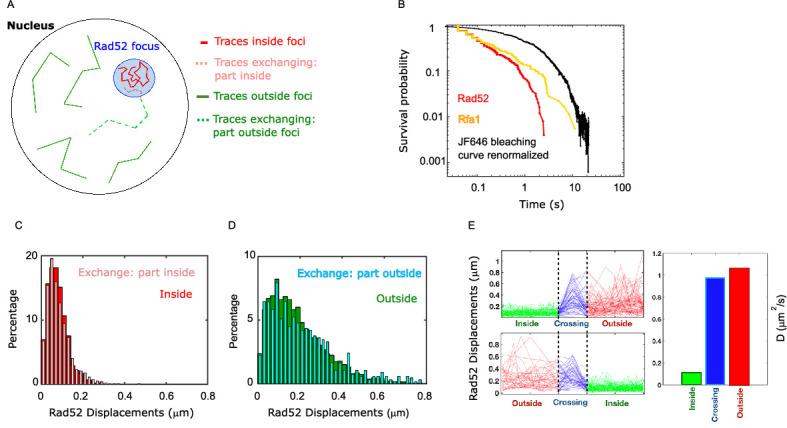
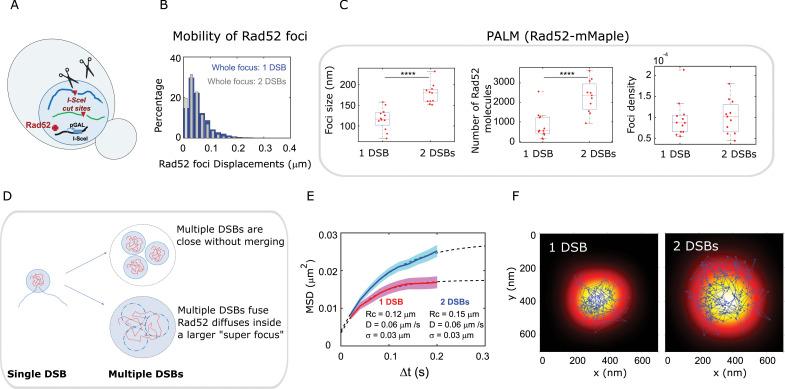
In response to double strand breaks (DSB), repair proteins accumulate at damaged sites, forming membrane-less sub-compartments or foci. Here we explored the physical nature of these foci, using single molecule microscopy in living cells. Rad52, the functional homolog of BRCA2 in yeast, accumulates at DSB sites and diffuses ~6 times faster within repair foci than the focus itself, exhibiting confined motion. The Rad52 confinement radius coincides with the focus size: foci resulting from 2 DSBs are twice larger in volume that the ones induced by a unique DSB and the Rad52 confinement radius scales accordingly. In contrast, molecules of the single strand binding protein Rfa1 follow anomalous diffusion similar to the focus itself or damaged chromatin. We conclude that while most Rfa1 molecules are bound to the ssDNA, Rad52 molecules are free to explore the entire focus reflecting the existence of a liquid droplet around damaged DNA.
针对双链断裂 (DSB),修复蛋白在受损部位聚集,形成无膜的亚区或焦点。在这里,我们使用活细胞中的单分子显微镜探索了这些焦点的物理性质。在酵母中,Rad52 是 BRCA2 的功能同源物,它在 DSB 位点聚集,并在修复焦点内扩散速度比焦点本身快约 6 倍,表现出受限的运动。Rad52 的限制半径与焦点大小一致:由 2 个 DSB 产生的焦点体积是由单个 DSB 产生的焦点的两倍大,而 Rad52 的限制半径相应地按比例缩放。相比之下,单链结合蛋白 Rfa1 的分子表现出类似于焦点本身或受损染色质的异常扩散。我们得出的结论是,虽然大多数 Rfa1 分子与 ssDNA 结合,但 Rad52 分子可以自由地探索整个焦点,这反映了受损 DNA 周围存在液滴。










 Zotero 插件