
大型大学医院可用的N95过滤式面罩呼吸器消毒方法的验证
Validation of N95 Filtering Facepiece Respirator Decontamination Methods Available at a Large University Hospital.
作者信息
Wigginton Krista R, Arts Peter J, Clack Herek L, Fitzsimmons William J, Gamba Mirko, Harrison Katherine R, LeBar William, Lauring Adam S, Li Lucinda, Roberts William W, Rockey Nicole C, Torreblanca Jania, Young Carol, Anderegg Loïc G, Cohn Amy M, Doyle John M, Meisenhelder Cole M, Raskin Lutgarde, Love Nancy G, Kaye Keith S
机构信息
Department of Civil and Environmental Engineering, University of Michigan, Ann Arbor, Michigan, USA.
Division of Infectious Diseases, Department of Internal Medicine, University of Michigan Health System, Ann Arbor, Michigan, USA.
出版信息
Open Forum Infect Dis. 2020 Dec 15;8(2):ofaa610. doi: 10.1093/ofid/ofaa610. eCollection 2021 Feb.
BACKGROUND
Due to unprecedented shortages in N95 filtering facepiece respirators, healthcare systems have explored N95 reprocessing. No single, full-scale reprocessing publication has reported an evaluation including multiple viruses, bacteria, and fungi along with respirator filtration and fit.
METHODS
We explored reprocessing methods using new 3M 1860 N95 respirators, including moist (50%-75% relative humidity [RH]) heat (80-82°C for 30 minutes), ethylene oxide (EtO), pulsed xenon UV-C (UV-PX), hydrogen peroxide gas plasma (HPGP), and hydrogen peroxide vapor (HPV). Respirator samples were analyzed using 4 viruses (MS2, phi6, influenza A virus [IAV], murine hepatitis virus [MHV)]), 3 bacteria (, , spores, and vegetative bacteria), and . Different application media were tested. Decontaminated respirators were evaluated for filtration integrity and fit.
RESULTS
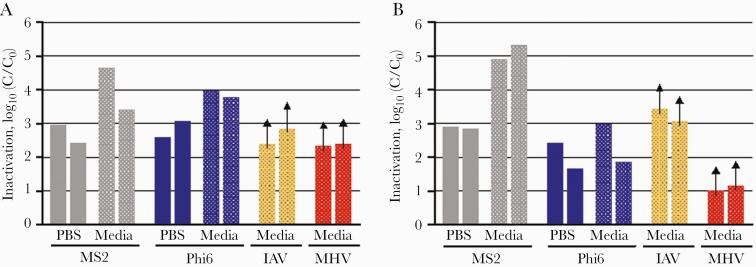
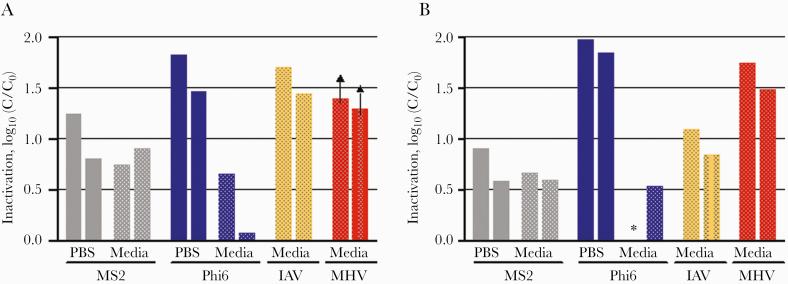
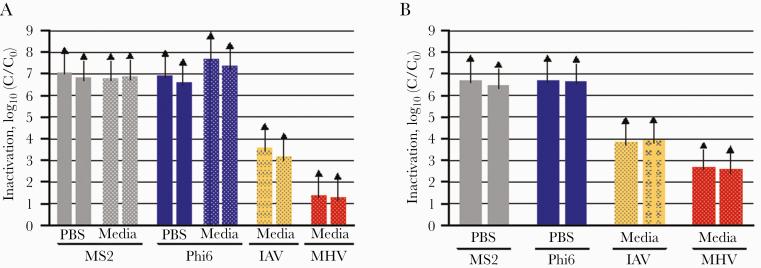
Heat with moderate RH most effectively inactivated virus, resulting in reductions of >6.6-log MS2, >6.7-log Phi6, >2.7-log MHV, and >3.9-log IAV and prokaryotes, except for . Hydrogen peroxide vapor was moderately effective at inactivating tested viruses, resulting in 1.5- to >4-log observable inactivation. inactivation by HPV was limited. Filtration efficiency and proper fit were maintained after 5 cycles of heat with moderate RH and HPV. Although it was effective at decontamination, HPGP resulted in decreased filtration efficiency, and EtO treatment raised toxicity concerns. Observed virus inactivation varied depending upon the application media used.
CONCLUSIONS
Both moist heat and HPV are scalable N95 reprocessing options because they achieve high levels of biological indicator inactivation while maintaining respirator fit and integrity.
背景
由于N95过滤式面罩呼吸器前所未有的短缺,医疗系统已探索N95再处理方法。尚无单一的全面再处理出版物报道过包括多种病毒、细菌和真菌以及呼吸器过滤和贴合性的评估。
方法
我们使用全新的3M 1860 N95呼吸器探索再处理方法,包括湿(相对湿度[RH]50%-75%)热(80-82°C持续30分钟)、环氧乙烷(EtO)、脉冲氙气紫外线C(UV-PX)、过氧化氢气体等离子体(HPGP)和过氧化氢蒸汽(HPV)。使用4种病毒(MS2、phi6、甲型流感病毒[IAV]、鼠肝炎病毒[MHV])、3种细菌(、、孢子和营养细菌)以及对呼吸器样本进行分析。测试了不同的应用介质。对经过去污处理的呼吸器进行过滤完整性和贴合性评估。
结果
中等相对湿度的热最有效地灭活病毒,导致MS2减少>6.6对数、phi6减少>6.7对数、MHV减少>2.7对数、IAV减少>3.9对数以及原核生物减少,但除外。过氧化氢蒸汽在灭活测试病毒方面效果中等,导致1.5至>4对数的可观察到的灭活。HPV对的灭活有限。在经过5次中等相对湿度的热和HPV处理后,过滤效率和适当贴合性得以保持。尽管HPGP在去污方面有效,但导致过滤效率降低,EtO处理引发了毒性问题。观察到的病毒灭活因所用的应用介质而异。
结论
湿热和HPV都是可扩展的N95再处理选项,因为它们在保持呼吸器贴合性和完整性的同时,实现了高水平的生物指示剂灭活。
 Zotero 插件