
建模表明,在 COVID-19 大流行期间重新开放挪威幼儿园和学校,繁殖数变化有限。
Modelling suggests limited change in the reproduction number from reopening Norwegian kindergartens and schools during the COVID-19 pandemic.
机构信息
Department of Mathematics and Statistics, UiT-The Arctic University of Norway, Tromsø, Norway.
Department of Clinical Medicine, UiT-The Arctic University of Norway, Tromsø, Norway.
出版信息
PLoS One. 2021 Feb 25;16(2):e0238268. doi: 10.1371/journal.pone.0238268. eCollection 2021.
BACKGROUND
To suppress the COVID-19 outbreak, the Norwegian government closed all schools on March 13, 2020. The kindergartens reopened on April 20, and the schools on April 27 and May 11 of 2020. The effect of these measures is largely unknown since the role of children in the spread of the SARS-CoV-2 virus is still unclear. There are only a few studies of school closures as a separate intervention to other social distancing measures, and little research exists on the effect of school opening during a pandemic.
OBJECTIVE
This study aimed to model the effect of opening kindergartens and the schools in Norway in terms of a change in the reproduction number (R). A secondary objective was to assess if we can use the estimated R after school openings to infer the rates of transmission between children in schools.
METHODS
We used an individual-based model (IBM) to assess the reopening of kindergartens and schools in two Norwegian cities, Oslo, the Norwegian capital, with a population of approximately 680 000, and Tromsø, which is the largest city in Northern Norway, with a population of approximately 75 000. The model uses demographic information and detailed data about the schools in both cities. We carried out an ensemble study to obtain robust results in spite of the considerable uncertainty that remains about the transmission of SARS-CoV-2.
RESULTS
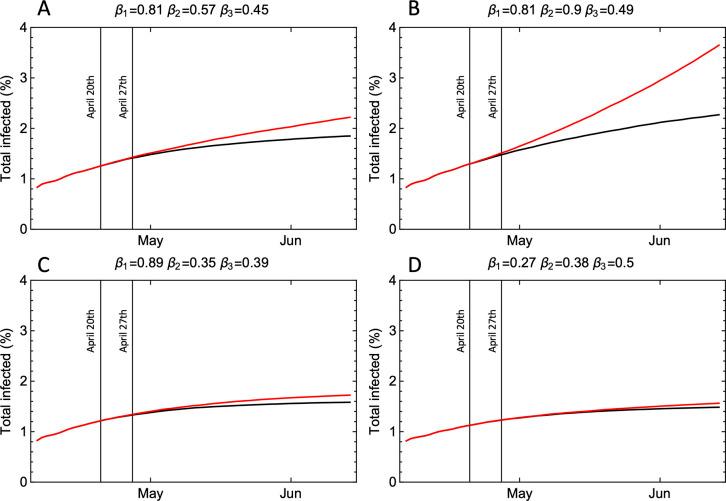
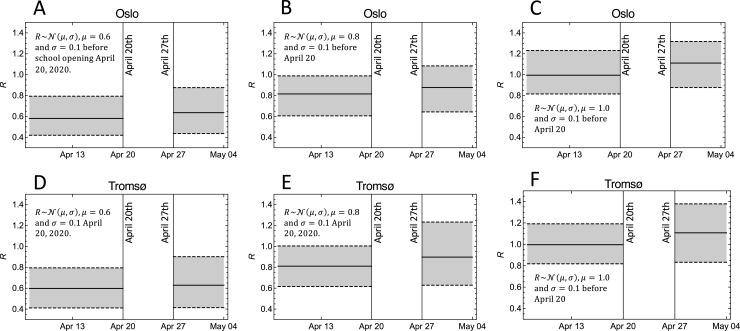
We found that reopening of Norwegian kindergartens and schools are associated with a change in R of 0.10 (95%CI 0.04-0.16) and 0.14 (95%CI 0.01-0.25) in the two cities under investigation if the in-school transmission rates for the SARS-CoV-2 virus are equal to what has previously been estimated for influenza pandemics.
CONCLUSION
We found only a limited effect of reopening schools on the reproduction number, and we expect the same to hold true in other countries where nonpharmaceutical interventions have suppressed the pandemic. Consequently, current R-estimates are insufficiently accurate for determining the transmission rates in schools. For countries that have closed schools, planned interventions, such as the opening of selected schools, can be useful to infer general knowledge about children-to-children transmission of SARS-CoV-2.
背景
为了抑制 COVID-19 疫情的爆发,挪威政府于 2020 年 3 月 13 日关闭了所有学校。幼儿园于 4 月 20 日重新开放,学校于 4 月 27 日和 5 月 11 日重新开放。由于儿童在 SARS-CoV-2 病毒传播中的作用尚不清楚,这些措施的效果在很大程度上是未知的。只有少数研究将学校关闭作为其他社会隔离措施的单独干预措施,而关于大流行期间学校开放的效果的研究很少。
目的
本研究旨在通过改变繁殖数(R)来模拟挪威幼儿园和学校开放的效果。次要目标是评估在学校开放后,我们是否可以使用估计的 R 来推断学校儿童之间的传播率。
方法
我们使用基于个体的模型(IBM)来评估挪威两个城市——首都奥斯陆(人口约 68 万)和挪威北部最大城市特罗姆瑟(人口约 7.5 万)——的幼儿园和学校的重新开放情况。该模型使用人口统计数据和这两个城市的学校详细数据。我们进行了一个集合研究,以获得稳健的结果,尽管 SARS-CoV-2 传播仍存在相当大的不确定性。
结果
我们发现,如果 SARS-CoV-2 的校内传播率与之前估计的流感大流行相同,那么挪威幼儿园和学校的重新开放与 R 的变化相关,在两个被调查的城市中,R 的变化分别为 0.10(95%CI 0.04-0.16)和 0.14(95%CI 0.01-0.25)。
结论
我们发现学校重新开放对繁殖数的影响有限,我们预计在其他非药物干预措施已抑制大流行的国家也是如此。因此,当前的 R 估计值对于确定学校内的传播率不够准确。对于已经关闭学校的国家,计划干预措施,如开放选定的学校,可以有助于推断关于 SARS-CoV-2 儿童间传播的一般知识。


 Zotero 插件