
德国日托中心儿童和保育员中 SARS-CoV-2 监测检测的可行性:一项非随机对照试验。
Feasibility of SARS-CoV-2 Surveillance Testing Among Children and Childcare Workers at German Day Care Centers: A Nonrandomized Controlled Trial.
机构信息
Institute for Hygiene and Microbiology, University of Wuerzburg, Wuerzburg, Germany.
Department of Pediatrics, University Hospital Wuerzburg, Wuerzburg, Germany.
出版信息
JAMA Netw Open. 2022 Jan 4;5(1):e2142057. doi: 10.1001/jamanetworkopen.2021.42057.
IMPORTANCE
Closure of day care centers has been implemented globally to contain the COVID-19 pandemic but has negative effects on children's health and psychosocial well-being.
OBJECTIVE
To investigate the feasibility of surveillance among children and childcare workers and to model the efficacy of surveillance on viral spread prevention.
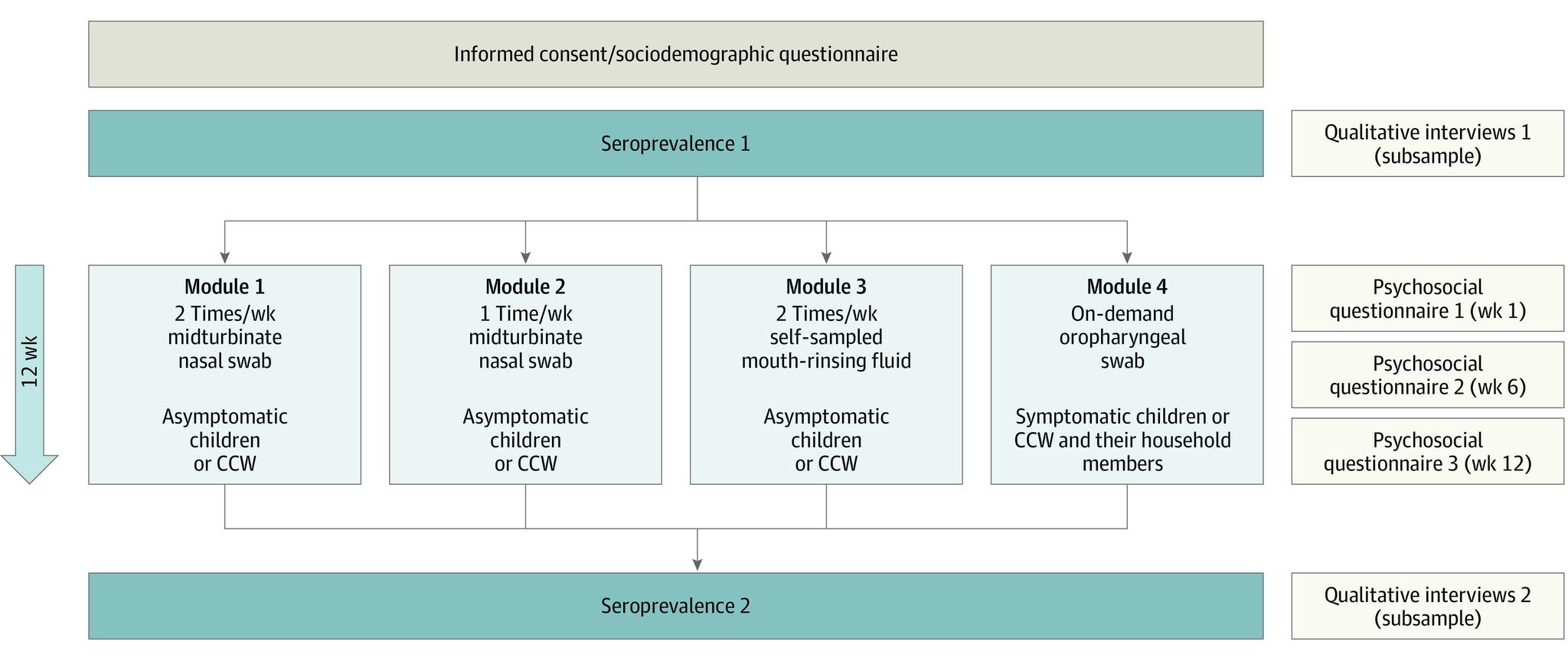
DESIGN, SETTING, AND PARTICIPANTS: This nonrandomized controlled trial was conducted at 9 day care centers in Wuerzburg, Germany, from October 2020 to March 2021. Participants included children attending day care, childcare workers, and household members. Participating day care centers were assigned to different surveillance modules in a nonrandomized feasibility study. A mathematical model for SARS-CoV-2 spread in day care centers was developed to identify optimal surveillance.
INTERVENTIONS
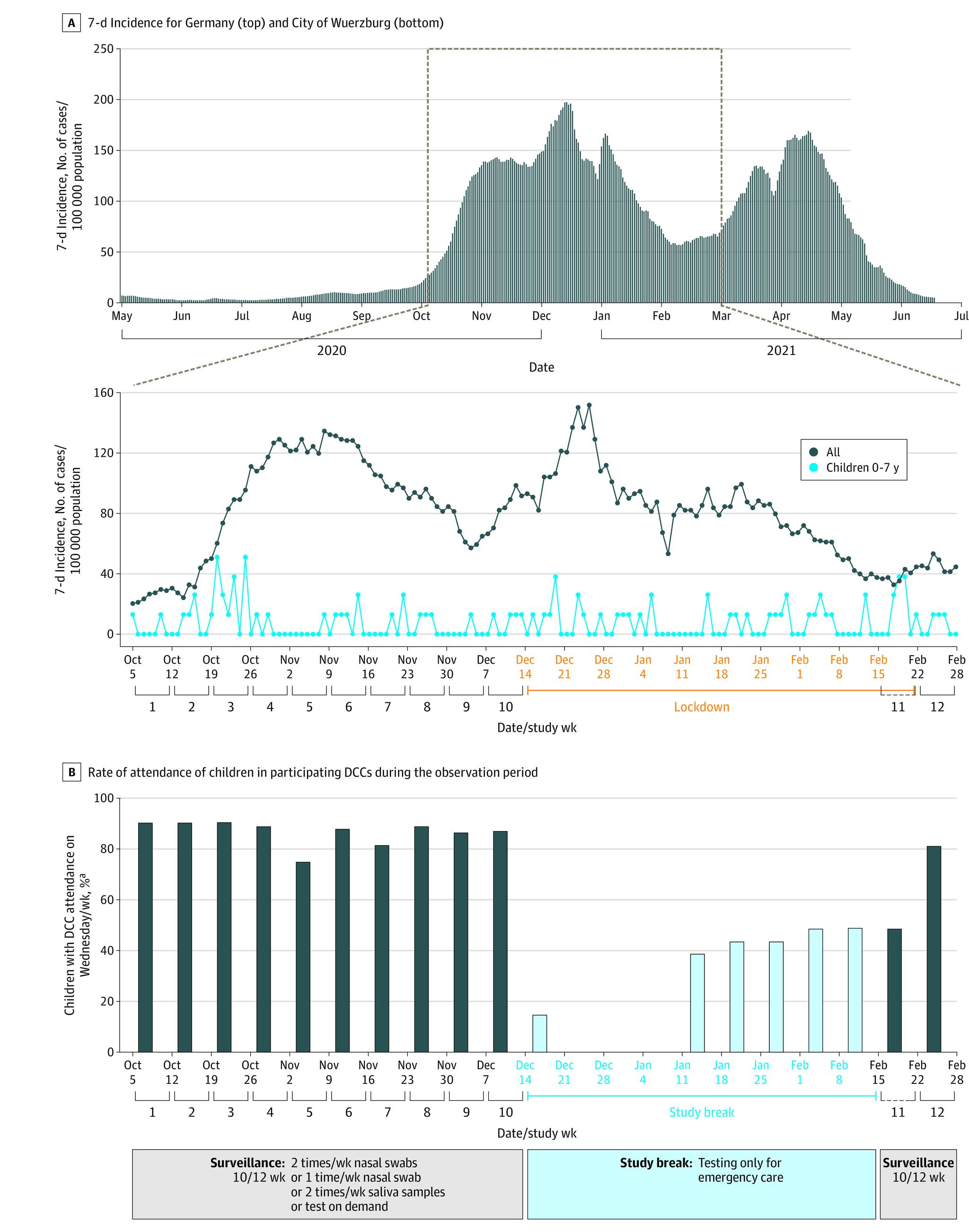
Modules 1, 2, and 3 involved continuous surveillance of asymptomatic children and childcare workers by SARS-CoV-2 polymerase chain reaction testing of either midturbinate nasal swabs twice weekly (module 1) or once weekly (module 2) or self-sampled saliva samples twice weekly (module 3). Module 4 involved symptom-based, on-demand testing of children, childcare workers, and their household members by oropharyngeal swabs. All participants underwent SARS-CoV-2 antibody status testing before and after the sampling period. Questionnaires on attitudes and perception of the pandemic were administered in weeks 1, 6, and 12. Mathematical modeling was used to estimate SARS-CoV-2 spread in day care centers.
MAIN OUTCOMES AND MEASURES
The primary outcomes were acceptance of the respective surveillance protocols (feasibility study) and the estimated number of secondary infections (mathematical modeling).
RESULTS
Of 954 eligible individuals (772 children and 182 childcare workers), 592 (62%), including 442 children (median [IQR] age, 3 [2-4] years; 214 [48.6%] female) and 150 childcare workers (median [IQR] age, 29 [25-44] years; 129 [90.8%] female) participated in the surveillance. In total, 4755 tests for SARS-CoV-2 detected 2 infections (1 childcare worker and 1 adult household member). Acceptance for continuous surveillance was highest for biweekly saliva testing (150 of 221 eligible individuals [67.9%; 95% CI, 61.5%-73.7%]) compared with biweekly (51 of 117 individuals [43.6%; 95% CI, 35.0%-52.6%]) and weekly (44 of 128 individuals [34.4%; 95% CI, 26.7%-43.0%]) midturbinate swabbing (P < .001). Dropout rates were higher for midturbinate swabbing (biweekly, 11 of 62 participants [18%]; once weekly, 11 of 55 participants [20%]) than for saliva testing (6 of 156 participants [4%]). Mathematical modeling based on study and literature data identified biweekly testing of at least 50% of children and childcare workers as minimal requirements to limit secondary infections.
CONCLUSIONS AND RELEVANCE
In this nonrandomized controlled trial, surveillance for SARS-CoV-2 in 9 German day care centers was feasible and well accepted. Mathematical modeling estimated that testing can minimize the spread of SARS-CoV-2 in day care centers. These findings enable setup of surveillance programs to maintain institutional childcare.
TRIAL REGISTRATION
German Registry for Clinical Trials Identifier: DRKS00023721.
重要性
为了控制 COVID-19 大流行,全球已经关闭了日托中心,但这对儿童的健康和心理社会福祉产生了负面影响。
目的
调查对儿童和保育员进行监测的可行性,并对监测对病毒传播预防的效果进行建模。
设计、设置和参与者:本非随机对照试验于 2020 年 10 月至 2021 年 3 月在德国维尔茨堡的 9 个日托中心进行。参与者包括入托儿童、保育员和家庭成员。参与的日托中心在一项非随机可行性研究中被分配到不同的监测模块。为了确定最佳监测方案,开发了一种用于日托中心 SARS-CoV-2 传播的数学模型。
干预措施
模块 1、2 和 3 涉及通过对无症状儿童和保育员进行 SARS-CoV-2 聚合酶链反应检测,每周两次(模块 1)或每周一次(模块 2)对鼻中隔鼻拭子进行连续监测,或每周两次进行自我采样唾液样本(模块 3)。模块 4 涉及对儿童、保育员及其家庭成员进行基于症状的按需检测,使用咽拭子。所有参与者在采样前和采样后都接受了 SARS-CoV-2 抗体状态检测。在第 1、6 和 12 周进行了关于态度和对大流行看法的问卷调查。数学模型用于估计日托中心的 SARS-CoV-2 传播。
主要结果和措施
主要结果是接受各自的监测方案(可行性研究)和估计的二次感染数量(数学建模)。
结果
在 954 名符合条件的个体(772 名儿童和 182 名保育员)中,有 592 名(62%)参加了监测,包括 442 名儿童(中位数[IQR]年龄为 3[2-4]岁;214 名[48.6%]女性)和 150 名保育员(中位数[IQR]年龄为 29[25-44]岁;129 名[90.8%]女性)。共进行了 4755 次 SARS-CoV-2 检测,发现了 2 例感染(1 名保育员和 1 名成年家庭成员)。与每周两次的鼻中隔拭子检测(221 名符合条件的个体中有 150 名[67.9%];95%CI,61.5%-73.7%)相比,每周两次的唾液检测(117 名符合条件的个体中有 51 名[43.6%];95%CI,35.0%-52.6%)和每周一次的唾液检测(128 名符合条件的个体中有 44 名[34.4%];95%CI,26.7%-43.0%)的接受率更高(P<0.001)。与鼻中隔拭子检测(每周两次,11 名参与者中有 11 名[18%];每周一次,55 名参与者中有 11 名[20%])相比,鼻中隔拭子检测的退出率更高(每周两次,6 名参与者中有 6 名[4%])。基于研究和文献数据的数学建模确定,对至少 50%的儿童和保育员进行检测是限制二次感染的最低要求。
结论和相关性
在这项非随机对照试验中,对德国 9 家日托中心的 SARS-CoV-2 监测是可行的,并且得到了很好的接受。数学建模估计,检测可以最大限度地减少 SARS-CoV-2 在日托中心的传播。这些发现为建立监测计划以维持机构日托服务提供了依据。
试验注册
德国临床试验注册中心标识符:DRKS00023721。

 Zotero 插件