
含有受限磷脂的纳米颗粒在无靶向配体的情况下将信使核糖核酸体内递送至肝脏免疫细胞。
Nanoparticles containing constrained phospholipids deliver mRNA to liver immune cells in vivo without targeting ligands.
作者信息
Gan Zubao, Lokugamage Melissa P, Hatit Marine Z C, Loughrey David, Paunovska Kalina, Sato Manaka, Cristian Ana, Dahlman James E
机构信息
Wallace H. Coulter Department of Biomedical Engineering Georgia Institute of Technology and Emory School of Medicine Atlanta Georgia USA.
出版信息
Bioeng Transl Med. 2020 May 27;5(3):e10161. doi: 10.1002/btm2.10161. eCollection 2020 Sep.
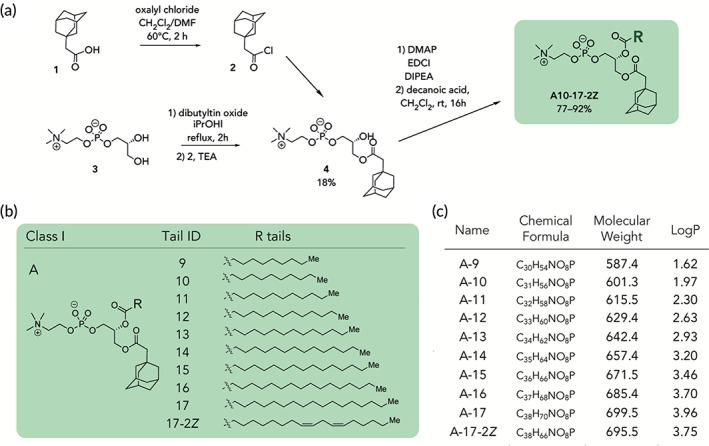
Once inside the cytoplasm of a cell, mRNA can be used to treat disease by upregulating the expression of any gene. Lipid nanoparticles (LNPs) can deliver mRNA to hepatocytes in humans, yet systemic non-hepatocyte delivery at clinical doses remains difficult. We noted that LNPs have historically been formulated with phospholipids containing unconstrained alkyl tails. Based on evidence that constrained adamantyl groups have unique properties that can improve small molecule drug delivery, we hypothesized that a phospholipid containing an adamantyl group would facilitate mRNA delivery in vivo. We quantified how 109 LNPs containing "constrained phospholipids" delivered mRNA to 16 cell types in mice, then using a DNA barcoding-based analytical pipeline, related phospholipid structure to in vivo delivery. By analyzing delivery mediated by constrained phospholipids, we identified a novel LNP that delivers mRNA to immune cells at 0.5 mg/kg. Unlike many previous LNPs, these (a) did not preferentially target hepatocytes and (b) delivered mRNA to immune cells without targeting ligands. These data suggest constrained phospholipids may be useful LNP components.
一旦进入细胞的细胞质,信使核糖核酸(mRNA)就可用于通过上调任何基因的表达来治疗疾病。脂质纳米颗粒(LNPs)能够将mRNA递送至人类肝细胞,但以临床剂量进行全身性非肝细胞递送仍然困难。我们注意到,脂质纳米颗粒历来是用含有无约束烷基链的磷脂配制而成。基于有证据表明受约束的金刚烷基具有可改善小分子药物递送的独特性质,我们推测含有金刚烷基的磷脂将有助于mRNA在体内的递送。我们量化了109种含有“受约束磷脂”的脂质纳米颗粒如何将mRNA递送至小鼠的16种细胞类型,然后使用基于DNA条形码的分析流程,将磷脂结构与体内递送关联起来。通过分析受约束磷脂介导的递送,我们鉴定出一种新型脂质纳米颗粒,其能以0.5毫克/千克的剂量将mRNA递送至免疫细胞。与许多先前的脂质纳米颗粒不同,这些脂质纳米颗粒(a)不会优先靶向肝细胞,且(b)在没有靶向配体的情况下将mRNA递送至免疫细胞。这些数据表明受约束磷脂可能是有用的脂质纳米颗粒成分。


 Zotero 插件