
安罗替尼治疗晚期肝细胞癌的开放性 II 期研究(ALTER-0802 研究)。
Anlotinib in the treatment of advanced hepatocellular carcinoma: an open-label phase II study (ALTER-0802 study).
机构信息
Department of Medical Oncology, National Cancer Center/National Clinical Research Center for Cancer/Cancer Hospital, Chinese Academy of Medical Sciences and Peking Union Medical College, Beijing, 100021, People's Republic of China.
Department of Radiotherapy, National Cancer Center/National Clinical Research Center for Cancer/Cancer Hospital, Chinese Academy of Medical Sciences and Peking Union Medical College, Beijing, 100021, People's Republic of China.
出版信息
Hepatol Int. 2021 Jun;15(3):621-629. doi: 10.1007/s12072-021-10171-0. Epub 2021 Apr 7.
PURPOSE
This study aimed to assess efficacy and safety of anlotinib as a first- or second-line treatment for advanced or metastatic hepatocellular carcinoma (aHCC) and to identify the predictive plasma cytokines on efficacy of anlotinib.
METHODS
It was a phase II clinical study. Patients with aHCC were recruited from October 2016 to April 2019 and divided into two cohorts according to previous tyrosine kinase inhibitors (TKIs) therapy. Those without or with prior TKIs were in Cohort 1 or 2, respectively. All patients took anlotinib (12 mg/day, Day1-14, 3 weeks per cycle). The primary endpoint was 12-week progression-free survival (PFS) rate. Relationship between the series plasma cytokine level and the efficacy of anlotinib was analyzed.
RESULTS
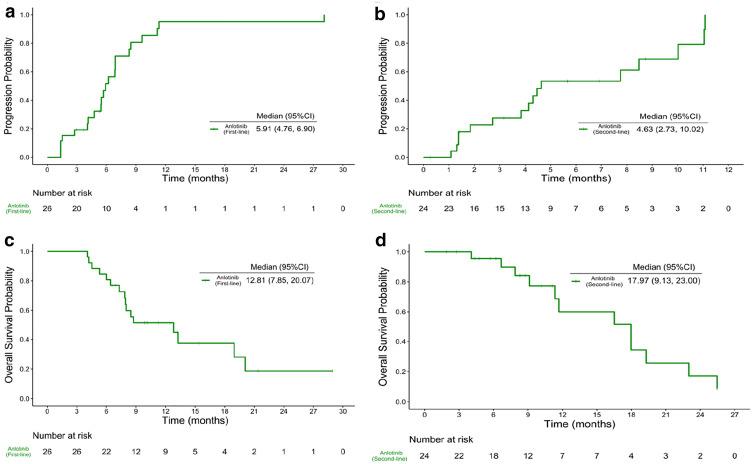
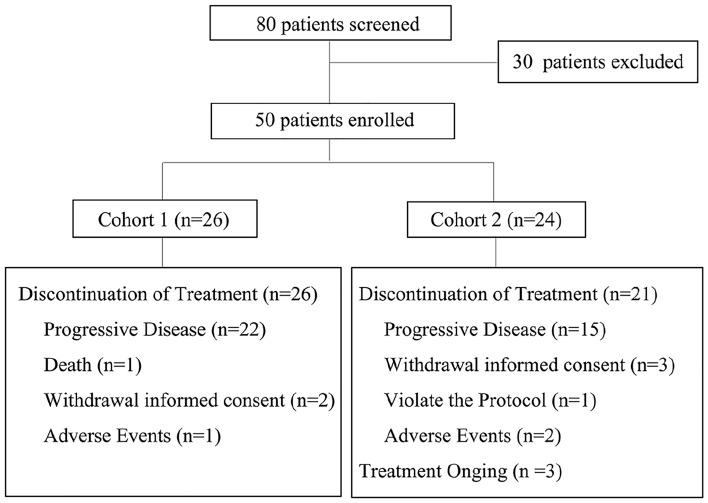
Enrolled 26 patients in Cohort 1 and 24 in Cohort 2. In Cohort 1, the 12-week PFS rate was 80.8% [95% confidence interval (CI); 59.8%-91.5%] and median time to progression (TTP) was 5.9 months (95% CI 4.8-6.9). In Cohort 2, the 12-week PFS rate and median TTP was 72.5% (95% CI 48.7%-86.6%) and 4.6 months (95% CI 2.7-10.0), respectively. The median TTP on patients with a baseline plasma level of CXCL1 (C-X-C motif chemokine ligand 1) less than 7.6 ng/μl was significantly longer in both cohorts. The most common grade 3-5 adverse events were hypertension (8%), diarrhea (8%) and hand-foot syndrome (6%).
CONCLUSION
Anlotinib showed promising efficacy and safety as a first- or second-line treatment with a continuous TKIs treatment strategy in aHCC. The plasma CXCL1 might be a predictor for the efficacy of anlotinib.
目的
本研究旨在评估安罗替尼作为晚期或转移性肝细胞癌(aHCC)一线或二线治疗的疗效和安全性,并确定预测安罗替尼疗效的血浆细胞因子。
方法
这是一项 II 期临床研究。2016 年 10 月至 2019 年 4 月,招募了 aHCC 患者,并根据既往酪氨酸激酶抑制剂(TKI)治疗分为两组。无既往 TKI 或有既往 TKI 的患者分别归入队列 1 或队列 2。所有患者均接受安罗替尼(12mg/天,第 1-14 天,每 3 周为 1 个周期)治疗。主要终点为 12 周无进展生存期(PFS)率。分析了一系列血浆细胞因子水平与安罗替尼疗效之间的关系。
结果
队列 1纳入 26 例患者,队列 2纳入 24 例患者。在队列 1 中,12 周 PFS 率为 80.8%(95%置信区间 [CI];59.8%-91.5%),中位无进展时间(TTP)为 5.9 个月(95%CI 4.8-6.9)。在队列 2 中,12 周 PFS 率和中位 TTP 分别为 72.5%(95%CI 48.7%-86.6%)和 4.6 个月(95%CI 2.7-10.0)。两组中基线血浆 CXCL1(C-X-C 基序趋化因子配体 1)水平低于 7.6ng/μl 的患者的中位 TTP 明显更长。最常见的 3-5 级不良事件为高血压(8%)、腹泻(8%)和手足综合征(6%)。
结论
安罗替尼作为 aHCC 一线或二线治疗的一种连续 TKI 治疗策略,显示出良好的疗效和安全性。血浆 CXCL1 可能是安罗替尼疗效的预测因子。
 Zotero 插件