
头颈部鳞状细胞癌自噬相关预后标志物的鉴定与验证
Identification and validation of autophagy-related prognostic signature for head and neck squamous cell carcinoma.
作者信息
Fang Jiayu, Yang Zhiqiang, Xie Jing, Li Ziang, Hu Chang, Yang Minlan, Zhou Xuhong
机构信息
Department of Otorhinolaryngology-Head and Neck Surgery, Zhongnan Hospital of Wuhan University, Wuhan 430000, China.
Department of Spine Surgery and Musculoskeletal Tumor, Zhongnan Hospital of Wuhan University, Wuhan, China.
出版信息
Transl Oncol. 2021 Jul;14(7):101094. doi: 10.1016/j.tranon.2021.101094. Epub 2021 Apr 18.
BACKGROUND
Many studies have demonstrated that autophagy plays a significant role in regulating tumor growth and progression. However, the effect of autophagy-related genes (ARGs) on the prognosis have rarely been analyzed in head and neck squamous cell carcinoma (HNSCC).
METHODS
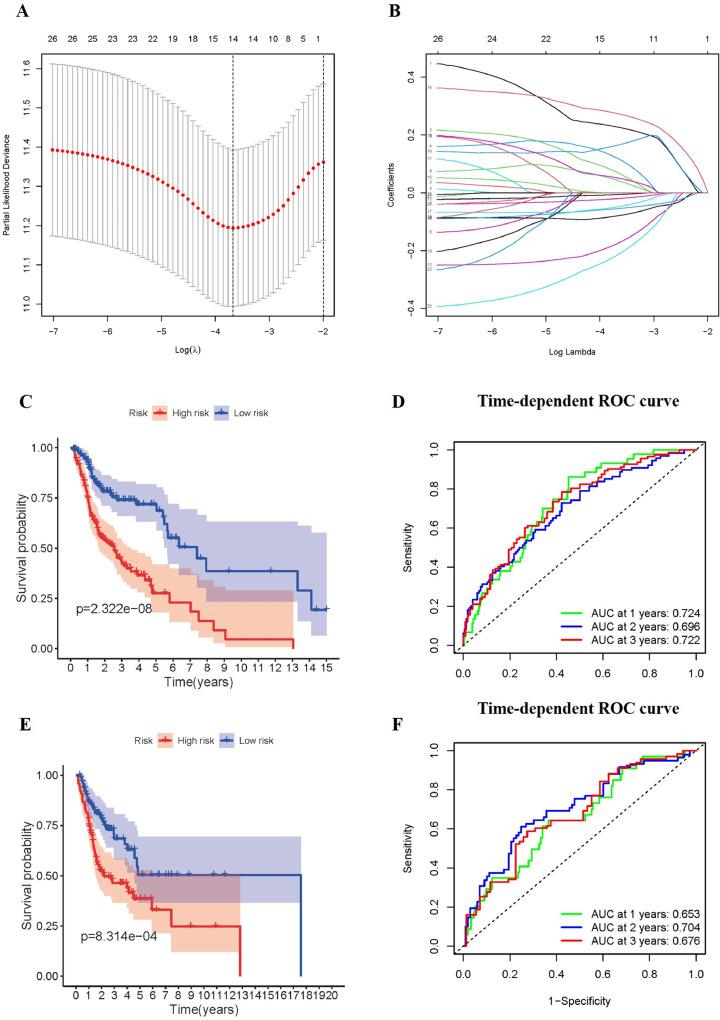
We obtained differentially expressed ARGs from HNSCC mRNA data in The Cancer Genome Atlas (TCGA) database. And then we performed gene ontology (GO) and Kyoto Encyclopedia of Genes and Genomes (KEGG) enrichment analyses to explore the autophagy-related biological functions. The overall survival (OS)-related and disease specific survival (DSS)-related ARGs were identified by univariate Cox regression analyses. With these genes, we established OS-related and DSS-related risk signature by LASSO regression method, respectively. We validated the reliability of the risk signature with receiver operating characteristic (ROC) analysis, Kaplan-Meier survival curves, clinical correlation analysis, and nomogram. Then we analyzed relationships between risk signature and immune cell infiltration.
RESULTS
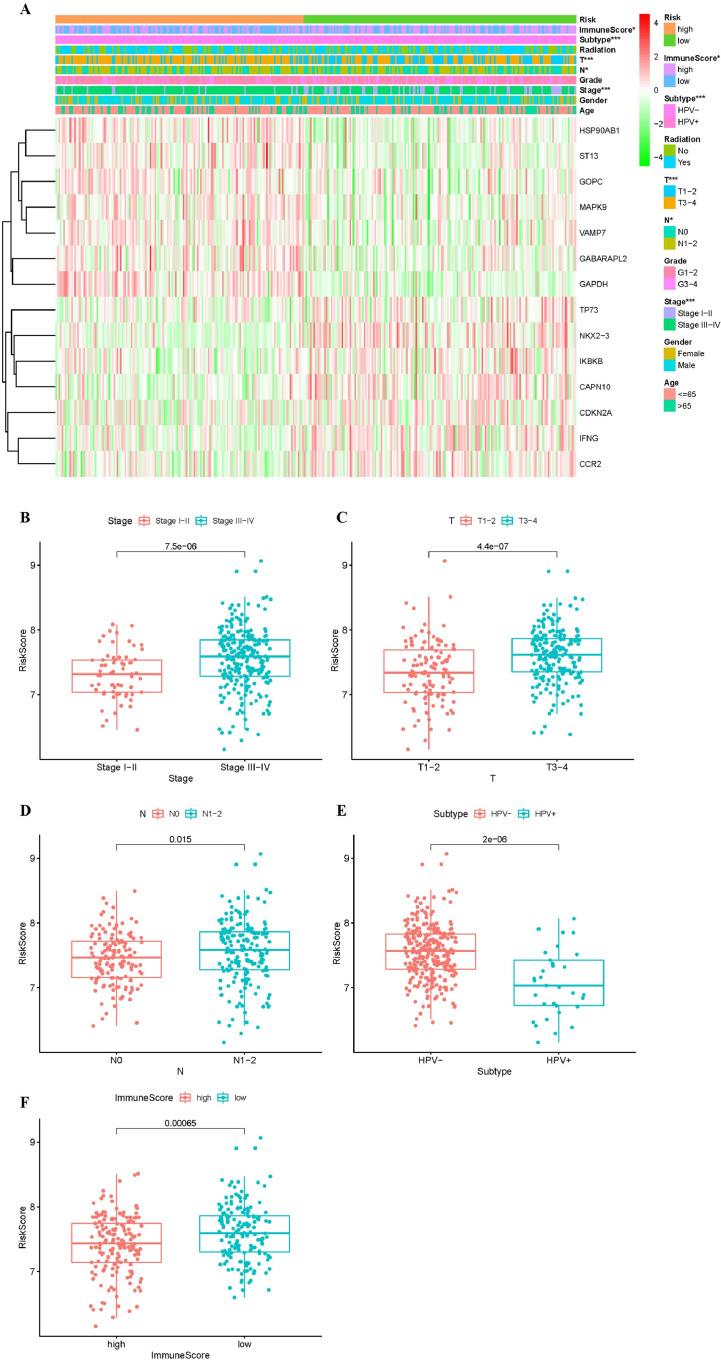
We established the prognostic signatures based on 14 ARGs for OS and 12 ARGs for DSS. The ROC curves, survival analysis, and nomogram validated the predictive accuracy of the models. Clinic correlation analysis showed that the risk group was closely related to Stage, pathological T stage, pathological N stage and human papilloma virus (HPV) subtype. Cox regression demonstrated that the risk score was an independent predictor for the prognosis of HNSCC patients. Furthermore, patients in low-risk score group exhibited higher immunescore and distinct immune cell infiltration than high-risk score group. And we further analysis revealed that the copy number alterations (CNAs) of ARGs-based signature affected the abundance of tumor-infiltrating immune cells.
CONCLUSION
In this study, we identified novel autophagy-related signature for the prediction of OS and DSS in patients with HNSCC. Meanwhile, our study provides a novel sight to understand the role of autophagy and elucidate the important role of autophagy in tumor immune microenvironment (TIME) of HNSCC.
背景
许多研究表明自噬在调节肿瘤生长和进展中起重要作用。然而,自噬相关基因(ARGs)对头颈部鳞状细胞癌(HNSCC)预后的影响鲜有分析。
方法
我们从癌症基因组图谱(TCGA)数据库的HNSCC mRNA数据中获得差异表达的ARGs。然后进行基因本体(GO)和京都基因与基因组百科全书(KEGG)富集分析,以探索自噬相关的生物学功能。通过单变量Cox回归分析确定与总生存(OS)相关和疾病特异性生存(DSS)相关的ARGs。利用这些基因,我们分别通过LASSO回归方法建立了与OS相关和与DSS相关的风险特征。我们通过受试者工作特征(ROC)分析、Kaplan-Meier生存曲线、临床相关性分析和列线图验证了风险特征的可靠性。然后我们分析了风险特征与免疫细胞浸润之间的关系。
结果
我们建立了基于14个ARGs的OS预后特征和基于12个ARGs的DSS预后特征。ROC曲线、生存分析和列线图验证了模型的预测准确性。临床相关性分析表明,风险组与分期、病理T分期、病理N分期和人乳头瘤病毒(HPV)亚型密切相关。Cox回归表明,风险评分是HNSCC患者预后的独立预测因子。此外,低风险评分组患者比高风险评分组表现出更高的免疫评分和明显的免疫细胞浸润。我们的进一步分析表明,基于ARGs的特征的拷贝数改变(CNAs)影响肿瘤浸润免疫细胞的丰度。
结论
在本研究中,我们鉴定了用于预测HNSCC患者OS和DSS的新型自噬相关特征。同时,我们的研究为理解自噬的作用提供了新视角,并阐明了自噬在HNSCC肿瘤免疫微环境(TIME)中的重要作用。






 Zotero 插件