
转化生长因子β1:基于对癌症基因组图谱(TCGA)的综合分析得出的结肠癌肿瘤免疫微环境指标
TGFβ1: An Indicator for Tumor Immune Microenvironment of Colon Cancer From a Comprehensive Analysis of TCGA.
作者信息
Wang Jinyan, Wang Jinqiu, Gu Quan, Yang Yan, Ma Yajun, Zhang Quan'an
机构信息
Department of Oncology, Nanjing Jiangning Hospital, The Affiliated Jiangning Hospital of Nanjing Medical University, Nanjing, China.
Department of Oncology, The Affiliated Jiangning Hospital of Jiangsu Health Vocational College, Nanjing, China.
出版信息
Front Genet. 2021 Apr 28;12:612011. doi: 10.3389/fgene.2021.612011. eCollection 2021.
BACKGROUND
Tumor microenvironment (TME) and tumor-infiltrating immune cells (TICs) greatly participate in the genesis and development of colon cancer (CC). However, there is little research exploring the dynamic modulation of TME.
METHODS
We analyzed the proportion of immune/stromal component and TICs in the TME of 473 CC samples and 41 normal samples from The Cancer Genome Atlas (TCGA) database through ESTIMATE and CIBERSORT algorithms. Correlation analysis was conducted to evaluate the association between immune/stromal component in the TME and clinicopathological characteristics of CC patients. The difference analysis was performed to obtain the differentially expressed genes (DEGs). These DEGs were further analyzed by GO and KEGG enrichment analyses, PPI network, and COX regression analysis. Transforming growth factor β1 (TGFβ1) was finally overlapped from the above analysis. Paired analysis and GSEA were carried out to understand the role of TGFβ1 in colon cancer. The intersection between the difference analysis and correlation analysis was conducted to learn the association between TGFβ1 and TICs.
RESULTS
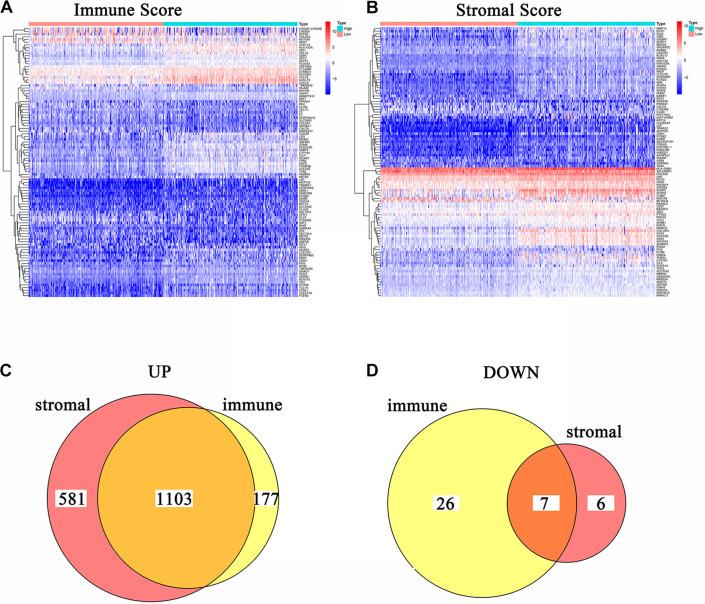
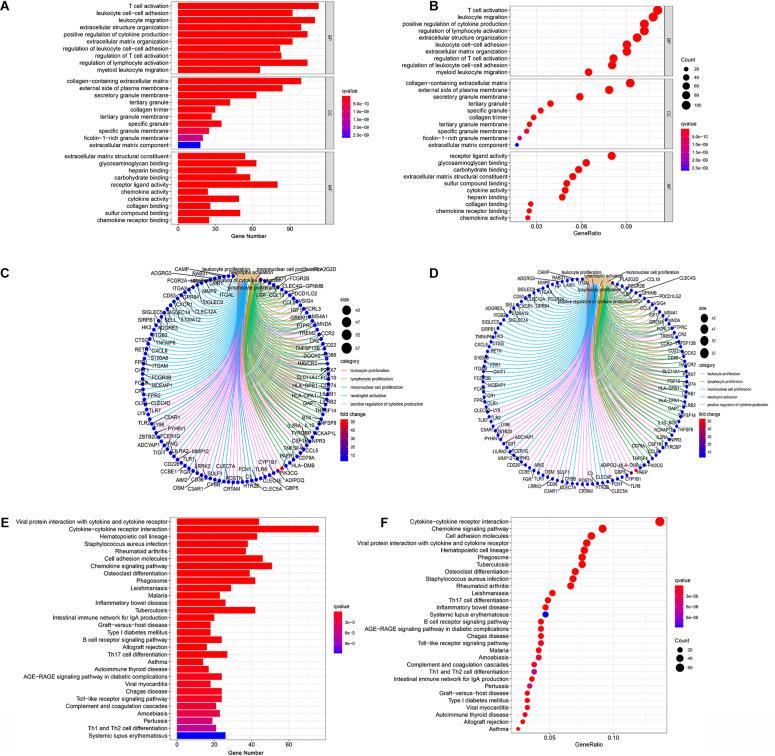
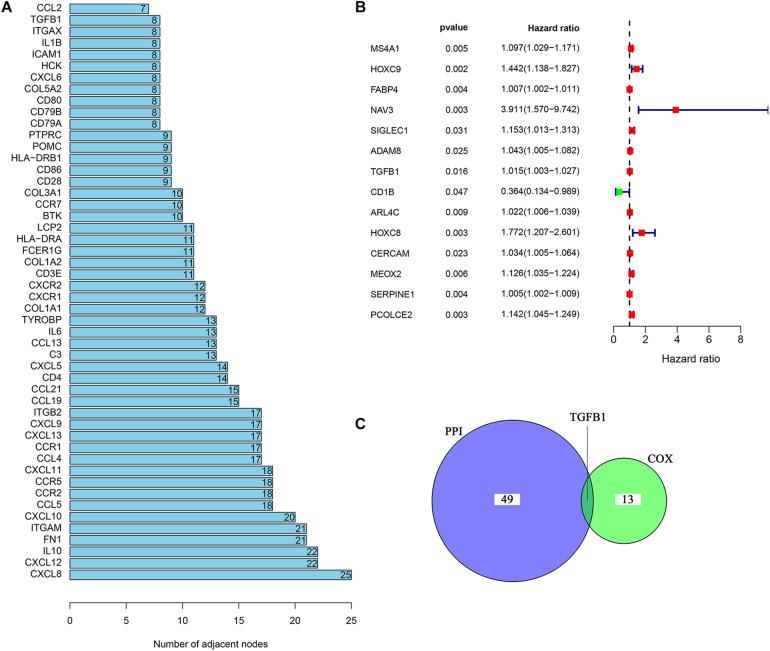
Our results showed that the immune component in the TME was negatively related with the stages of CC. GO and KEGG enrichment analysis revealed that 1,110 DEGs obtained from the difference analysis were mainly enriched in immune-related activities. The intersection analysis between PPI network and COX regression analysis indicated that TGFβ1 was significantly associated with the communication of genes in the PPI network and the survival of CC patients. In addition, TGFβ1 was up-regulated in the tumor samples and significantly related with poor prognosis of CC patients. Further GSEA suggested that genes in the TGFβ1 up-regulated group were enriched in immune-related activities and the function of TGFβ1 might depend on the communications with TICs, including T cells CD4 naïve and T cells regulatory.
CONCLUSION
The expression of TGFβ1 might be an indicator for the tumor immune microenvironment of CC and serve as a prognostic factor. Drugs targeting TGFβ1 might be a potential immunotherapy for CC patients in the future.
背景
肿瘤微环境(TME)和肿瘤浸润免疫细胞(TICs)在结肠癌(CC)的发生和发展中起着重要作用。然而,关于TME动态调节的研究较少。
方法
我们通过ESTIMATE和CIBERSORT算法分析了癌症基因组图谱(TCGA)数据库中473例CC样本和41例正常样本的TME中免疫/基质成分及TICs的比例。进行相关性分析以评估TME中免疫/基质成分与CC患者临床病理特征之间的关联。进行差异分析以获得差异表达基因(DEGs)。通过GO和KEGG富集分析、蛋白质-蛋白质相互作用(PPI)网络分析和COX回归分析对这些DEGs进行进一步分析。最终从上述分析中筛选出转化生长因子β1(TGFβ1)。进行配对分析和基因集富集分析(GSEA)以了解TGFβ1在结肠癌中的作用。进行差异分析和相关性分析的交集分析以了解TGFβ1与TICs之间的关联。
结果
我们的结果表明,TME中的免疫成分与CC的分期呈负相关。GO和KEGG富集分析显示,差异分析获得的1110个DEGs主要富集在免疫相关活动中。PPI网络和COX回归分析的交集分析表明,TGFβ1与PPI网络中的基因交流及CC患者的生存显著相关。此外,TGFβ1在肿瘤样本中上调,且与CC患者的不良预后显著相关。进一步的GSEA表明,TGFβ1上调组中的基因富集在免疫相关活动中,TGFβ1的功能可能取决于与TICs的相互作用,包括初始CD4 + T细胞和调节性T细胞。
结论
TGFβ1的表达可能是CC肿瘤免疫微环境的一个指标,并可作为预后因素。靶向TGFβ1的药物可能是未来CC患者潜在的免疫治疗方法。





 Zotero 插件