
心血管危险因素与结直肠癌之间的关联:前瞻性队列研究的系统评价和荟萃分析。
Association between cardiovascular risk factors and colorectal cancer: A systematic review and meta-analysis of prospective cohort studies.
作者信息
Zhang Chen, Cheng Yunjiu, Luo Dongling, Wang Jinghua, Liu Jianhua, Luo Yujun, Zhou Weijie, Zhuo Zewei, Guo Kehang, Zeng Ruijie, Yang Jun, Sha Weihong, Chen Hao
机构信息
Department of Gastroenterology, Guangdong Provincial People's Hospital, Guangdong Academy of Medical Sciences, Guangzhou 510080, China.
Department of Gastroenterology, Affiliated South China Hospital, Southern Medical University (Guangdong Provincial People's Hospital), Guangzhou 510080, China.
出版信息
EClinicalMedicine. 2021 Mar 18;34:100794. doi: 10.1016/j.eclinm.2021.100794. eCollection 2021 Apr.
BACKGROUND
Emerging data have suggested colorectal cancer (CRC) often coexists with cardiovascular diseases, but whether cardiovascular risk factors play a role in CRC remains unclear. We performed a systematic review and meta-analysis to better illustrate the associations between cardiovascular risk factors and CRC.
METHODS
We searched EMBASE, MEDLINE and Web of Science databases from inception up to June 14, 2020. Prospective cohort studies were included if they evaluated the association between at least one of cardiovascular risk factors and CRC incidence, containing sufficient data to obtain relative risk (RR) and 95% confidence interval (CI). We performed separate meta-analyses for each cardiovascular risk factor using random-effect model. PROSPERO registration number CRD42020175537.
FINDINGS
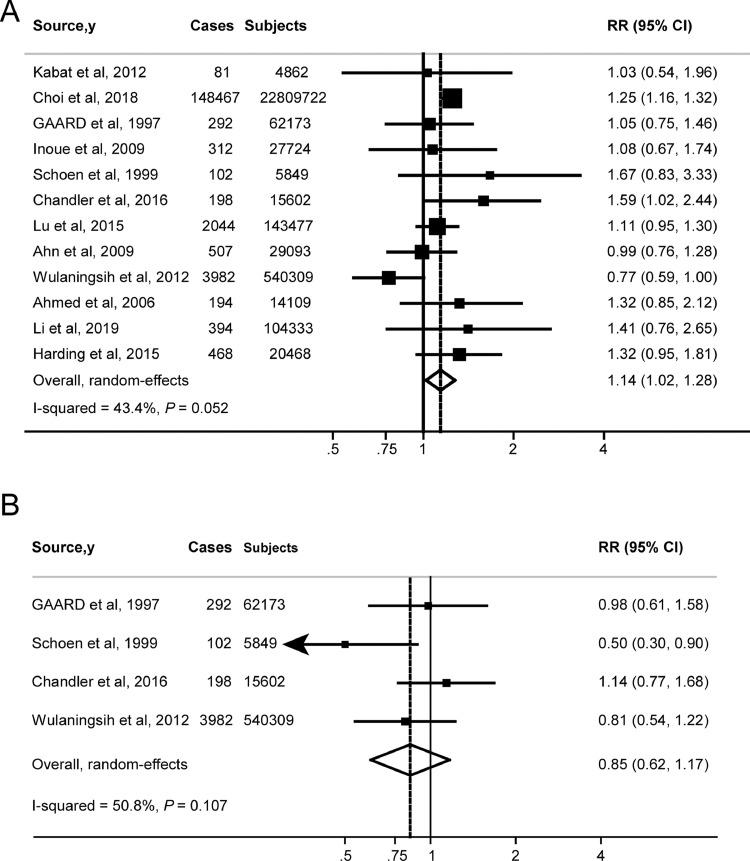
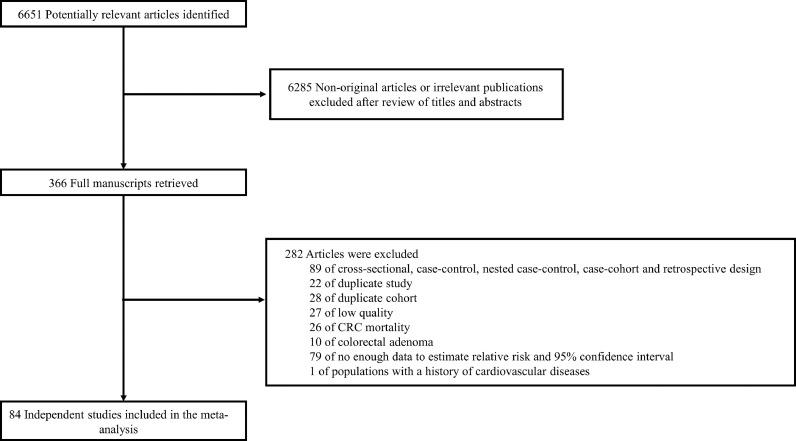
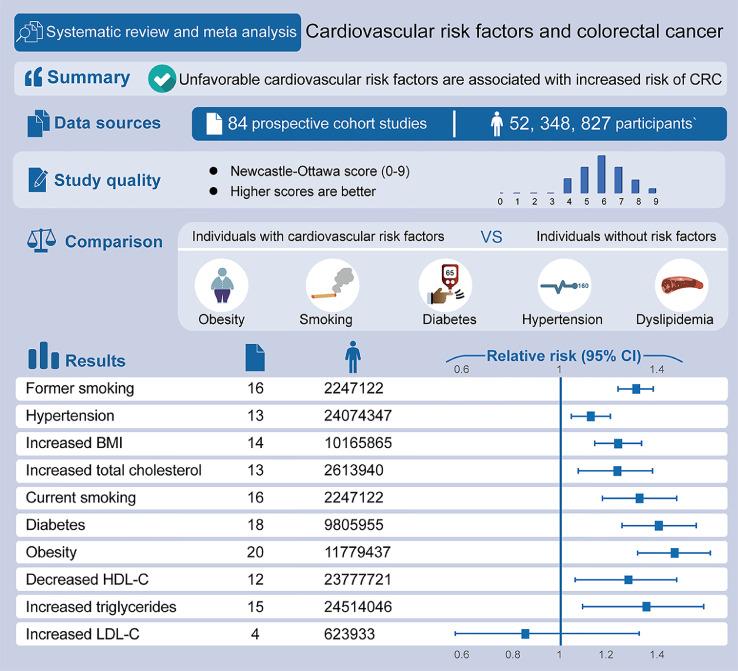
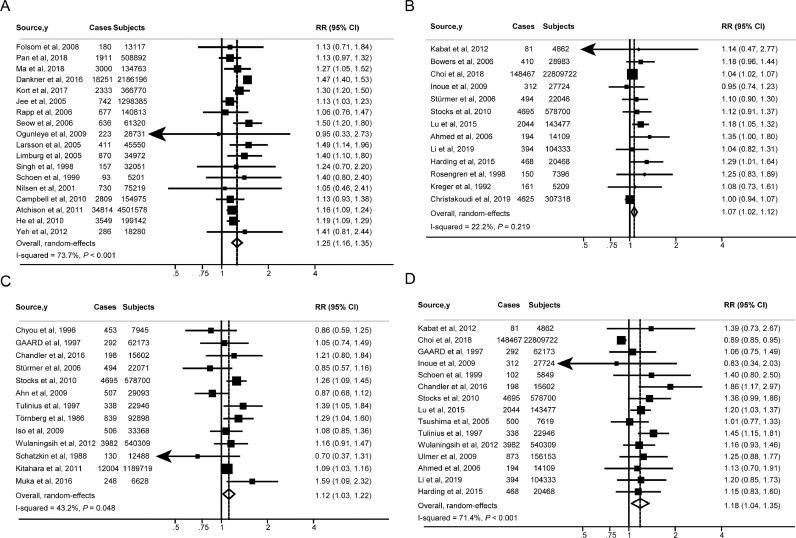
Data from 84 studies, reporting 52, 348, 827 individuals and 384, 973 incident cases were included in the analysis. Overall, the risk of CRC was 1.31(95% CI, 1.21-1.42) for obesity, 1.14 (95% CI, 1.09-1.20) for per 5 kg/m increase in body mass index, 1.18 (95% CI, 1.14-1.23) for former smoker, 1.20 (95% CI, 1.11-1.30) for current smoker, 1.25 (95% CI, 1.16-1.35) for diabetes, 1.07 (95% CI, 1.02-1.12) for hypertension. The summary RRs of CRC for the highest versus lowest quartiles of total cholesterol, triglyceride, low-density lipoprotein were 1.12 (95% CI, 1.03-1.22), 1.18 (95% CI, 1.04-1.35), 0.85 (95% CI, 0.62-1.17) respectively and the pooled RR for the lowest versus highest quartile of high-density lipoprotein was 1.14 (95% CI, 1.02-1.28).
INTERPRETATION
Unfavorable cardiovascular risk factors are associated with increased risk of CRC, which may provide novel insight into the screening strategies of CRC in patient with these risk factors.
背景
新出现的数据表明,结直肠癌(CRC)常与心血管疾病共存,但心血管危险因素是否在结直肠癌中起作用仍不清楚。我们进行了一项系统综述和荟萃分析,以更好地阐明心血管危险因素与结直肠癌之间的关联。
方法
我们检索了从数据库建立至2020年6月14日的EMBASE、MEDLINE和Web of Science数据库。纳入前瞻性队列研究,条件为评估至少一种心血管危险因素与结直肠癌发病率之间的关联,且包含足够的数据以获得相对风险(RR)和95%置信区间(CI)。我们使用随机效应模型对每个心血管危险因素进行单独的荟萃分析。国际前瞻性系统评价注册库注册号为CRD42020175537。
结果
分析纳入了84项研究的数据,涉及52348827名个体和384973例发病病例。总体而言,肥胖者患结直肠癌的风险为1.31(95%CI,1.21 - 1.42),体重指数每增加5kg/m²风险为1.14(95%CI,1.09 - 1.20),既往吸烟者为1.18(95%CI,1.14 - 1.23),当前吸烟者为1.20(95%CI,1.11 - 1.30),糖尿病患者为1.25(95%CI,1.16 - 1.35),高血压患者为1.07(95%CI,1.02 - 1.12)。总胆固醇、甘油三酯、低密度脂蛋白最高四分位数与最低四分位数相比,结直肠癌的汇总RR分别为1.12(95%CI,1.03 - 1.22)、1.18(95%CI,1.04 - 1.35)、0.85(95%CI,0.62 - 1.17),高密度脂蛋白最低四分位数与最高四分位数相比的合并RR为1.14(95%CI,1.02 - 1.28)。
解读
不良心血管危险因素与结直肠癌风险增加相关,这可能为有这些危险因素的患者的结直肠癌筛查策略提供新的见解。

 Zotero 插件