
在哥伦比亚,非洲化蜜蜂表现出很高的螨类感染率但螨类感染水平较低,以及低的致病性病毒感染率。
Africanized honey bees in Colombia exhibit high prevalence but low level of infestation of Varroa mites and low prevalence of pathogenic viruses.
机构信息
Facultad de Medicina Veterinaria y Zootecnia, Grupos de Investigación AYNI-Ciencia y Tecnología Apícola, Universidad Nacional de Colombia, Bogotá, Colombia.
Bee Research Lab, United States Department of Agriculture, Beltsville, MD, United States of America.
出版信息
PLoS One. 2021 May 20;16(5):e0244906. doi: 10.1371/journal.pone.0244906. eCollection 2021.
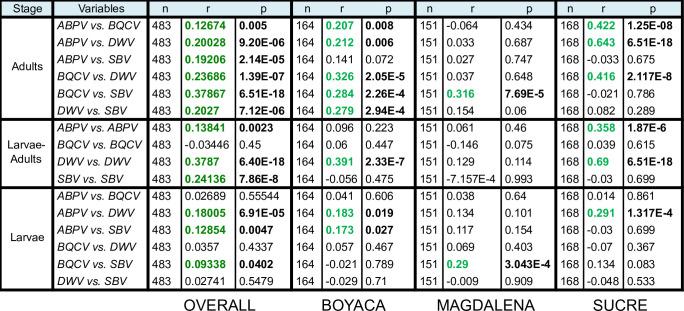
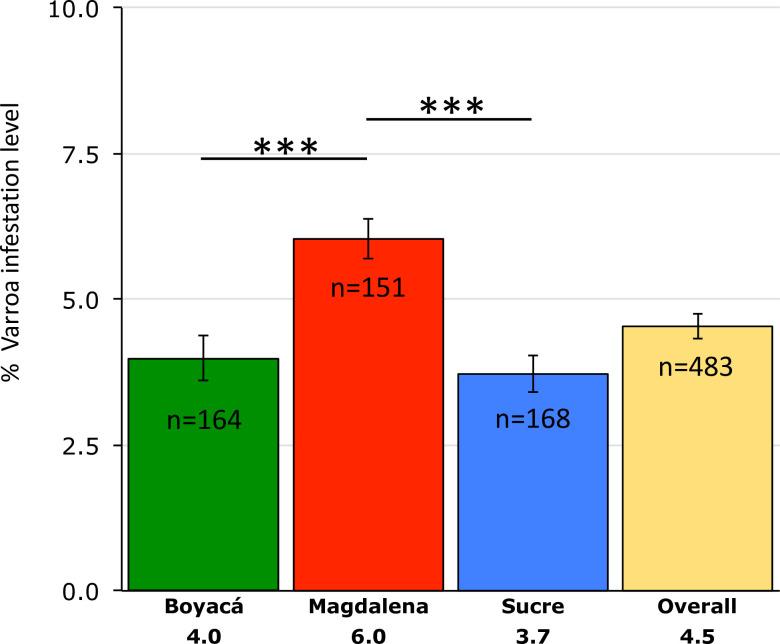
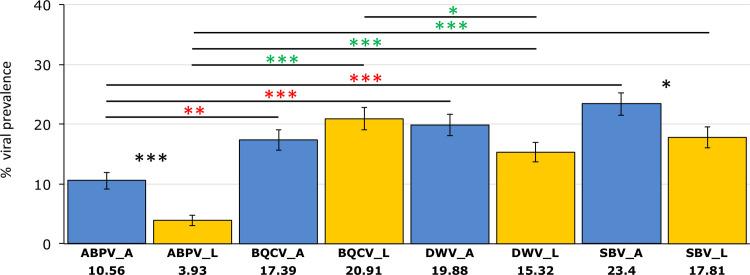
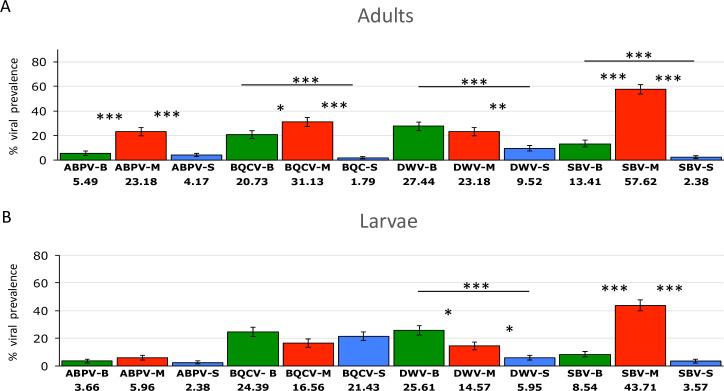
The global spread of the ectoparasitic mite Varroa destructor has promoted the spread and virulence of highly infectious honey bee viruses. This phenomenon is considered the leading cause for the increased number of colony losses experienced by the mite-susceptible European honey bee populations in the Northern hemisphere. Most of the honey bee populations in Central and South America are Africanized honey bees (AHBs), which are considered more resistant to Varroa compared to European honey bees. However, the relationship between Varroa levels and the spread of honey bee viruses in AHBs remains unknown. In this study, we determined Varroa prevalence and infestation levels as well as the prevalence of seven major honey bee viruses in AHBs from three regions of Colombia. We found that although Varroa exhibited high prevalence (92%), its infestation levels were low (4.5%) considering that these populations never received acaricide treatments. We also detected four viruses in the three regions analyzed, but all colonies were asymptomatic, and virus prevalence was considerably lower than those found in other countries with higher rates of mite-associated colony loss (DWV 19.88%, BQCV 17.39%, SBV 23.4%, ABPV 10.56%). Our findings indicate that AHBs possess a natural resistance to Varroa that does not prevent the spread of this parasite among their population, but restrains mite population growth and suppresses the prevalence and pathogenicity of mite-associated viruses.
寄生性螨类瓦螨在全球范围内的传播促进了高度传染性的蜜蜂病毒在全球范围内的传播和毒力增强。这种现象被认为是导致北方地区螨类敏感的欧洲蜜蜂种群数量增加的主要原因。中美洲和南美洲的大多数蜜蜂种群都是非洲化蜜蜂(AHBs),与欧洲蜜蜂相比,它们被认为对瓦螨更具抵抗力。然而,瓦螨水平与 AHB 中蜜蜂病毒传播之间的关系尚不清楚。在这项研究中,我们确定了哥伦比亚三个地区 AHB 中的瓦螨流行率和感染水平以及七种主要蜜蜂病毒的流行率。我们发现,尽管瓦螨的流行率很高(92%),但其感染水平较低(4.5%),因为这些种群从未接受过杀螨剂处理。我们还在三个分析地区检测到了四种病毒,但所有的蜂群都没有出现症状,病毒的流行率明显低于其他螨类相关蜂群损失率较高的国家(DWV 为 19.88%,BQCV 为 17.39%,SBV 为 23.4%,ABPV 为 10.56%)。我们的研究结果表明,AHBs 对瓦螨具有天然的抵抗力,这种抵抗力不会阻止寄生虫在其种群中的传播,但会限制螨类种群的增长,并抑制与螨类相关的病毒的流行率和致病性。

 Zotero 插件