
基因型而非气候影响蜜蜂对病毒感染和瓦螨的抗性。
Genotype, but Not Climate, Affects the Resistance of Honey Bees () to Viral Infections and to the Mite .
作者信息
Ramos-Cuellar Ana K, De la Mora Alvaro, Contreras-Escareño Francisca, Morfin Nuria, Tapia-González José M, Macías-Macías José O, Petukhova Tatiana, Correa-Benítez Adriana, Guzman-Novoa Ernesto
机构信息
Departamento de Medicina y Zootecnia de Abejas, FMVZ, UNAM, Cd. Universitaria, Mexico City 04510, Mexico.
School of Environmental Sciences, University of Guelph, 50 Stone Road East, Guelph, ON N1G 2W1, Canada.
出版信息
Vet Sci. 2022 Jul 15;9(7):358. doi: 10.3390/vetsci9070358.
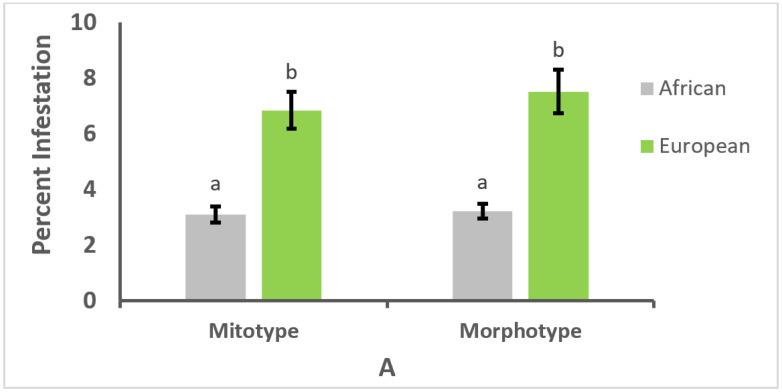
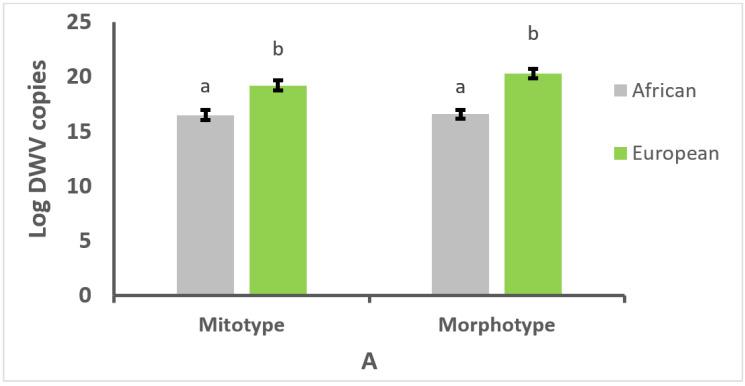
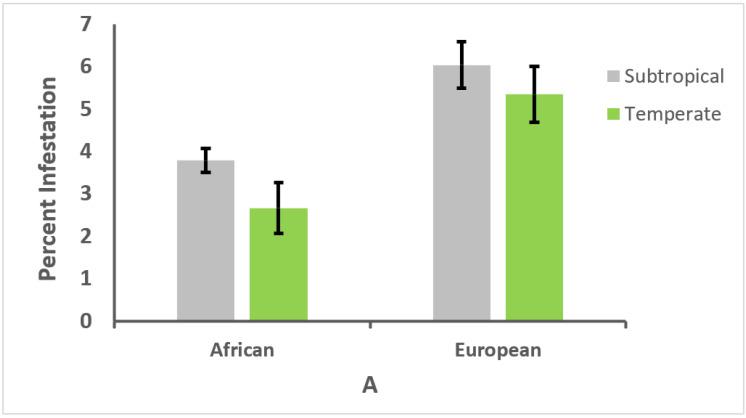
This study was conducted to analyze the effect of genotype and climate on the resistance of honey bee (Apis mellifera) colonies to parasitic and viral diseases. The prevalence and intensity of parasitism by Varroa destructor, or infection by Nosema spp., and four honey bee viruses were determined in 365 colonies of predominantly European or African ancestry (descendants of A. m. scutellata) in subtropical and temperate regions of Mexico. Varroa destructor was the most prevalent parasite (95%), whilst N. ceranae was the least prevalent parasite (15%). Deformed wing virus (DWV) and black queen cell virus (BQCV) were the only viruses detected, at frequencies of 38% and 66%, respectively. Varroa destructor was significantly more prevalent in colonies of European ancestry (p < 0.05), and the intensity of parasitism by V. destructor or infection by DWV and BQCV was also significantly higher in colonies of European descent than in African descent colonies (p < 0.01), although no genotype−parasite associations were found for N. ceranae. Additionally, significant and positive correlations were found between V. destructor and DWV levels, and the abundance of these pathogens was negatively correlated with the African ancestry of colonies (p < 0.01). However, there were no significant effects of environment on parasitism or infection intensity for the colonies of both genotypes. Therefore, it is concluded that the genotype of honey bee colonies, but not climate, influences their resistance to DWV, BQCV, and V. destructor.
本研究旨在分析基因型和气候对蜂群(西方蜜蜂)抵抗寄生虫病和病毒病能力的影响。在墨西哥亚热带和温带地区,对365个主要为欧洲血统或非洲血统(盾形亚种后代)的蜂群,测定了狄斯瓦螨的寄生率和寄生强度、微孢子虫属的感染情况以及四种蜜蜂病毒的感染情况。狄斯瓦螨是最常见的寄生虫(95%),而中华蜜蜂微孢子虫是最不常见的寄生虫(15%)。仅检测到了残翅病毒(DWV)和黑蜂王台病毒(BQCV),其检出频率分别为38%和66%。狄斯瓦螨在欧洲血统的蜂群中更为常见(p < 0.05),狄斯瓦螨的寄生强度以及DWV和BQCV的感染强度在欧洲血统的蜂群中也显著高于非洲血统的蜂群(p < 0.01),不过未发现中华蜜蜂微孢子虫的基因型与寄生虫之间的关联。此外,狄斯瓦螨和DWV的水平之间存在显著正相关,这些病原体的丰度与蜂群的非洲血统呈负相关(p < 0.01)。然而,环境对两种基因型蜂群的寄生或感染强度均无显著影响。因此,得出结论:蜂群的基因型而非气候,会影响其对DWV、BQCV和狄斯瓦螨的抵抗力。

 Zotero 插件