
利用电子健康记录应对 COVID-19 大流行。
Leveraging the Electronic Health Record to Address the COVID-19 Pandemic.
机构信息
Department of Cardiovascular Medicine, Mayo Clinic, Rochester, MN.
Department of Cardiovascular Medicine, Mayo Clinic, Rochester, MN; Gonda Vascular Center, Mayo Clinic, Rochester, MN.
出版信息
Mayo Clin Proc. 2021 Jun;96(6):1592-1608. doi: 10.1016/j.mayocp.2021.04.008. Epub 2021 Apr 21.
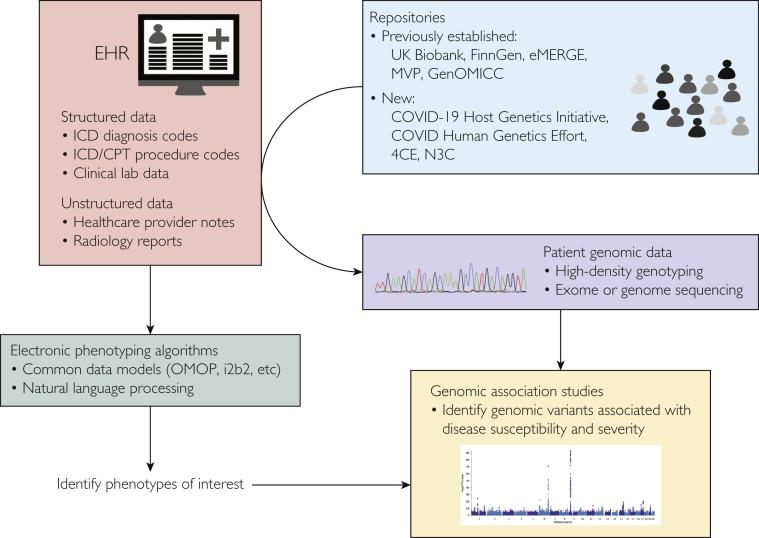
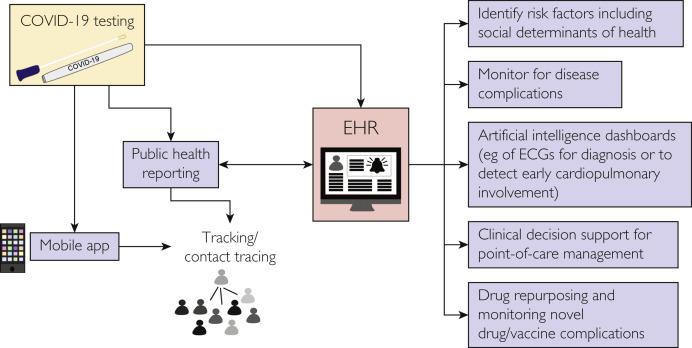
The coronavirus disease 2019 (COVID-19) pandemic continues its global spread. Coordinated effort on a vast scale is required to halt its progression and to save lives. Electronic health record (EHR) data are a valuable resource to mitigate the COVID-19 pandemic. We review how the EHR could be used for disease surveillance and contact tracing. When linked to "omics" data, the EHR could facilitate identification of genetic susceptibility variants, leading to insights into risk factors, disease complications, and drug repurposing. Real-time monitoring of patients could enable early detection of potential complications, informing appropriate interventions and therapy. We reviewed relevant articles from PubMed, MEDLINE, and Google Scholar searches as well as preprint servers, given the rapidly evolving understanding of the COVID-19 pandemic.
2019 年冠状病毒病(COVID-19)疫情仍在全球蔓延。需要大规模协调努力才能阻止其蔓延并拯救生命。电子健康记录(EHR)数据是减轻 COVID-19 大流行的宝贵资源。我们回顾了 EHR 如何用于疾病监测和接触者追踪。当与“组学”数据相关联时,EHR 可以促进识别遗传易感性变体,从而深入了解危险因素、疾病并发症和药物再利用。对患者进行实时监测可以早期发现潜在并发症,从而为适当的干预和治疗提供信息。鉴于对 COVID-19 大流行的认识正在迅速发展,我们从 PubMed、MEDLINE 和 Google Scholar 搜索以及预印本服务器中查阅了相关文章。

 Zotero 插件