
聚乙二醇包覆的超小超顺磁性氧化铁纳米颗粒偶联唾液酸化路易斯 X 的纳米诊疗平台用于鼻咽癌成像和光热治疗。
Polyethylene glycol-coated ultrasmall superparamagnetic iron oxide nanoparticles-coupled sialyl Lewis X nanotheranostic platform for nasopharyngeal carcinoma imaging and photothermal therapy.
机构信息
Department of Radiology, Guangxi Medical University Cancer Hospital, Nanning, 530021, China.
Department of Chemistry and Biochemistry, Jackson State University, Jackson, MS, 39217, USA.
出版信息
J Nanobiotechnology. 2021 Jun 8;19(1):171. doi: 10.1186/s12951-021-00918-0.
BACKGROUND
Nasopharyngeal carcinoma (NPC) is a type of head and neck malignant tumor with a high incidence in specific regional distribution, and its traditional therapies face some challenges. It has become an urgent need to seek new therapeutic strategies without or with low toxicity and side effects. At present, more and more researchers has been attracting attention by nanotheranostic platform. Therefore, our team synthesized the polyethylene glycol-coated ultrasmall superparamagnetic iron oxide nanoparticles-coupled sialyl Lewis X (USPIO-PEG-sLe) nanotheranostic platform with high temperature pyrolysis.
RESULTS
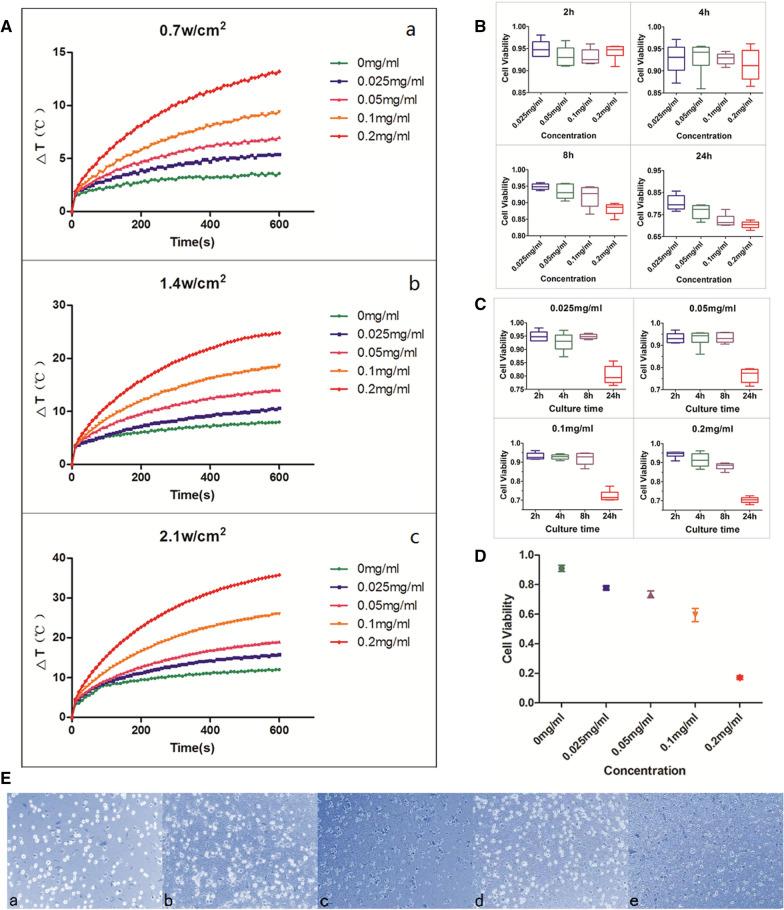
The USPIO-PEG-sLe nanoparticles had excellent photothermal conversion property, and the temperature of USPIO-PEG-sLe nanoparticles solution increased with its concentration and power density of near-infrared (NIR) on 808 nm wavelengths. Five USPIO-PEG-sLe nanoparticles with different concentrations of 0 mg/ml, 0.025 mg/ml, 0.05 mg/ml, 0.1 mg/ml and 0.2 mg/ml were prepared. The biological toxicity results showed that the viability of NPC 5-8F cells is related to the concentration of USPIO-PEG-sLe nanoparticles and the culture time (P < 0.001). The results of photothermal therapy (PTT) in vitro indicated that the viability of 5-8F cells decreased significantly with the concentration of USPIO-PEG-sLe nanoparticles increases (P < 0.001), and the viability of NPC 5-8F cells were 91.04% ± 5.20%, 77.83% ± 3.01%, 73.48% ± 5.55%, 59.50% ± 10.98%, 17.11% ± 3.14%, respectively. The USPIO-PEG-sLe nanoparticles could target the tumor area, and reduce the T2* value of tumor tissue. The T2* values of tumor pre- and post-injection were 30.870 ± 5.604 and 18.335 ± 4.351, respectively (P < 0.001). In addition, USPIO-PEG-sLe nanoparticles as a photothermal agent for PTT could effectively inhibit tumor progression. The ratio of volume change between tail vein injection group, control group, nanoparticles without laser irradiation group and blank group after 5 treatments were 3.04 ± 0.57, 5.80 ± 1.06, 8.09 ± 1.96, 7.89 ± 2.20, respectively (P < 0.001).
CONCLUSIONS
Our synthesized USPIO-PEG-sLe nanotheranostic platform, and it may be become a new strategy for the treatment of NPC.
背景
鼻咽癌(NPC)是一种具有特定区域分布高发的头颈部恶性肿瘤,其传统疗法面临一些挑战。因此,迫切需要寻求无毒性或低毒性、低副作用的新治疗策略。目前,越来越多的研究人员开始关注纳米诊疗平台。因此,我们的团队通过高温热解合成了聚乙二醇包裹的超小超顺磁性氧化铁纳米颗粒偶联唾液酸化路易斯 X(USPIO-PEG-sLe)纳米诊疗平台。
结果
USPIO-PEG-sLe 纳米粒子具有优异的光热转换性能,USPIO-PEG-sLe 纳米粒子溶液的温度随其浓度和 808nm 波长近红外(NIR)的功率密度增加而升高。制备了 5 种不同浓度的 0mg/ml、0.025mg/ml、0.05mg/ml、0.1mg/ml 和 0.2mg/ml 的 USPIO-PEG-sLe 纳米粒子。生物毒性结果表明,NPC 5-8F 细胞的活力与 USPIO-PEG-sLe 纳米粒子的浓度和培养时间有关(P<0.001)。体外光热治疗(PTT)结果表明,随着 USPIO-PEG-sLe 纳米粒子浓度的增加,5-8F 细胞的活力显著降低(P<0.001),NPC 5-8F 细胞的活力分别为 91.04%±5.20%、77.83%±3.01%、73.48%±5.55%、59.50%±10.98%、17.11%±3.14%。USPIO-PEG-sLe 纳米粒子可靶向肿瘤区域,并降低肿瘤组织的 T2* 值。肿瘤预注射和后注射的 T2* 值分别为 30.870±5.604 和 18.335±4.351(P<0.001)。此外,USPIO-PEG-sLe 纳米粒子作为 PTT 的光热剂可有效抑制肿瘤进展。尾静脉注射组、对照组、无激光照射纳米粒子组和空白组治疗 5 次后体积变化比分别为 3.04±0.57、5.80±1.06、8.09±1.96、7.89±2.20(P<0.001)。
结论
我们合成的 USPIO-PEG-sLe 纳米诊疗平台,可能成为 NPC 治疗的新策略。




 Zotero 插件