
哪些国家因素对新冠病毒的传播影响最大?
Which National Factors Are Most Influential in the Spread of COVID-19?
作者信息
Kim Hakyong, Apio Catherine, Ko Yeonghyeon, Han Kyulhee, Goo Taewan, Heo Gyujin, Kim Taehyun, Chung Hye Won, Lee Doeun, Lim Jisun, Park Taesung
机构信息
Department of Industrial Engineering, Seoul National University, Seoul 08826, Korea.
Interdisciplinary Program in Bioinformatics, Seoul National University, Seoul 08826, Korea.
出版信息
Int J Environ Res Public Health. 2021 Jul 16;18(14):7592. doi: 10.3390/ijerph18147592.
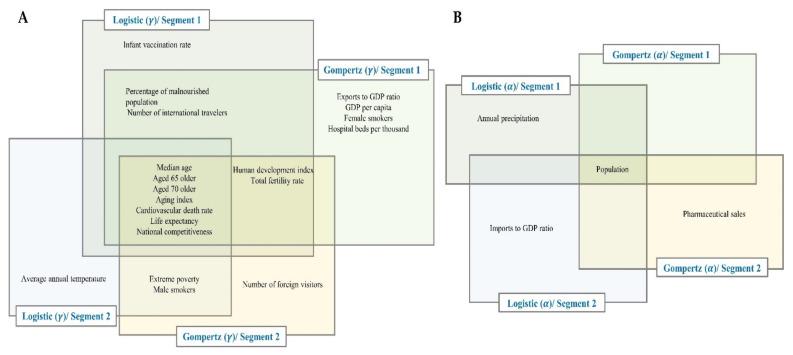
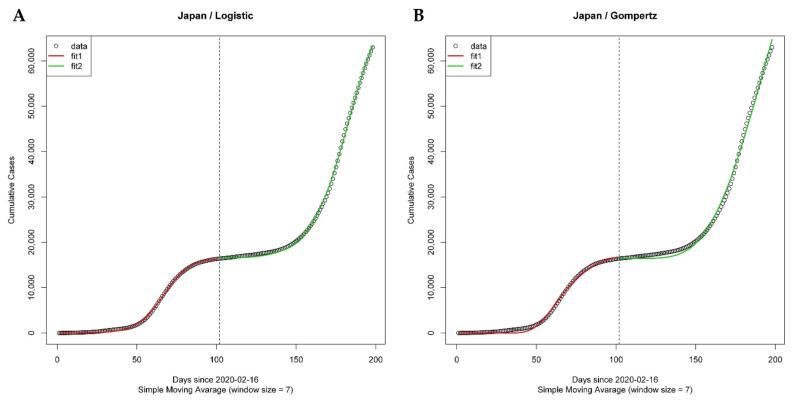
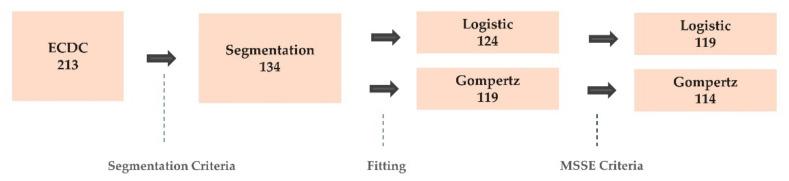
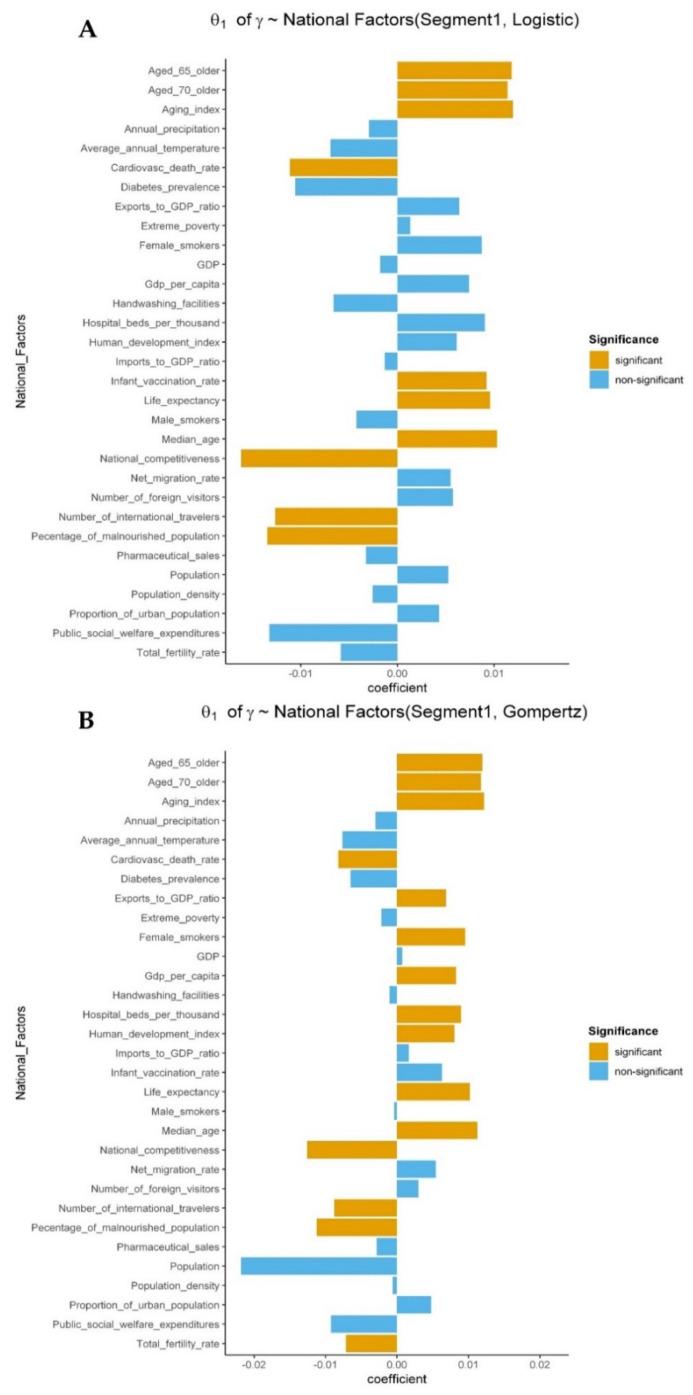
The outbreak of the novel COVID-19, declared a global pandemic by WHO, is the most serious public health threat seen in terms of respiratory viruses since the 1918 H1N1 influenza pandemic. It is surprising that the total number of COVID-19 confirmed cases and the number of deaths has varied greatly across countries. Such great variations are caused by age population, health conditions, travel, economy, and environmental factors. Here, we investigated which national factors (life expectancy, aging index, human development index, percentage of malnourished people in the population, extreme poverty, economic ability, health policy, population, age distributions, etc.) influenced the spread of COVID-19 through systematic statistical analysis. First, we employed segmented growth curve models (GCMs) to model the cumulative confirmed cases for 134 countries from 1 January to 31 August 2020 (logistic and Gompertz). Thus, each country's COVID-19 spread pattern was summarized into three growth-curve model parameters. Secondly, we investigated the relationship of selected 31 national factors (from KOSIS and ) to these GCM parameters. Our analysis showed that with time, the parameters were influenced by different factors; for example, the parameter related to the maximum number of predicted cumulative confirmed cases was greatly influenced by the total population size, as expected. The other parameter related to the rate of spread of COVID-19 was influenced by aging index, cardiovascular death rate, extreme poverty, median age, percentage of population aged 65 or 70 and older, and so forth. We hope that with their consideration of a country's resources and population dynamics that our results will help in making informed decisions with the most impact against similar infectious diseases.
新型冠状病毒肺炎疫情被世界卫生组织宣布为全球大流行,是自1918年甲型H1N1流感大流行以来,在呼吸道病毒方面所出现的最严重的公共卫生威胁。令人惊讶的是,各国新型冠状病毒肺炎确诊病例总数和死亡人数差异极大。这种巨大差异是由年龄人口、健康状况、旅行、经济和环境因素造成的。在此,我们通过系统的统计分析,研究了哪些国家因素(预期寿命、老龄化指数、人类发展指数、人口中营养不良人口的百分比、极端贫困、经济能力、卫生政策、人口、年龄分布等)影响了新型冠状病毒肺炎的传播。首先,我们采用分段增长曲线模型(GCMs)对2020年1月1日至8月31日期间134个国家的累计确诊病例进行建模(逻辑斯蒂模型和冈珀茨模型)。因此,每个国家的新型冠状病毒肺炎传播模式被总结为三个增长曲线模型参数。其次,我们研究了选定的31个国家因素(来自韩国国家统计局和……)与这些GCM参数之间的关系。我们的分析表明,随着时间的推移,这些参数受到不同因素的影响;例如,正如预期那样,与预测累计确诊病例最大数量相关的参数受到总人口规模的极大影响。与新型冠状病毒肺炎传播速度相关的另一个参数受到老龄化指数、心血管疾病死亡率、极端贫困、中位数年龄、65岁或70岁及以上人口的百分比等因素的影响。我们希望,考虑到一个国家的资源和人口动态,我们的结果将有助于做出对类似传染病最具影响力的明智决策。


 Zotero 插件