
咪唑作为一种有前途的药用支架:现状和未来方向。
Imidazole as a Promising Medicinal Scaffold: Current Status and Future Direction.
机构信息
College of Pharmacy, King Saud bin Abdulaziz University for Health Sciences, Riyadh, Kingdom of Saudi Arabia.
Medical Research Core Facility and Platforms, King Abdullah International Medical Research Center (KAIMRC), Ministry of National Guard Health Affairs, Riyadh, Kingdom of Saudi Arabia.
出版信息
Drug Des Devel Ther. 2021 Jul 29;15:3289-3312. doi: 10.2147/DDDT.S307113. eCollection 2021.
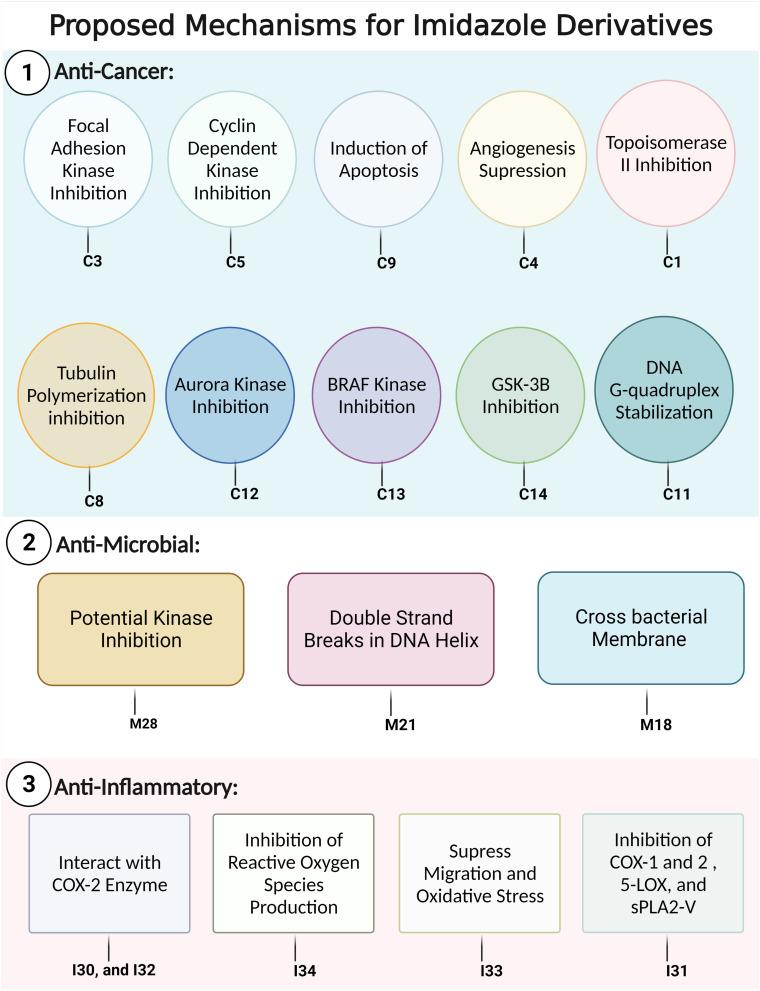
Various imidazole-containing compounds have been tested for their medical usefulness in clinical trials for several disease conditions. The rapid expansion of imidazole-based medicinal chemistry suggests the promising and potential therapeutic values of imidazole-derived compounds for treating incurable diseases. Imidazole core scaffold contains three carbon atoms, and two nitrogen with electronic-rich characteristics that are responsible for readily binding with a variety of enzymes, proteins, and receptors compared to the other heterocyclic rings. Herein, we provide a thorough overview of the current research status of imidazole-based compounds with a wide variety of biological activities including anti-cancer, anti-microbial, anti-inflammatory and their potential mechanisms including topoisomerase IIR catalytic inhibition, focal adhesion kinase (FAK) inhibition, c-MYC G-quadruplex DNA stabilization, and aurora kinase inhibition. Additionally, a great interest was reported in the discovery of novel imidazole compounds with anti-microbial properties that break DNA double-strand helix and inhibit protein kinase. Moreover, anti-inflammatory mechanisms of imidazole derivatives include inhibition of COX-2 enzyme, inhibit neutrophils degranulation, and generation of reactive oxygen species. This systemic review helps to design and discover more potent and efficacious imidazole compounds based on the reported derivatives, their ADME profiles, and bioavailability scores that together aid to advance this class of compounds.
各种含咪唑的化合物已在临床试验中针对多种疾病状况进行了医学用途测试。咪唑基药物化学的迅速发展表明,咪唑衍生化合物在治疗不治之症方面具有有前途和潜在的治疗价值。咪唑核心支架含有三个碳原子和两个具有富电子特性的氮原子,与其他杂环相比,这些原子易于与各种酶、蛋白质和受体结合。在此,我们全面概述了具有广泛生物活性的基于咪唑的化合物的最新研究现状,包括抗癌、抗菌、抗炎作用及其潜在机制,包括拓扑异构酶 IIIR 催化抑制、黏着斑激酶 (FAK) 抑制、c-MYC G-四链体 DNA 稳定和 Aurora 激酶抑制。此外,人们对发现具有破坏 DNA 双链螺旋和抑制蛋白激酶的新型抗菌咪唑化合物表现出极大的兴趣。此外,咪唑衍生物的抗炎机制包括抑制 COX-2 酶、抑制嗜中性粒细胞脱颗粒和产生活性氧。本系统综述有助于根据报道的衍生物、它们的 ADME 概况和生物利用度评分来设计和发现更有效和有效的咪唑化合物,这些评分共同有助于推进这一类化合物的发展。
 Zotero 插件