
噬菌体Sb-1与苯唑西林对耐甲氧西林菌的协同作用
Synergy between Phage Sb-1 and Oxacillin against Methicillin-Resistant .
作者信息
Simon Kevin, Pier Wolfgang, Krüttgen Alex, Horz Hans-Peter
机构信息
Institute of Medical Microbiology, RWTH Aachen University Hospital, 52074 Aachen, Germany.
Laboratory Diagnostic Center, RWTH Aachen University Hospital, 52074 Aachen, Germany.
出版信息
Antibiotics (Basel). 2021 Jul 13;10(7):849. doi: 10.3390/antibiotics10070849.
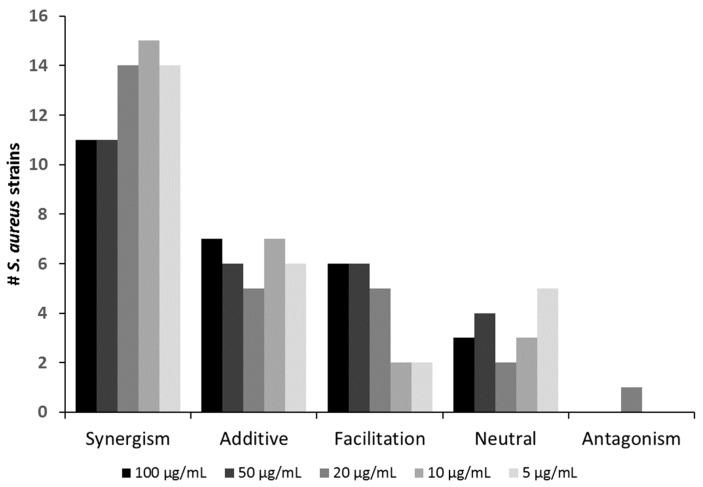
Methicillin-resistant (MRSA) is a notorious pathogen responsible for not only a number of difficult-to-treat hospital-acquired infections, but also for infections that are community- or livestock-acquired. The increasing lack of efficient antibiotics has renewed the interest in lytic bacteriophages (briefly phages) as additional antimicrobials against multi-drug resistant bacteria, including MRSA. The aim of this study was to test the hypothesis that a combination of the well-known and strictly lytic phage Sb-1 and oxacillin, which as sole agent is ineffective against MRSA, exerts a significantly stronger bacterial reduction than either antimicrobial alone. Eighteen different MRSA isolates and, for comparison, five MSSA and four reference strains were included in this study. The bacteria were challenged with a combination of varying dosages of the phage and the antibiotic in liquid medium using five different antibiotic levels and four different viral titers (i.e., multiplicity of infections (MOIs) ranging from 10 to 10). The dynamics of the cell density changes were determined via time-kill assays over 16 h. Positive interactions between both antimicrobials in the form of facilitation, additive effects, or synergism were observed for most isolates. These enhanced antibacterial effects were robust with phage MOIs of 10 and 10 irrespective of the antibiotic concentrations, ranging from 5 to 100 µg/mL. Neutral effects between both antimicrobials were seen only with few isolates. Importantly, antagonism was a rare exception. As a conclusion, phage Sb-1 and oxacillin constitute a robust heterologous antimicrobial pair which extends the efficacy of a phage-only approach for controlling MRSA.
耐甲氧西林金黄色葡萄球菌(MRSA)是一种臭名昭著的病原体,不仅会引发多种难以治疗的医院获得性感染,还会导致社区或牲畜获得性感染。高效抗生素的日益短缺,使人们重新对裂解性噬菌体(简称噬菌体)作为对抗包括MRSA在内的多重耐药细菌的额外抗菌剂产生了兴趣。本研究的目的是检验以下假设:著名的严格裂解性噬菌体Sb-1与单独使用时对MRSA无效的苯唑西林联合使用,比单独使用任何一种抗菌剂能更显著地减少细菌数量。本研究纳入了18种不同的MRSA分离株,作为对照还纳入了5种甲氧西林敏感金黄色葡萄球菌(MSSA)和4种参考菌株。在液体培养基中,使用5种不同的抗生素水平和4种不同的病毒滴度(即感染复数(MOI)范围为10至10),用不同剂量的噬菌体和抗生素组合对细菌进行攻击。通过16小时的时间杀菌试验确定细胞密度变化的动态。对于大多数分离株,观察到两种抗菌剂之间以促进、相加或协同形式存在的正向相互作用。无论抗生素浓度在5至100μg/mL范围内,噬菌体MOI为10和10时,这些增强的抗菌作用都很显著。仅在少数分离株中观察到两种抗菌剂之间的中性作用。重要的是,拮抗作用是罕见的例外情况。总之,噬菌体Sb-1和苯唑西林构成了一对强大的异源抗菌组合,扩展了仅用噬菌体控制MRSA的方法的疗效。

 Zotero 插件