
调控甘南牦牛( )糖酵解和热休克蛋白以应对青藏高原缺氧环境。 (括号部分原文缺失具体内容)
Regulating glycolysis and heat shock proteins in Gannan yaks ( ) in response to hypoxia of the Qinghai-Tibet Plateau.
作者信息
Wen Yuliang, Wang Jiqing, Liu Xiu, Li Shaobin, Hu Jiang, Luo Yuzhu
机构信息
Faculty of Animal Science and Technology, Gansu Agricultural University, Gansu Key Laboratory of Herbivorous Animal Biotechnology, Lanzhou 730070, China.
出版信息
Arch Anim Breed. 2021 Aug 19;64(2):345-353. doi: 10.5194/aab-64-345-2021. eCollection 2021.
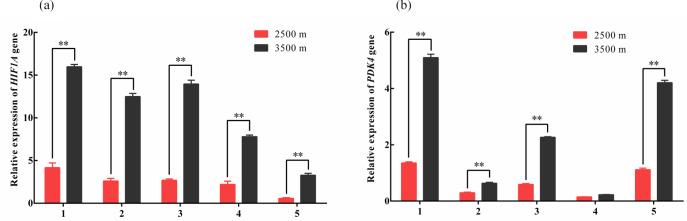
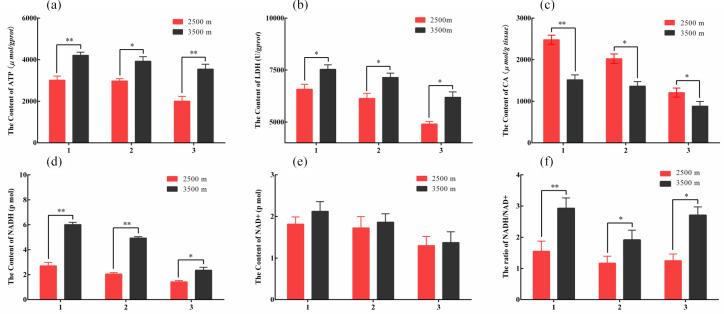
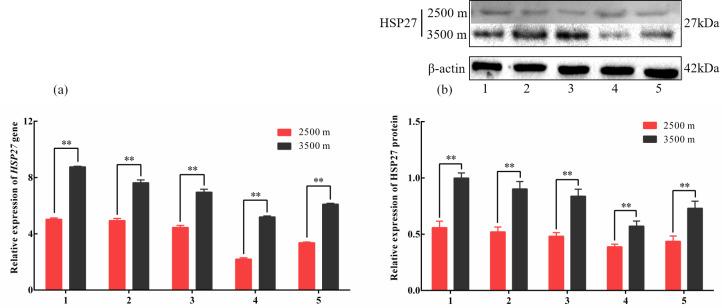
Glycolysis and heat shock proteins (HSPs) play an important role in hypoxia-intolerant species during hypoxia conditions. This study was conducted to evaluate the differences of glycolysis and heat shock proteins (HSPs) in Gannan yaks (), with the main goal of understanding how the response to hypoxia changes with altitude. Here, the genes and enzymes of glycolysis and HSPs were detected in heart, liver, lung, kidney, and longissimus dorsi from Gannan yaks at different altitude (2500 and 3500 ) using qPCR, western blot, and enzyme kits. The results showed that the expression of and was increased with altitude ( ) in above tissues. Significantly increased lactate dehydrogenase (LDH), adenosine triphosphate (ATP), and nicotinamide adenine dinucleotide (NADH) levels and the ratio of NADH/NAD were also observed in heart, lung, and longissimus dorsi tissues ( ), as well as a decreased citric acid (CA) level ( ). Furthermore, we observed significant global increases in the protein and mRNA expression levels of both the ATP-independent HSP27 and the ATP-dependent HSP60 during hypoxic conditions ( ). These findings revealed that hypoxia-reprogrammed glucose metabolism promotes energy supply via up-regulated glycolysis and weakness of the tricarboxylic acid (TCA) cycle. HSPs were activated and the prioritization of cytoprotective protein chaperone functions over energy conservation in yak under hypoxic conditions. These results are useful to better understand the unique adaptability of yak, allowing them to survive in hypoxia conditions.
糖酵解和热休克蛋白(HSPs)在低氧耐受物种处于低氧条件时发挥重要作用。本研究旨在评估甘南牦牛糖酵解和热休克蛋白(HSPs)的差异,主要目的是了解对低氧的反应如何随海拔变化。在此,使用qPCR、蛋白质印迹法和酶试剂盒,检测了不同海拔(2500米和3500米)的甘南牦牛心脏、肝脏、肺、肾脏和背最长肌中糖酵解和热休克蛋白(HSPs)的基因及酶。结果表明,上述组织中己糖激酶(HK)和磷酸果糖激酶(PFK)的表达随海拔升高而增加(P<0.05)。在心脏、肺和背最长肌组织中还观察到乳酸脱氢酶(LDH)、三磷酸腺苷(ATP)和烟酰胺腺嘌呤二核苷酸(NADH)水平显著升高以及NADH/NAD⁺比值升高(P<0.05),同时柠檬酸(CA)水平降低(P<0.05)。此外,我们观察到在低氧条件下,不依赖ATP的HSP27和依赖ATP的HSP60的蛋白质和mRNA表达水平均显著整体升高(P<0.05)。这些发现揭示,低氧重编程的葡萄糖代谢通过上调糖酵解和三羧酸(TCA)循环减弱来促进能量供应。热休克蛋白被激活,并且在低氧条件下牦牛体内细胞保护蛋白伴侣功能优先于能量保存。这些结果有助于更好地理解牦牛独特的适应性,使其能够在低氧条件下生存。

 Zotero 插件