
低氧诱导牦牛(Bos Grunniens)肾组织及肾间质成纤维样细胞中丙酮酸脱氢酶激酶1相关因子表达的差异
Hypoxia-Induced Differences in the Expression of Pyruvate Dehydrogenase Kinase 1-Related Factors in the Renal Tissues and Renal Interstitial Fibroblast-like Cells of Yak (Bos Grunniens).
作者信息
Zhou Manlin, Wang Jun, Cao Ruirui, Zhang Fan, Luo Xuehui, Liao Yiyuan, Chen Weiji, Ding Haie, Tan Xiao, Qiao Zilin, Yang Kun
机构信息
Engineering Research Center of Key Technology and Industrialization of Cell-Based Vaccine, Ministry of Education, Northwest Minzu University, Lanzhou 730030, China.
Gansu Tech Innovation Center of Animal Cell, Biomedical Research Center, Northwest Minzu University, Lanzhou 730030, China.
出版信息
Animals (Basel). 2024 Oct 29;14(21):3110. doi: 10.3390/ani14213110.
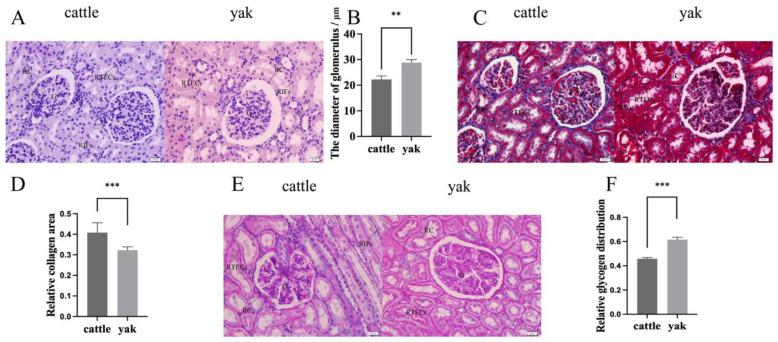
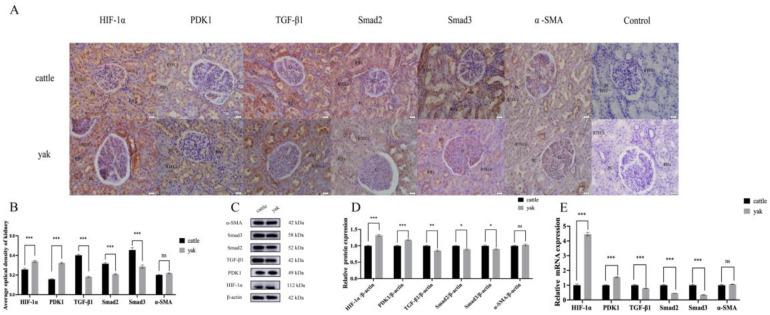
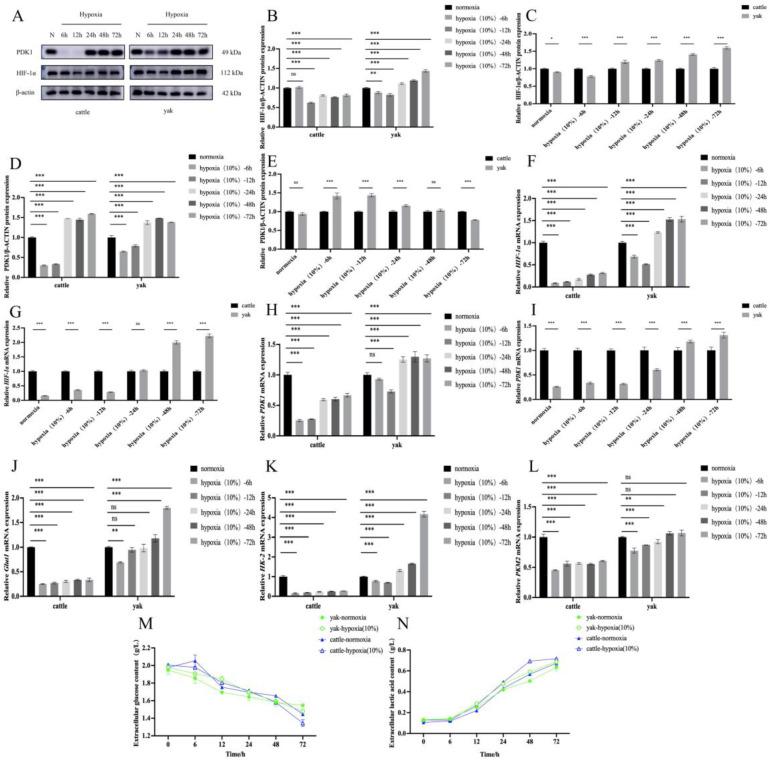
Hypoxia is one of the factors severely affect renal function, and, in severe cases, it can lead to renal fibrosis. Although much progress has been made in identifying the molecular mediators of fibrosis, the mechanisms that govern renal fibrosis remain unclear, and there have been no effective therapeutic anti-fibrotic strategies to date. Mammals exposed to low oxygen in the plateau environment for a long time are prone to high-altitude disease, while yaks have been living in the plateau for generations do not develop kidney fibrosis caused by low oxygen. It has been suggested that metabolic reprogramming occurs in renal fibrosis and that pyruvate dehydrogenase kinase 1 (PDK1) plays a crucial role in metabolic reprogramming as an important node between glycolysis and the tricarboxylic acid cycle. The aim of this study was to investigate the effects of hypoxia on the renal tissues and renal interstitial fibroblasts of yaks. We found that, at the tissue level, HIF-1α, PDK1, TGF-β1, Smad2, Smad3, and α-SMA were mainly distributed and expressed in tubular epithelial cells but were barely present in the renal mesenchymal fibroblasts of healthy cattle and yak kidneys. Anoptical density analysis showed that in healthy cattle kidneys, TGF-β1, Smad2, and Smad3 expression was significantly higher than in yak kidneys ( < 0.05), and HIF-1α and PDK1 expression was significantly lower than in yak kidneys ( < 0.05). The results at the protein and gene levels showed the same trend. At the cellular level, prolonged hypoxia significantly elevated PDK1 expression in the renal mesangial fibroblasts of cattle and yak kidneys compared with normoxia ( < 0.05) and was proportional to the degree of cellular fibrosis. However, PDK1 expression remained stable in yaks compared with renal interstitial fibroblast-like cells in cattle during the same hypoxic time period. At the same time, prolonged hypoxia also promoted changes in cellular phenotype, promoting the proliferation, activation, glucose consumption, lactate production, and anti-apoptosis in the both of cattle and yaks renal interstitial fibroblasts The differences in kidney structure and expression of PDK1 and HIF-1α in kidney tissue and renal interstitial fibroblasts induced by different oxygen concentrations suggest that there may be a regulatory relationship between yak kidney adaptation and hypoxic environment at high altitude. This provides strong support for the elucidation of the regulatory relationship between PDK1 and HIF-1α, as well as a new direction for the treatment or delay of hypoxic renal fibrosis; additionally, these findings provide a basis for further analysis of the molecular mechanism of hypoxia adaptation-related factors and the adaptation of yaks to plateau hypoxia.
缺氧是严重影响肾功能的因素之一,在严重情况下,可导致肾纤维化。尽管在确定纤维化的分子介质方面已取得很大进展,但肾纤维化的调控机制仍不清楚,迄今为止尚无有效的抗纤维化治疗策略。长期暴露于高原环境低氧中的哺乳动物易患高原病,而世世代代生活在高原的牦牛不会发生由低氧引起的肾纤维化。有人提出,肾纤维化中会发生代谢重编程,丙酮酸脱氢酶激酶1(PDK1)作为糖酵解和三羧酸循环之间的重要节点,在代谢重编程中起关键作用。本研究的目的是探讨缺氧对牦牛肾组织和肾间质成纤维细胞的影响。我们发现,在组织水平上,HIF-1α、PDK1、TGF-β1、Smad2、Smad3和α-SMA主要分布并表达于肾小管上皮细胞,但在健康牛和牦牛肾脏的肾间充质成纤维细胞中几乎不存在。光密度分析显示,在健康牛肾脏中,TGF-β1、Smad2和Smad3的表达显著高于牦牛肾脏(<0.05),而HIF-1α和PDK1的表达显著低于牦牛肾脏(<0.05)。蛋白质和基因水平的结果显示出相同的趋势。在细胞水平上,与常氧相比,长时间缺氧显著提高了牛和牦牛肾脏肾系膜成纤维细胞中PDK1的表达(<0.05),且与细胞纤维化程度成正比。然而,在相同的缺氧时间段内,与牛的肾间质成纤维样细胞相比,牦牛的PDK1表达保持稳定。同时,长时间缺氧还促进了细胞表型的改变,促进了牛和牦牛肾间质成纤维细胞的增殖、激活、葡萄糖消耗、乳酸产生和抗凋亡。不同氧浓度诱导的肾脏结构以及肾组织和肾间质成纤维细胞中PDK1和HIF-1α表达的差异表明,牦牛肾脏适应与高原低氧环境之间可能存在调控关系。这为阐明PDK1与HIF-1α之间的调控关系以及治疗或延缓缺氧性肾纤维化提供了有力支持;此外,这些发现为进一步分析缺氧适应相关因子的分子机制以及牦牛对高原缺氧的适应提供了依据。




 Zotero 插件