
美国职业地位与 COVID-19 相关工作暴露的种族和民族差异。
Racial and ethnic differentials in COVID-19-related job exposures by occupational standing in the US.
机构信息
Office of Population Research, School of Public and International Affairs, Princeton University, Princeton, New Jersey, United States of America.
California Center for Population Research, Fielding School of Public Health, University of California Los Angeles, Los Angeles, California, United States of America.
出版信息
PLoS One. 2021 Sep 1;16(9):e0256085. doi: 10.1371/journal.pone.0256085. eCollection 2021.
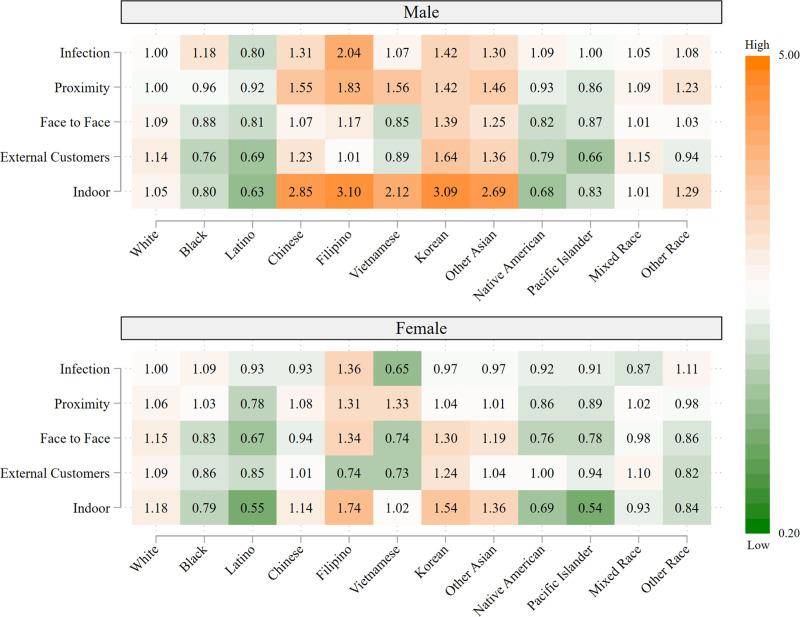
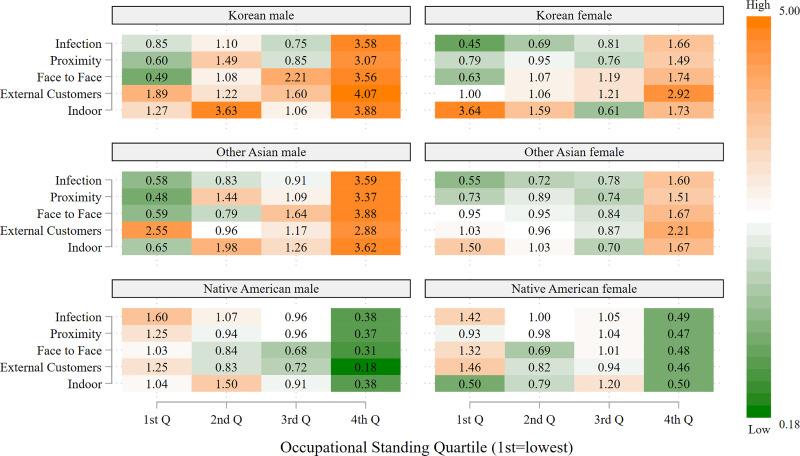
Researchers and journalists have argued that work-related factors may be partly responsible for disproportionate COVID-19 infection and death rates among vulnerable groups. We evaluate these issues by describing racial and ethnic differences in the likelihood of work-related exposure to COVID-19. We extend previous studies by considering 12 racial and ethnic groups and five types of potential occupational exposure to the virus: exposure to infection, physical proximity to others, face-to-face discussions, interactions with external customers and the public, and working indoors. Most importantly, we stratify our results by occupational standing, defined as the proportion of workers within each occupation with at least some college education. This measure serves as a proxy for whether workplaces and workers employ COVID-19-related risk reduction strategies. We use the 2018 American Community Survey to identify recent workers by occupation, and link 409 occupations to information on work context from the Occupational Information Network to identify potential COVID-related risk factors. We then examine the racial/ethnic distribution of all frontline workers and frontline workers at highest potential risk of COVID-19, by occupational standing and by sex. The results indicate that, contrary to expectation, White frontline workers are often overrepresented in high-risk jobs while Black and Latino frontline workers are generally underrepresented in these jobs. However, disaggregation of the results by occupational standing shows that, in contrast to Whites and several Asian groups, Latino and Black frontline workers are overrepresented in lower standing occupations overall and in lower standing occupations associated with high risk, and thus may be less likely to have adequate COVID-19 protections. Our findings suggest that greater work exposures likely contribute to a higher prevalence of COVID-19 among Latino and Black adults and underscore the need for measures to reduce potential exposure for workers in low standing occupations and for the development of programs outside the workplace.
研究人员和记者认为,与工作相关的因素可能是弱势群体中 COVID-19 感染和死亡率不成比例的部分原因。我们通过描述与 COVID-19 相关的工作接触的可能性在种族和族裔方面的差异来评估这些问题。我们通过考虑 12 个种族和族裔群体以及五种潜在的职业接触病毒的类型来扩展以前的研究:接触感染、与他人身体接近、面对面讨论、与外部客户和公众的互动以及在室内工作。最重要的是,我们根据职业地位对结果进行分层,职业地位定义为每个职业中至少具有一些大学教育的工人比例。这一衡量标准是衡量工作场所和工人是否采用 COVID-19 相关风险降低策略的一个指标。我们使用 2018 年美国社区调查按职业识别最近的工人,并将 409 种职业与职业信息网络中有关工作环境的信息联系起来,以确定潜在的 COVID 相关风险因素。然后,我们根据职业地位和性别,检查所有一线工人和面临 COVID-19 最高风险的一线工人的种族/族裔分布情况。结果表明,与预期相反,白人一线工人往往在高风险工作中占比过高,而黑人和拉丁裔一线工人在这些工作中普遍代表性不足。然而,按职业地位对结果进行细分表明,与白人以及几个亚洲群体相比,拉丁裔和黑人工人在整体地位较低的职业中以及与高风险相关的地位较低的职业中占比过高,因此可能不太可能获得充分的 COVID-19 保护措施。我们的研究结果表明,更大的工作暴露可能导致拉丁裔和黑人群体中 COVID-19 的发病率更高,这突显了需要采取措施减少低地位职业工人的潜在暴露,并在工作场所之外制定计划。



 Zotero 插件