
用于3D打印高电容微型超级电容器的原始石墨烯水性油墨。
Aqueous Inks of Pristine Graphene for 3D Printed Microsupercapacitors with High Capacitance.
作者信息
Tagliaferri Stefano, Nagaraju Goli, Panagiotopoulos Apostolos, Och Mauro, Cheng Gang, Iacoviello Francesco, Mattevi Cecilia
机构信息
Department of Materials, Imperial College London, London SW7 2AZ, United Kingdom.
Electrochemical Innovation Lab, Department of Chemical Engineering, University College London, London WC1E 7JE, U.K.
出版信息
ACS Nano. 2021 Sep 28;15(9):15342-15353. doi: 10.1021/acsnano.1c06535. Epub 2021 Sep 7.
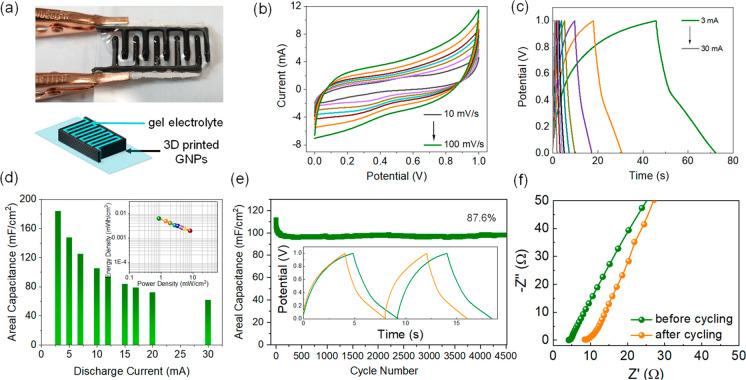
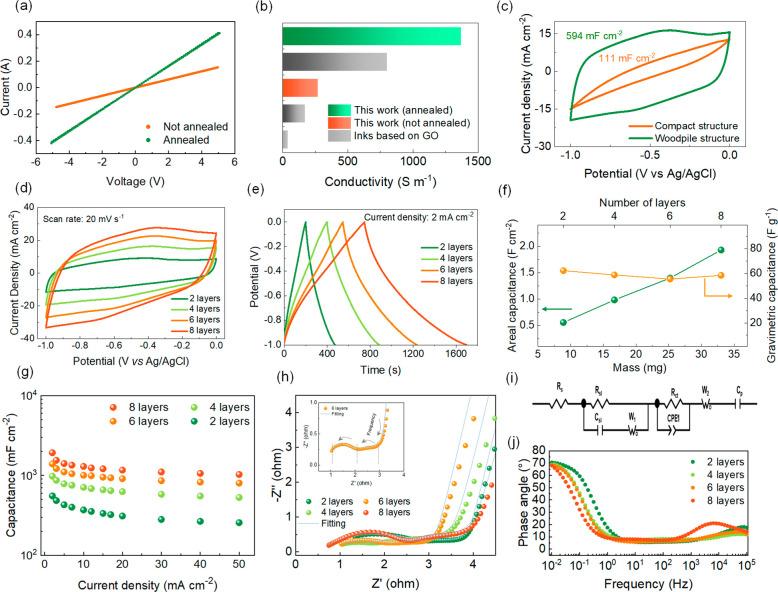
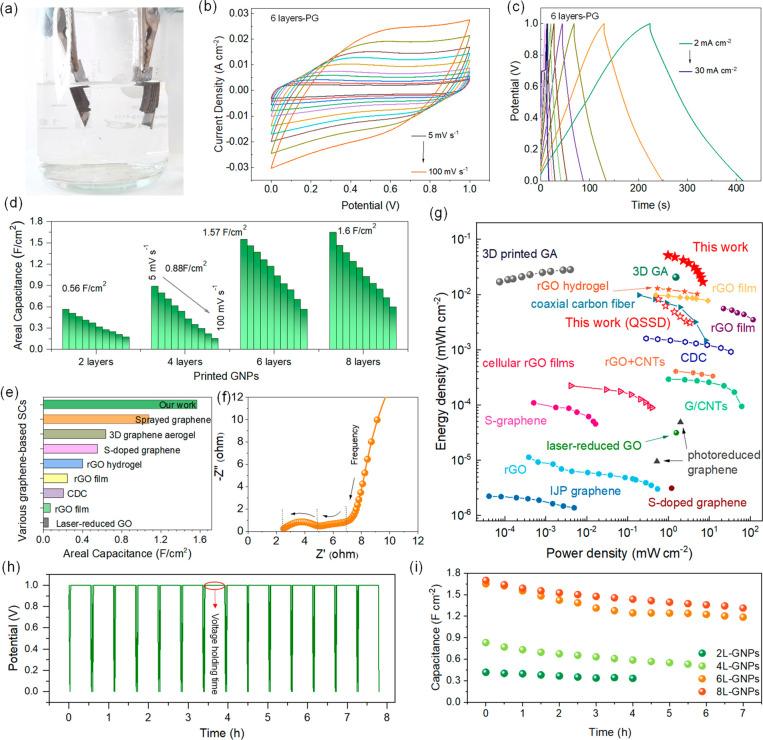
Three-dimensional (3D) printing is gaining importance as a sustainable route for the fabrication of high-performance energy storage devices. It enables the streamlined manufacture of devices with programmable geometry at different length scales down to micron-sized dimensions. Miniaturized energy storage devices are fundamental components for on-chip technologies to enable energy autonomy. In this work, we demonstrate 3D printed microsupercapacitor electrodes from aqueous inks of pristine graphene without the need of high temperature processing and functional additives. With an intrinsic electrical conductivity of ∼1370 S m and rationally designed architectures, the symmetric microsupercapacitors exhibit an exceptional areal capacitance of 1.57 F cm at 2 mA cm which is retained over 72% after repeated voltage holding tests. The areal power density (0.968 mW cm) and areal energy density (51.2 μWh cm) outperform the ones of previously reported carbon-based supercapacitors which have been either 3D or inkjet printed. Moreover, a current collector-free interdigitated microsupercapacitor combined with a gel electrolyte provides electrochemical performance approaching the one of devices with liquid-like ion transport properties. Our studies provide a sustainable and low-cost approach to fabricate efficient energy storage devices with programmable geometry.
三维(3D)打印作为制造高性能储能设备的可持续途径正变得越来越重要。它能够以简化的方式制造具有可编程几何形状的设备,这些设备的尺寸范围从不同的长度尺度到微米级。小型化储能设备是实现片上技术能量自主的基本组件。在这项工作中,我们展示了由原始石墨烯水性油墨制成的3D打印微超级电容器电极,无需高温处理和功能添加剂。凭借约1370 S m的固有电导率和合理设计的结构,对称微超级电容器在2 mA cm时表现出1.57 F cm的优异面积电容,在重复电压保持测试后仍保留超过72%。面积功率密度(0.968 mW cm)和面积能量密度(51.2 μWh cm)优于先前报道的通过3D打印或喷墨打印的碳基超级电容器。此外,一种无集流体的叉指式微超级电容器与凝胶电解质相结合,提供了接近具有类似液体离子传输特性的设备的电化学性能。我们的研究提供了一种可持续且低成本的方法来制造具有可编程几何形状的高效储能设备。


 Zotero 插件