
一种与炎症相关的九基因标志物,可改善肺腺癌的预后预测。
An Inflammation-Related Nine-Gene Signature to Improve Prognosis Prediction of Lung Adenocarcinoma.
机构信息
Department of Oncology, Shanxi Provincial Hospital of Traditional Chinese Medicine, Taiyuan City, Shanxi Province, China.
Department of Traditional Chinese Medicine, Shanxi Cancer Hospital, Taiyuan City, Shanxi Province, China.
出版信息
Dis Markers. 2021 Sep 18;2021:9568057. doi: 10.1155/2021/9568057. eCollection 2021.
BACKGROUND
A novel predictive model was rarely reported based on inflammation-related genes to explore clinical outcomes of lung adenocarcinoma (LUAD) patients.
METHODS
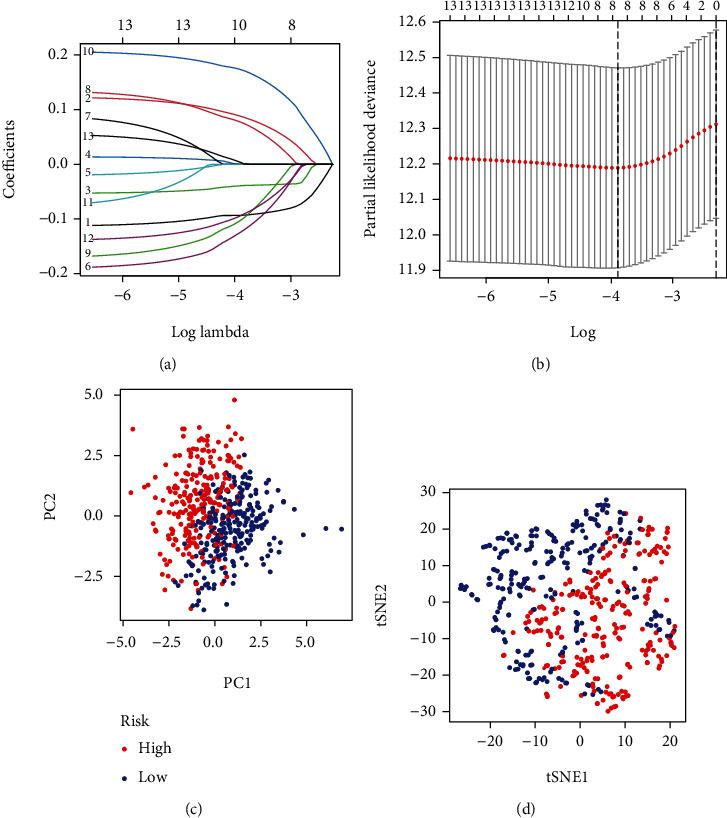
Using TCGA database, we screened nine inflammation-related genes with a prognostic value, and LASSO regression was applied for model construction. The predictive value of the prognostic signature developed from inflammation-related genes was assessed by survival assays and multivariate assays. PCA and t-SNE analysis were performed to demonstrate clustering abilities of risk scores.
RESULTS
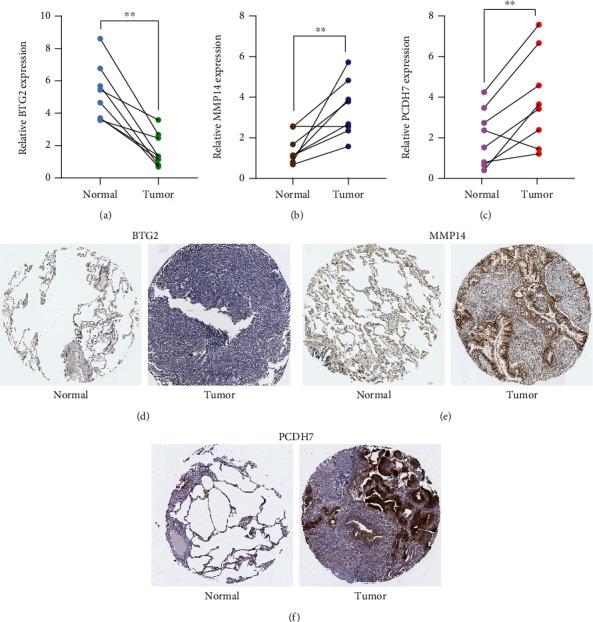
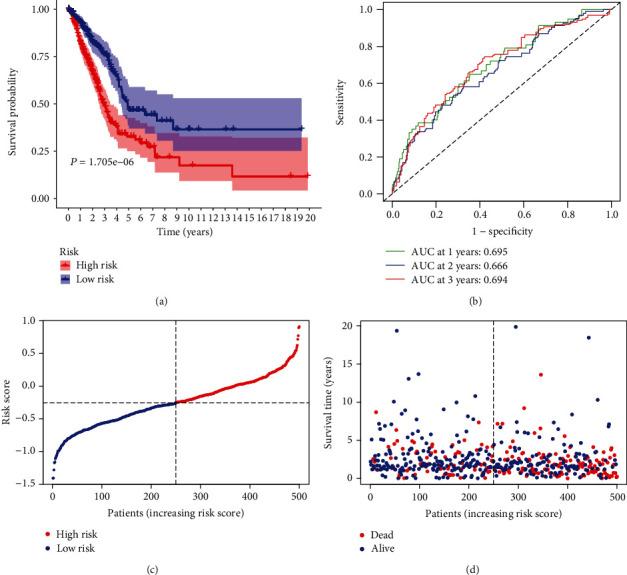
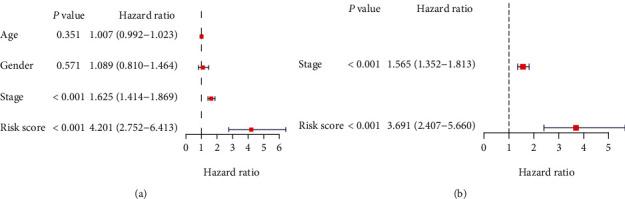
Thirteen inflammation-related genes (BTG2, CCL20, CD69, DCBLD2, GPC3, IL7R, LAMP3, MMP14, NMUR1, PCDH7, PIK3R5, RNF144B, and TPBG) with prognostic values were finally identified. LASSO regression further screened nine candidates (BTG2, CCL20, CD69, IL7R, MMP14, NMUR1, PCDH7, RNF144B, and TPBG). Then, a prognostic prediction model using the above nine genes was constructed. A reliable clustering ability of risk score was demonstrated by PCA and t-SNE assays in 500 LUAD patients. The survival assays revealed that the overall survivals of the high-risk group were distinctly poorer than those of the low-risk group with 1-, 3-, and 5-year AUC values of 0.695, 0.666, and 0.694, respectively. Finally, multivariate assays demonstrated the scoring system as an independent prognostic factor for overall survival.
CONCLUSIONS
Our study shows that the signature of nine inflammation-related genes can be used as a prognostic marker for LUAD.
背景
基于炎症相关基因的新型预测模型很少用于探索肺腺癌(LUAD)患者的临床结局。
方法
使用 TCGA 数据库,我们筛选出了 9 个具有预后价值的炎症相关基因,并应用 LASSO 回归进行模型构建。通过生存分析和多变量分析评估了炎症相关基因开发的预后特征的预测价值。进行 PCA 和 t-SNE 分析以证明风险评分的聚类能力。
结果
最终确定了 13 个具有预后价值的炎症相关基因(BTG2、CCL20、CD69、DCBLD2、GPC3、IL7R、LAMP3、MMP14、NMUR1、PCDH7、PIK3R5、RNF144B 和 TPBG)。LASSO 回归进一步筛选出 9 个候选基因(BTG2、CCL20、CD69、IL7R、MMP14、NMUR1、PCDH7、RNF144B 和 TPBG)。然后,使用上述九个基因构建了一个预后预测模型。PCA 和 t-SNE 分析在 500 名 LUAD 患者中证明了风险评分的可靠聚类能力。生存分析显示,高风险组的总生存率明显低于低风险组,1 年、3 年和 5 年 AUC 值分别为 0.695、0.666 和 0.694。最后,多变量分析表明评分系统是总生存率的独立预后因素。
结论
我们的研究表明,九个炎症相关基因的特征可以用作 LUAD 的预后标志物。

 Zotero 插件