
粒细胞酶 A 和 K 在脓毒症中的生物学相关性。
Biological relevance of Granzymes A and K during sepsis.
机构信息
Fundación Instituto de Investigación Sanitaria Aragón (IIS Aragón), Biomedical Research Centre of Aragón (CIBA), 50009, Zaragoza, Spain.
Animal Unit, University of Zaragoza, 50009, Zaragoza, Spain.
出版信息
Theranostics. 2021 Oct 17;11(20):9873-9883. doi: 10.7150/thno.59418. eCollection 2021.
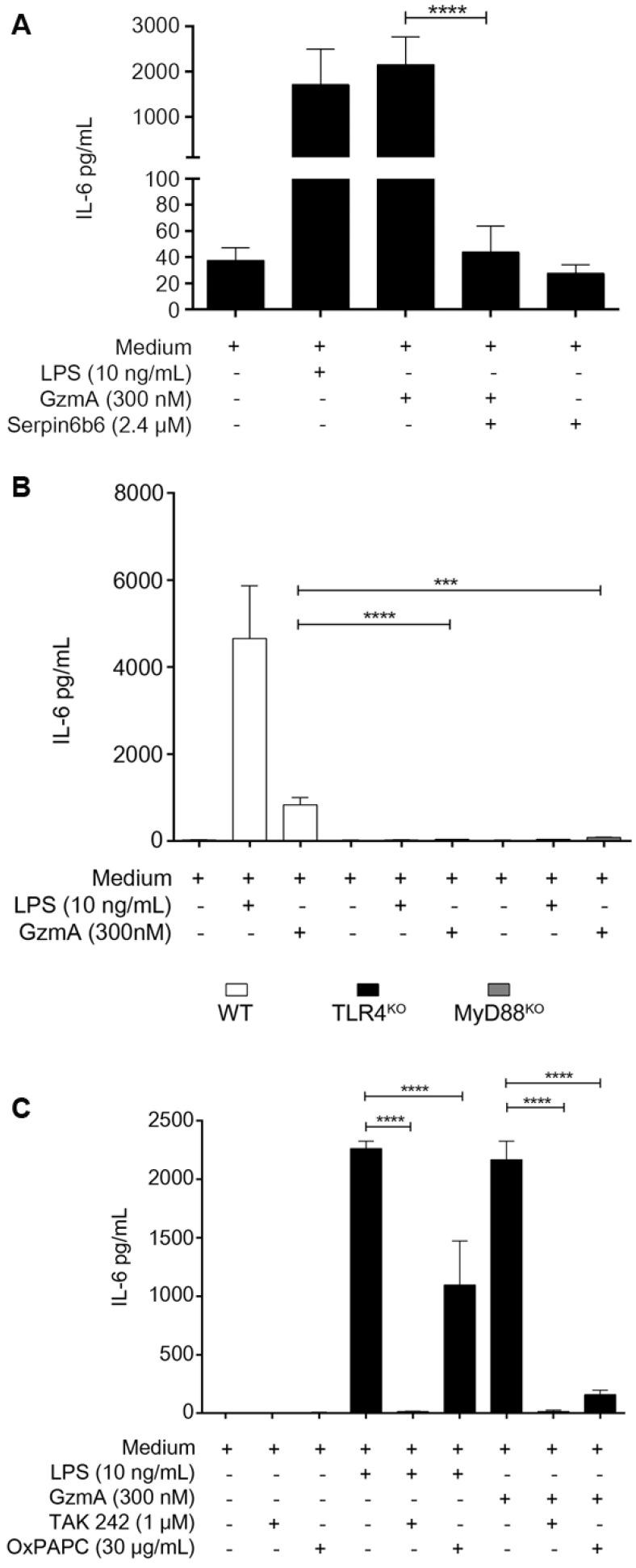
Recent findings suggest that the serine protease Granzyme K (GzmK) may act as a proinflammatory mediator. However, its role in sepsis is unknown. Here we aim to understand the role of GzmK in a mouse model of bacterial sepsis and compare it to the biological relevance of Granzyme A (GzmA). Sepsis was induced in WT, GzmA and GzmK mice by an intraperitoneal injection of 2x10 CFU from . Mouse survival was monitored during 5 days. Levels of IL-1α, IL-1β, TNFα and IL-6 in plasma were measured and bacterial load in blood, liver and spleen was analyzed. Finally, profile of cellular expression of GzmA and GzmK was analyzed by FACS. GzmA and GzmK are not involved in the control of bacterial infection. However, GzmA and GzmK deficient mice showed a lower sepsis score in comparison with WT mice, although only GzmA deficient mice exhibited increased survival. GzmA deficient mice also showed reduced expression of some proinflammatory cytokines like IL1-α, IL-β and IL-6. A similar result was found when extracellular GzmA was therapeutically inhibited in WT mice using serpinb6b, which improved survival and reduced IL-6 expression. Mechanistically, active extracellular GzmA induces the production of IL-6 in macrophages by a mechanism dependent on TLR4 and MyD88. These results suggest that although both proteases contribute to the clinical signs of -induced sepsis, inhibition of GzmA is sufficient to reduce inflammation and improve survival irrespectively of the presence of other inflammatory granzymes, like GzmK.
最近的研究结果表明,丝氨酸蛋白酶 Granzyme K(GzmK)可能作为一种促炎介质发挥作用。然而,其在脓毒症中的作用尚不清楚。在这里,我们旨在了解 GzmK 在细菌脓毒症小鼠模型中的作用,并将其与 Granzyme A(GzmA)的生物学相关性进行比较。通过腹腔内注射 2x10 CFU 的 ,在 WT、GzmA 和 GzmK 小鼠中诱导脓毒症。在 5 天内监测小鼠的存活情况。测量血浆中白细胞介素-1α(IL-1α)、白细胞介素-1β(IL-1β)、肿瘤坏死因子-α(TNFα)和白细胞介素-6(IL-6)的水平,并分析血液、肝脏和脾脏中的细菌负荷。最后,通过 FACS 分析 GzmA 和 GzmK 的细胞表达谱。GzmA 和 GzmK 不参与控制细菌感染。然而,与 WT 小鼠相比,GzmA 和 GzmK 缺陷小鼠的脓毒症评分较低,尽管只有 GzmA 缺陷小鼠的存活率增加。GzmA 缺陷小鼠还表现出一些促炎细胞因子(如 IL1-α、IL-β 和 IL-6)表达减少。当使用 serpina6b 在 WT 小鼠中治疗性抑制细胞外 GzmA 时,也发现了类似的结果,这改善了存活率并降低了 IL-6 的表达。在机制上,活性细胞外 GzmA 通过依赖 TLR4 和 MyD88 的机制诱导巨噬细胞产生 IL-6。这些结果表明,尽管两种蛋白酶都有助于 - 诱导的脓毒症的临床症状,但抑制 GzmA 足以减少炎症并提高存活率,而与其他炎症颗粒酶(如 GzmK)无关。


 Zotero 插件