
关注的 SARS-CoV-2 变异株的出现是由替换率的加速所驱动的。
The Emergence of SARS-CoV-2 Variants of Concern Is Driven by Acceleration of the Substitution Rate.
机构信息
Peter Doherty Institute for Infection and Immunity, University of Melbourne, Melbourne, VIC, Australia.
出版信息
Mol Biol Evol. 2022 Feb 3;39(2). doi: 10.1093/molbev/msac013.
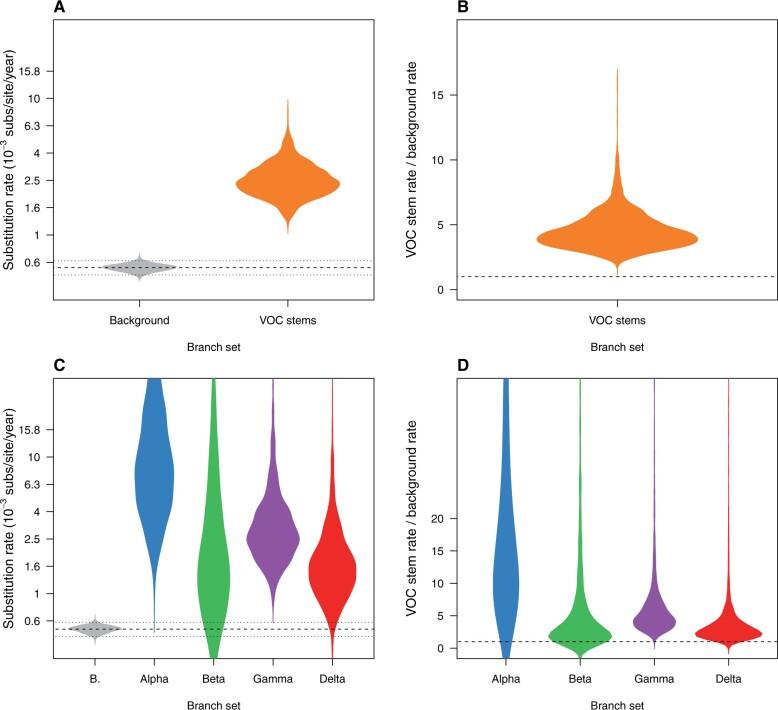
The ongoing SARS-CoV-2 pandemic has seen an unprecedented amount of rapidly generated genome data. These data have revealed the emergence of lineages with mutations associated to transmissibility and antigenicity, known as variants of concern (VOCs). A striking aspect of VOCs is that many of them involve an unusually large number of defining mutations. Current phylogenetic estimates of the substitution rate of SARS-CoV-2 suggest that its genome accrues around two mutations per month. However, VOCs can have 15 or more defining mutations and it is hypothesized that they emerged over the course of a few months, implying that they must have evolved faster for a period of time. We analyzed genome sequence data from the GISAID database to assess whether the emergence of VOCs can be attributed to changes in the substitution rate of the virus and whether this pattern can be detected at a phylogenetic level using genome data. We fit a range of molecular clock models and assessed their statistical performance. Our analyses indicate that the emergence of VOCs is driven by an episodic increase in the substitution rate of around 4-fold the background phylogenetic rate estimate that may have lasted several weeks or months. These results underscore the importance of monitoring the molecular evolution of the virus as a means of understanding the circumstances under which VOCs may emerge.
持续的 SARS-CoV-2 大流行带来了前所未有的大量快速产生的基因组数据。这些数据揭示了与传染性和抗原性相关的突变的谱系的出现,被称为关注变体(VOCs)。VOCs 的一个显著特点是,它们中的许多都涉及异常多的定义突变。目前对 SARS-CoV-2 替代率的系统发育估计表明,其基因组每月积累约 2 个突变。然而,VOCs 可以有 15 个或更多的定义突变,据推测它们在几个月内出现,这意味着它们在一段时间内必须进化得更快。我们分析了 GISAID 数据库中的基因组序列数据,以评估 VOCs 的出现是否可以归因于病毒替代率的变化,以及这种模式是否可以使用基因组数据在系统发育水平上检测到。我们拟合了一系列分子钟模型,并评估了它们的统计性能。我们的分析表明,VOCs 的出现是由替代率的爆发式增长驱动的,其增长率约为背景系统发育率估计值的 4 倍,这种增长可能持续了数周或数月。这些结果强调了监测病毒的分子进化作为了解 VOCs 可能出现的情况的一种手段的重要性。


 Zotero 插件